1929 · CLOSE READING
Magick in Theory and Practice (Section 1)
Magick in Theory and Practice (Section 1) (1929), PDF p. 16
Original page
Enlarge ↗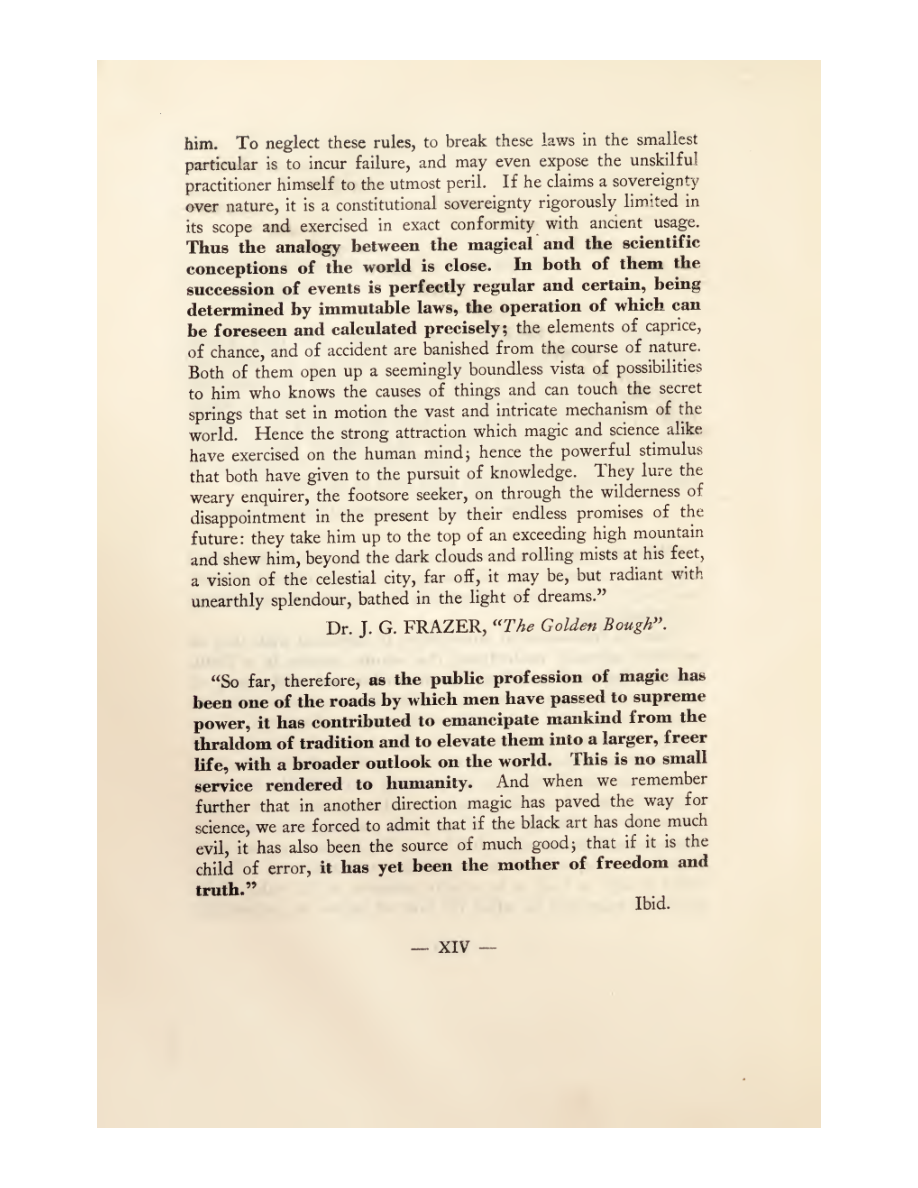
Highlights use the original PDF text layer. OCR-only matches may not be visible on the scan.
Transcription
Download text ↓raw extractionoriginal embedded textReview: unreviewed
him. To neglect these rules, to break these laws in the smallest
particular is to incur failure, and may even expose the unskilfu!
practitioner himself to the utmost péril. If he daims a sovereignty
over nature, it is a constitutional sovereignty rigorously limited in
its scope and exercised in exact conformity with ancient usage.
Thus the analogy between the magical and the scientific
conceptions of the worid is close. In both of them the
succession of events is perfectly regular and certain, being
determined by immutable laws, the operation of which can
be foreseen and calculated precisely; the éléments of caprice,
of chance, and of accident are banished from the course of nature.
Both of them open up a seemingly boundless vista of possibilities
to him who knows the causes of things and can touch the secret
springs that set in motion the vast and intncate mechanism of the
worid. Hence the strong attraction which magic and science alike
hâve exercised on the human mindj hence the powerful stimulus
that both hâve given to the pursuit of knowledge. They lure the
weary enquirer, the footsore seeker, on through the wilderness of
disappointment in the présent by their endless promises of the
future: they take him up to the top of an exceeding high mountain
and shew him, beyond the dark clouds and rolling mists at his feet,
a vision of the celestial city, far off, it may be, but radiant with
unearthly splendour, bathed in the light of dreams.”
Dr. J. G. FRAZER, «The Golden Bough
“So far, therefore, as the public profession of magic has
been one of the roads by which men hâve passed to suprême
power, it has contributed to emancipate mankind from the
thraldom of tradition and to elevate them into a larger, f reer
life, with a broader outlook, on the worid. This is no small
service rendered to humanity. And when we remember
further that in another direction magic has paved the way for
science, we are forced to admit that if the black art has done much
evil, it has also been the source of much goodj that if it is the
child of error, it has yet been the mother of freedom and
truth.”
Ibid.
XIV
Page provenance & review flags
Stable page ID: ada196c290adc6561dda8e9d:p00016
Line breaks are preserved. Reading order and OCR accuracy may need review.
Printed page label has not been verified.
- No automated review flags. This does not establish transcription accuracy.