1929 · CLOSE READING
Magick in Theory and Practice (Section 1)
Magick in Theory and Practice (Section 1) (1929), PDF p. 157
Original page
Enlarge ↗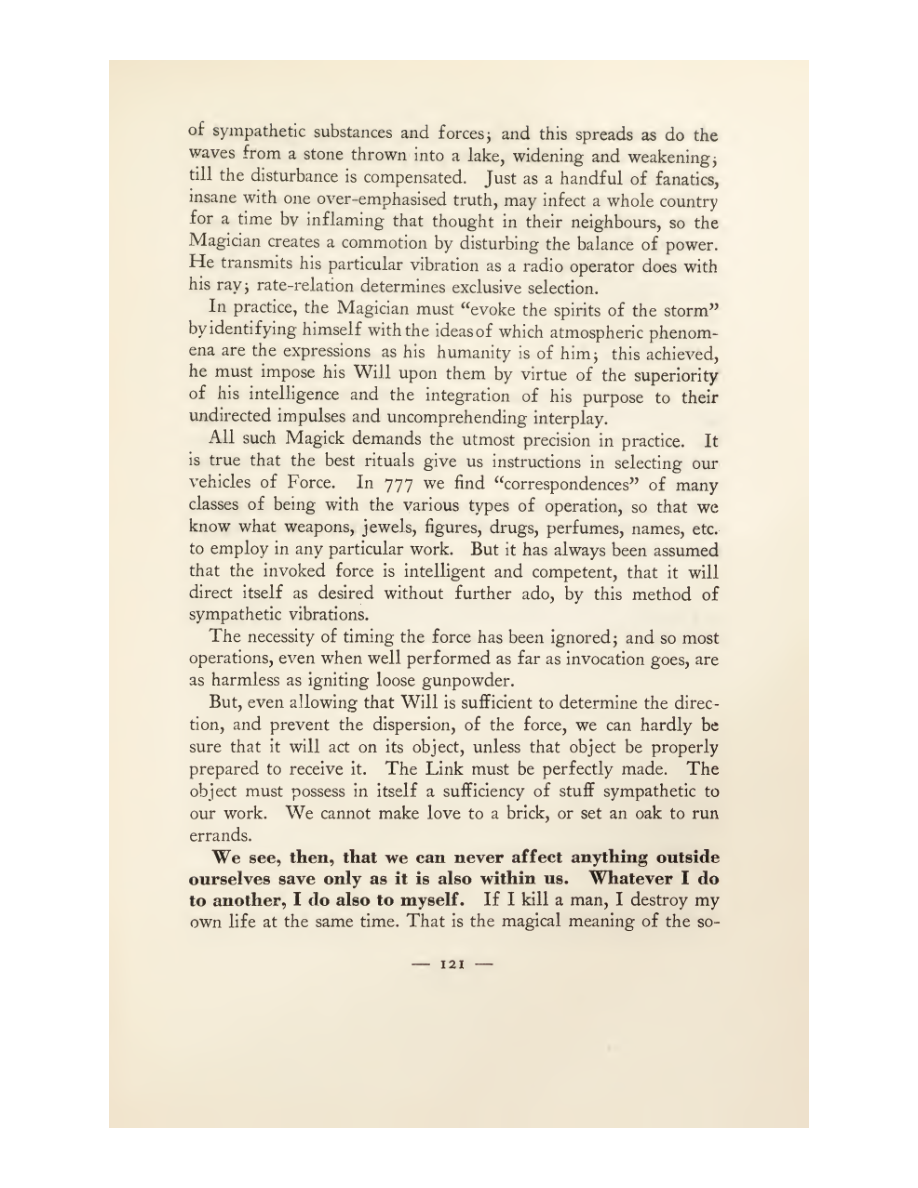
Highlights use the original PDF text layer. OCR-only matches may not be visible on the scan.
Transcription
Download text ↓raw extractionoriginal embedded textReview: unreviewed
of sympathetic substances and forces ; and this spreads as do the
waves from a stone thrown into a lake, widening and weakeningj
till the disturbance is compensated. Just as a handful of fanatics,
insane with one over-emphasised truth, may infect a whole country
for a time bv inflaming that thought in their neighbours, so the
Magician créâtes a commotion by disturbing the balance of power.
He transmits his particular vibration as a radio operator does with
his ray 5 rate-relation détermines exclusive sélection.
In practice, the Magician must aevoke the spirits of the storm”
by identifying himself with the ideasof which atmospheric phenom-
ena are the expressions as his humanity is of him; this achieved,
he must impose his Will upon them by virtue of the superiority
of his intelligence and the intégration of his purpose to their
undirected impulses and uncomprehending interplay.
Ail such. Magick demands the utmost précision in practice. It
is true that the best rituals give us instructions in selecting our
vehicles of Force. In 777 we find “correspondences” of many
classes of being with the various types of operation, so that we
know what weapons, jewels, figures, drugs, perfurnes, names, etc.
to employ in any particular work. But it has always been assumed
that the invoked force is intelligent and competent, that it will
direct itself as desired without further ado, by this method of
sympathetic vibrations.
The necessity of timing the force has been ignored; and so most
operations, even when well performed as far as invocation goes, are
as harmless as igniting loose gunpowder.
But, even allowing that Will is sufficient to détermine the direc¬
tion, and prevent the dispersion, of the force, we can hardly be
sure that it will act on its object, unless that object be properly
prepared to receive it. The Link must be perfectly made. The
object must possess in itself a sufficiency of stuff sympathetic to
our work. We cannot make love to a brick, or set an oak to run
errands.
We see, then, that we can never affect anything outside
ourselves save only as it is also within us. Whatever I do
to another, I do also to myself. If I kill a man, I destroy my
own life at the same time. That is the magical meaning of the so-
121
Page provenance & review flags
Stable page ID: ada196c290adc6561dda8e9d:p00157
Line breaks are preserved. Reading order and OCR accuracy may need review.
Printed page label has not been verified.
- No automated review flags. This does not establish transcription accuracy.