1929 · CLOSE READING
Magick in Theory and Practice (Section 1)
Magick in Theory and Practice (Section 1) (1929), PDF p. 120
Original page
Enlarge ↗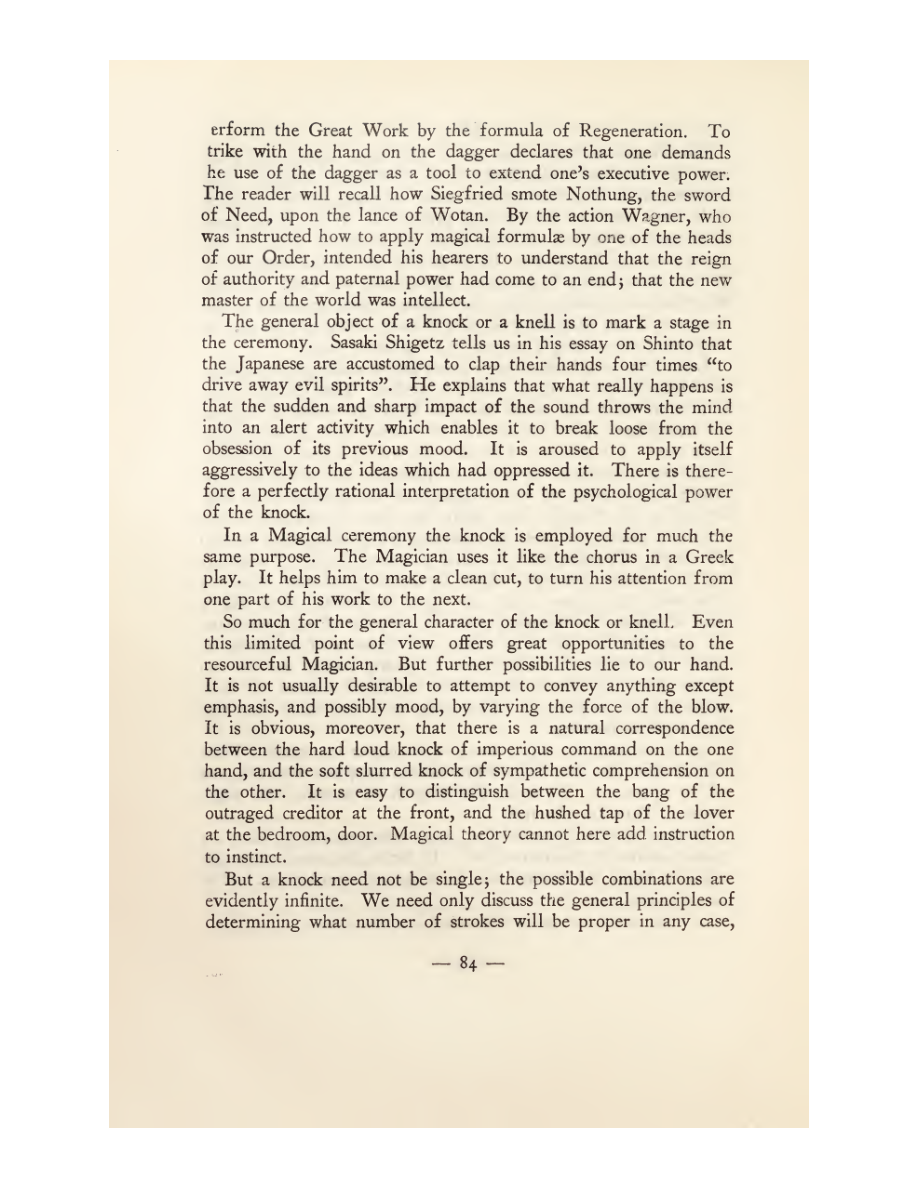
Highlights use the original PDF text layer. OCR-only matches may not be visible on the scan.
Transcription
Download text ↓raw extractionoriginal embedded textReview: unreviewed
erform the Great Work by the formula of Régénération. To
trike with the hand on the dagger déclarés that one demands
he use of the dagger as a tocl to extena one’s executive power.
The reader will recall how Siegfried smote Nothung, the sword
of Need, upon the lance of Wotan. By the action Wagner, who
was instructed how to apply magical formulæ by one of the heads
of our Order, intended his hearers to understand that the reign
of authority and paternal power had corne to an end 5 that the new
master of the world was intellect.
The general object of a knock or a knell is to mark a stage in
the ceremony. Sasaki Shigetz tells us in his essay on Shinto that
the Japanese are accustomed to clap their hands four times “to
drive away evil spirits”. He explains that what really happens is
that the sudden and sharp impact of the Sound throws the mind
into an alert activity which enables it to break loose from the
obsession of its previous mood. It is aroused to apply itself
aggressively to the ideas which had oppressed it. There is there-
fore a perfectly rational interprétation of the psychological power
of the knock.
In a Magical ceremony the knock is employed for much the
same purpose. The Magician uses it like the chorus in a Greek
play. It helps him to make a clean eut, to turn his attention from
one part of his work to the next.
So much for the general character of the knock or knell, Even
this limited point of view offers great opportunities to the
resourceful Magician. But further possibilities lie to our hand.
It is not usually désirable to attempt to convey anything except
emphasis, and possibly mood, by varying the force of the blow.
It is obvious, moreover, that there is a natural correspondence
between the hard loud knock of imperious command on the one
hand, and the soft slurred knock of sympathetic compréhension on
the other. It is easy to distinguish between the bang of the
outraged creditor at the front, and the hushed tap of the lover
at the bedroom, door. Magical theory cannot here add. instruction
to instinct.
But a knock need not be single j the possible combinations are
evidently infinité. We need only discuss the general principles of
determining what number of strokes will be proper in any case,
84 -
Page provenance & review flags
Stable page ID: ada196c290adc6561dda8e9d:p00120
Line breaks are preserved. Reading order and OCR accuracy may need review.
Printed page label has not been verified.
- No automated review flags. This does not establish transcription accuracy.