1929 · CLOSE READING
Magick in Theory and Practice (Section 1)
Magick in Theory and Practice (Section 1) (1929), PDF p. 114
Original page
Enlarge ↗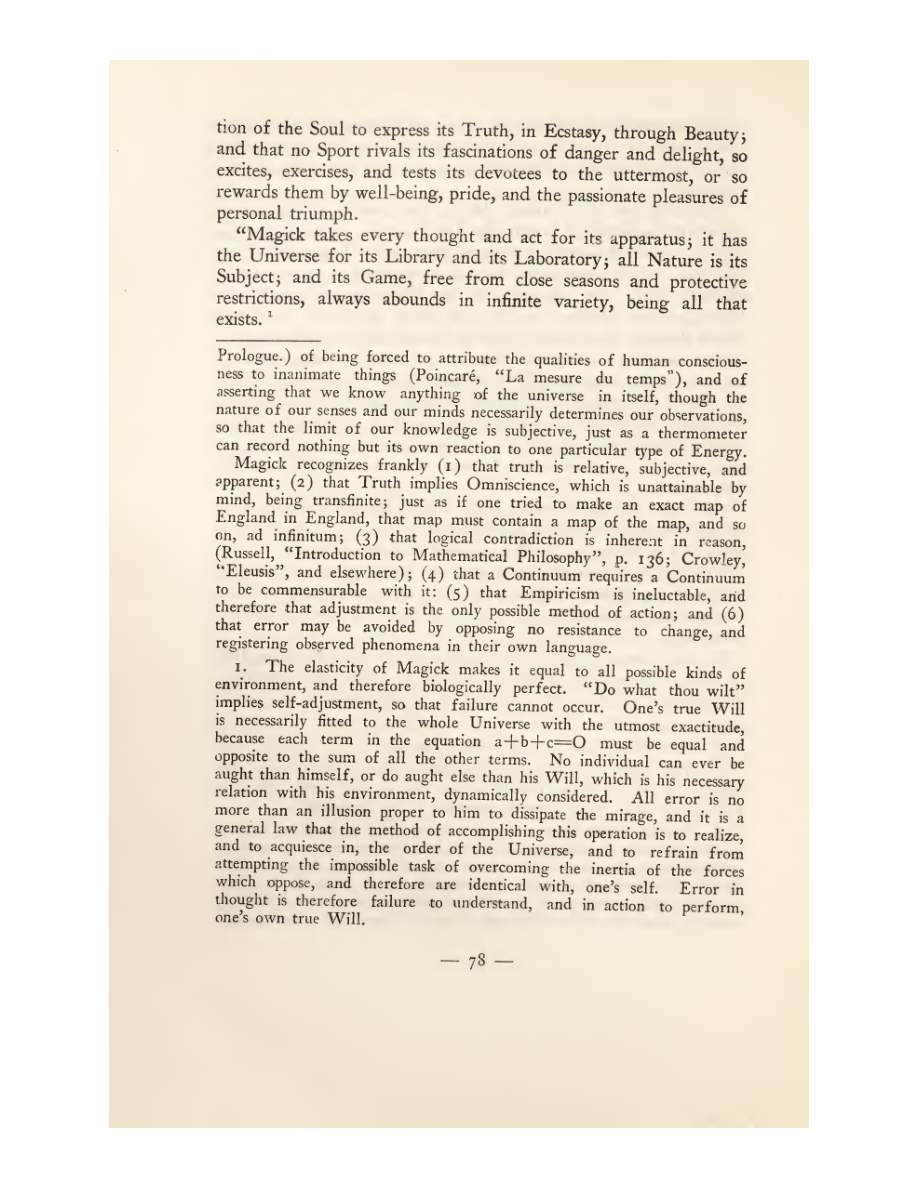
Highlights use the original PDF text layer. OCR-only matches may not be visible on the scan.
Transcription
Download text ↓raw extractionoriginal embedded textReview: unreviewed
tion of the Soûl to express its Truth, in Ecstasy, through Beauty;
and that no Sport rivais its fascinations of danger and delight, so
excites, exercises, and tests its devotees to the uttermost, or so
rewards them by well-being, pride, and the passionate pleasures of
Personal triumph.
“Magick takes every thought and act for ifs apparatus; it has
the Universe for its Library and its Laboratory; ail Nature is its
Subject; and its Game, free from close seasons and protective
restrictions, always abounds in infinité variety, being ail that
exists.* 1
Prologue.) of being forced to attribute the qualities of human conscious-
ness to inanimate things (Poincaré, “La mesure du temps”), and of
asserting that we know anything of the universe in itself, though the
nature of oui senses and our minds necessanly détermines our observations,
so that the limit of our knowledge is subjective, just as a thermometer
can record nothing but its own reaction to one particular type of Energy.
Magick recognizes frankly (i) that truth is relative, subjective, and
apparent; (2) that Truth implies Omniscience, which is unattainable by
mind, being transfînite; just as if one tried to malce an exact map of
Engiand in England, that map must contain a map of the map, and so
on, ad infinitum; (3) that logical contradiction is inhérent in reason,
(Russell,^“Introduction to Mathematical Philosophy”, p. 136; Crowley,
Eleusis , and elsewhere); (4) that a Continuum requires a Continuum
to be commensurable with it: (5) that Empiricism is inéluctable, and
therefore that adjustment is the only possible method of action; and (6)
that error may be avoided by opposing no résistance to change, and
registering observed phenomena in their own language.
1. The elasticity of Magick makes it equal to ail possible kinds of
environment, and therefore biologically perfect. “Do what thou wilt”
implies self-adjustment, so that failure cannot occur. One’s true Will
is necessarily fitted to the whole Universe with the utmost exactitude,
because each term in the équation a + b+c=0 must be equal and
opposite to the sum of ail the other terms. No individual can ever be
aught than himself, or do aught else than his Will, which is his necessary
relation with his environment, dynamically considered. Ail error is no
more than an illusion proper to him to dissipate the mirage, and it is a
general law that the method of accomplishing this operation is to realize,
and to acquiesce in, the order of the Universe, and to refrain from
attempting the impossible task of overcoming the inertia of the forces
which oppose, and therefore are identical with, one’s self. Error in
thought is therefore failure to understand, and in action to perform
one s own true Will. F
73
Page provenance & review flags
Stable page ID: ada196c290adc6561dda8e9d:p00114
Line breaks are preserved. Reading order and OCR accuracy may need review.
Printed page label has not been verified.
- No automated review flags. This does not establish transcription accuracy.