1929 · CLOSE READING
Magick in Theory and Practice (Section 1)
Magick in Theory and Practice (Section 1) (1929), PDF p. 104
Original page
Enlarge ↗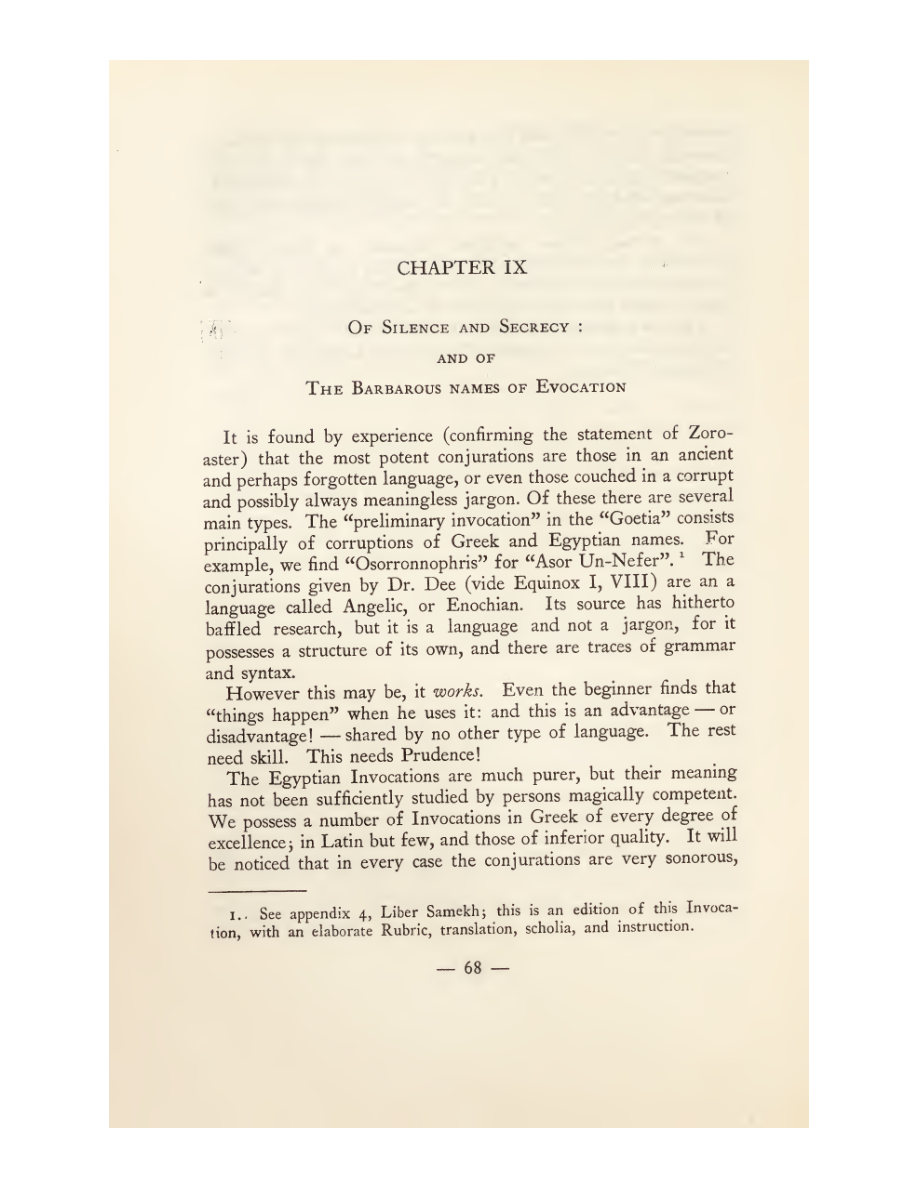
Highlights use the original PDF text layer. OCR-only matches may not be visible on the scan.
Transcription
Download text ↓raw extractionoriginal embedded textReview: unreviewed
CHAPTER IX
Of Silence and Secrecy :
AND OF
The Barbarous names of Evocation
It is found by expérience (confirming the statement of Zoro-
aster) that the most potent conjurations are those in an ancient
and perhaps forgotten language, or even those couched in a corrupt
and possibly always meaningless jargon. Of these there are several
main types. The “preliminary invocation” in the “Goetia” consists
principally of corruptions of Greek and Egyptian names. For
example, we find “Osorronnophris” for “Asor Un-Nefer”.1 The
conjurations given by Dr. Dee (vide Equinox I, VIII) are an a
language called Angelic, or Enochian. Its source has hnherto
baffled research, but it is a language and not a jargon, for it
possesses a structure of its own, and there are traces or grammar
and syntax.
However this may be, it works. Even the beginner finds that
“things happen” when he uses it: and this is an advantage or
disadvantage ! —shared by no other type of language. The rest
need skill. This needs Prudence!
The Egyptian Invocations are much purer, but their meaning
has not been sufficiently studied by persons magically competent.
We possess a number of Invocations in Greek of every degree of
excellence ; in Latin but few, and those of inferioi quality. It will
be noticed that in every case the conjurations are very sonorous,
I.. See appendix 4, Liber Samekh; this is an édition of this Invoca¬
tion, with an elaborate Rubric, translation, scholia, and instruction.
68 —
Page provenance & review flags
Stable page ID: ada196c290adc6561dda8e9d:p00104
Line breaks are preserved. Reading order and OCR accuracy may need review.
Printed page label has not been verified.
- No automated review flags. This does not establish transcription accuracy.