1910 · CLOSE READING
The Scented Garden
The Scented Garden (1910), PDF p. 22
Original page
Enlarge ↗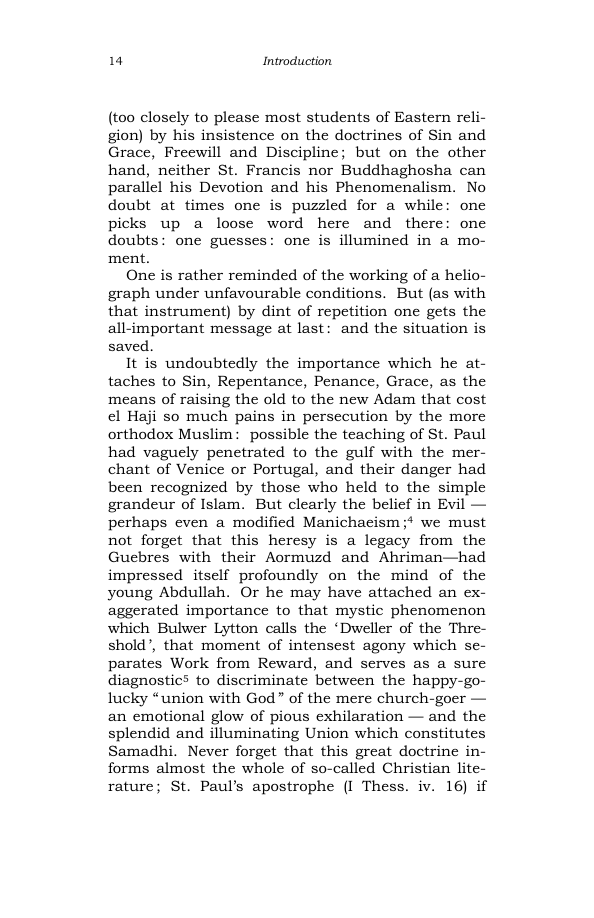
Highlights use the original PDF text layer. OCR-only matches may not be visible on the scan.
Transcription
Download text ↓raw extractionoriginal embedded textReview: unreviewed
14
Introduction
(too closely to please most students of Eastern reli-
gion) by his insistence on the doctrines of Sin and
Grace, Freewill and Discipline ; but on the other
hand, neither St. Francis nor Buddhaghosha can
parallel his Devotion and his Phenomenalism. No
doubt at times one is puzzled for a while : one
picks up a loose word here and there : one
doubts : one guesses : one is illumined in a mo-
ment.
One is rather reminded of the working of a helio-
graph under unfavourable conditions. But (as with
that instrument) by dint of repetition one gets the
all-important message at last : and the situation is
saved.
It is undoubtedly the importance which he at-
taches to Sin, Repentance, Penance, Grace, as the
means of raising the old to the new Adam that cost
el Haji so much pains in persecution by the more
orthodox Muslim : possible the teaching of St. Paul
had vaguely penetrated to the gulf with the mer-
chant of Venice or Portugal, and their danger had
been recognized by those who held to the simple
grandeur of Islam. But clearly the belief in Evil —
perhaps even a modified Manichaeism ;4 we must
not forget that this heresy is a legacy from the
Guebres with their Aormuzd and Ahriman—had
impressed itself profoundly on the mind of the
young Abdullah. Or he may have attached an ex-
aggerated importance to that mystic phenomenon
which Bulwer Lytton calls the ‘ Dweller of the Thre-
shold ’, that moment of intensest agony which se-
parates Work from Reward, and serves as a sure
diagnostic5 to discriminate between the happy-go-
lucky “ union with God ” of the mere church-goer —
an emotional glow of pious exhilaration — and the
splendid and illuminating Union which constitutes
Samadhi. Never forget that this great doctrine in-
forms almost the whole of so-called Christian lite-
rature ; St. Paul’s apostrophe (I Thess. iv. 16) if
Page provenance & review flags
Stable page ID: a228c280a925e8e147836342:p00022
Line breaks are preserved. Reading order and OCR accuracy may need review.
Printed page label has not been verified.
- No automated review flags. This does not establish transcription accuracy.