1910 · CLOSE READING
The Equinox (Volume I, Number IV)
The Equinox (Volume I, Number IV) (1910), PDF p. 87
Original page
Enlarge ↗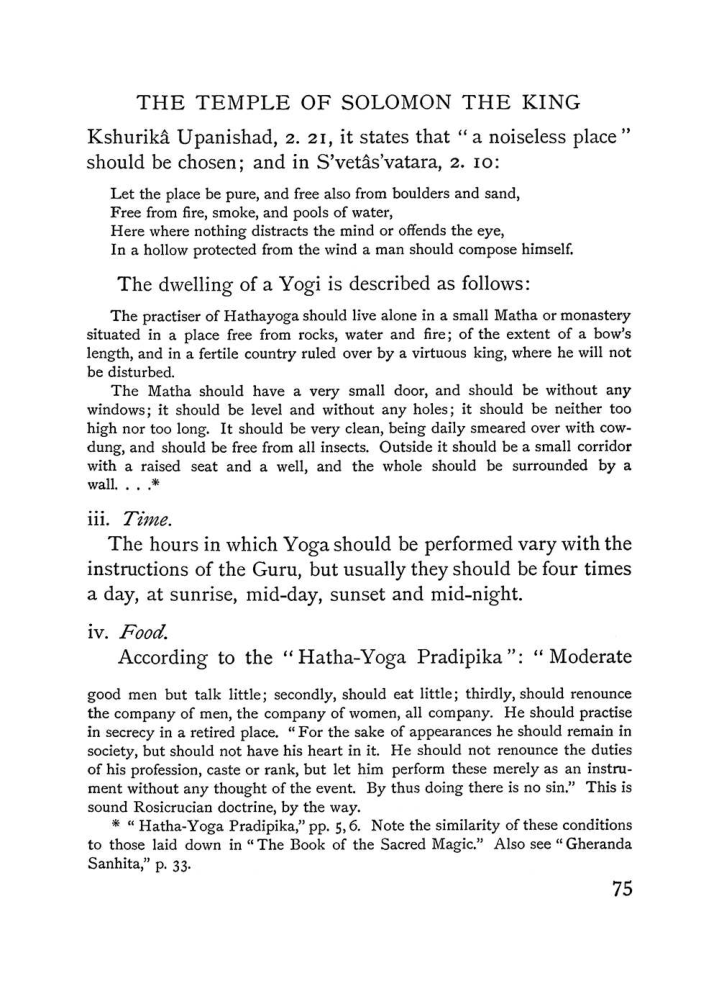
Highlights use the original PDF text layer. OCR-only matches may not be visible on the scan.
Transcription
Download text ↓raw extractionoriginal embedded textReview: unreviewed
THE TEMPLE OF SOLOMON THE KING
Kshurika Upanishad, 2. 21, it states that “a noiseless place”
should be chosen; and in S’vetds’vatara, 2. 10:
Let the place be pure, and free also from boulders and sand,
Free from fire, smoke, and pools of water,
Here where nothing distracts the mind or offends the eye,
In a hollow protected from the wind a man should compose himself.
The dwelling of a Yogi is described as follows:
The practiser of Hathayoga should live alone in a small Matha or monastery
situated in a place free from rocks, water and fire; of the extent of a bow’s
length, and in a fertile country ruled over by a virtuous king, where he will not
be disturbed.
The Matha should have a very small door, and should be without any
windows; it should be level and without any holes; it should be neither too
high nor too long. It should be very clean, being daily smeared over with cow-
dung, and should be free from all insects. Outside it should be a small corridor
with a raised seat and a well, and the whole should be surrounded by a
wall... .*
ili. Time.
The hours in which Yoga should be performed vary with the
instructions of the Guru, but usually they should be four times
a day, at sunrise, mid-day, sunset and mid-night.
iv. Food.
According to the ‘“ Hatha-Yoga Pradipika”: “ Moderate
good men but talk little; secondly, should eat little; thirdly, should renounce
the company of men, the company of women, all company. He should practise
in secrecy in a retired place. “For the sake of appearances he should remain in
society, but should not have his heart in it. He should not renounce the duties
of his profession, caste or rank, but let him perform these merely as an instru-
ment without any thought of the event. By thus doing there is no sin.” This is
sound Rosicrucian doctrine, by the way.
* “ Hatha-Yoga Pradipika,” pp. 5,6. Note the similarity of these conditions
to those laid down in “The Book of the Sacred Magic,” Also see “Gheranda
Sanhita,” p. 33.
75
Page provenance & review flags
Stable page ID: 8af424f3c6f02f3b8e8db2b3:p00087
Line breaks are preserved. Reading order and OCR accuracy may need review.
Printed page label has not been verified.
- No automated review flags. This does not establish transcription accuracy.