1910 · CLOSE READING
The Equinox (Volume I, Number IV)
The Equinox (Volume I, Number IV) (1910), PDF p. 69
Original page
Enlarge ↗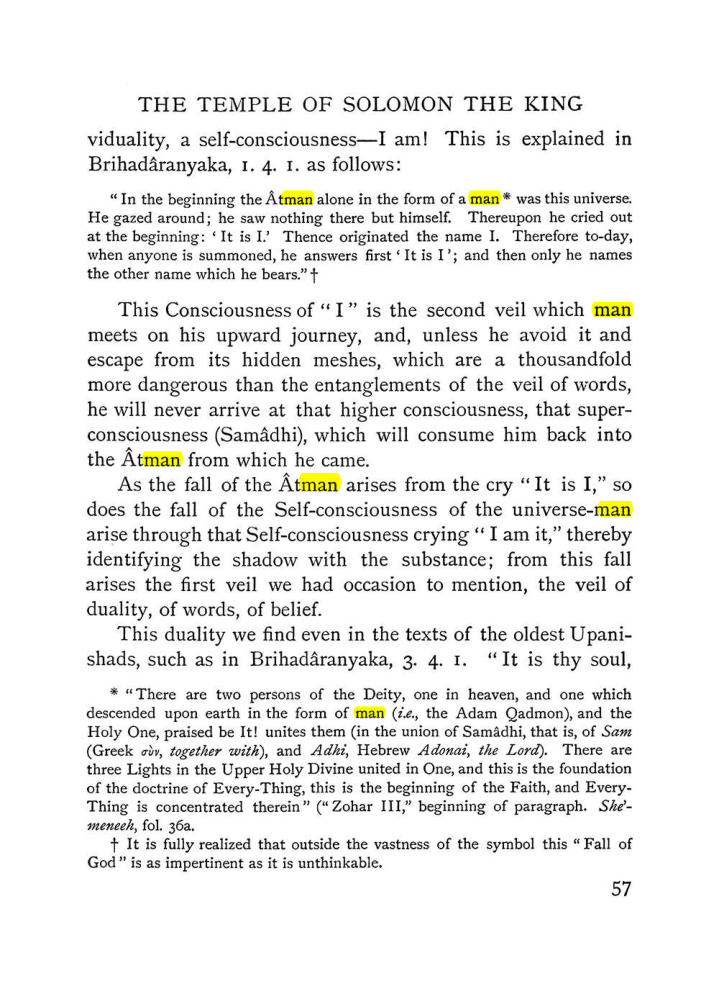
Highlights use the original PDF text layer. OCR-only matches may not be visible on the scan.
Transcription
Download text ↓raw extractionoriginal embedded textReview: unreviewed
THE TEMPLE OF SOLOMON THE KING
viduality, a self-consciousness—I am! This is explained in
Brihadaranyaka, 1. 4. 1. as follows:
“In the beginning the Atman alone in the form ofa man * was this universe.
He gazed around; he saw nothing there but himself. Thereupon he cried out
at the beginning: ‘It is I? Thence originated the name I. Therefore to-day,
when anyone is summoned, he answers first ‘It is 1’; and then only he names
the other name which he bears.”+
This Consciousness of “I” is the second veil which man
meets on his upward journey, and, unless he avoid it and
escape from its hidden meshes, which are a thousandfold
more dangerous than the entanglements of the veil of words,
he will never arrive at that higher consciousness, that super-
consciousness (Samadhi), which will consume him back into
the Atman from which he came.
As the fall of the Atman arises from the cry “It is I,” so
does the fall of the Self-consciousness of the universe-man
arise through that Self-consciousness crying ‘I am it,” thereby
identifying the shadow with the substance; from this fall
arises the first veil we had occasion to mention, the veil of
duality, of words, of belief.
This duality we find even in the texts of the oldest Upani-
shads, such as in Brihadaranyaka, 3. 4. 1. “It is thy soul,
* “There are two persons of the Deity, one in heaven, and one which
descended upon earth in the form of man (ze, the Adam Qadmon), and the
Holy One, praised be It! unites them (in the union of Samadhi, that is, of Sam
(Greek ody, together with), and Adhi, Hebrew Adonai, the Lord). There are
three Lights in the Upper Holy Divine united in One, and this is the foundation
of the doctrine of Every-Thing, this is the beginning of the Faith, and Every-
Thing is concentrated therein” (“Zohar III,” beginning of paragraph. She’-
meneeh, fol. 36a,
+ It is fully realized that outside the vastness of the symbol this “Fall of
God” is as impertinent as it is unthinkable.
57
Page provenance & review flags
Stable page ID: 8af424f3c6f02f3b8e8db2b3:p00069
Line breaks are preserved. Reading order and OCR accuracy may need review.
Printed page label has not been verified.
- No automated review flags. This does not establish transcription accuracy.