1910 · CLOSE READING
The Equinox (Volume I, Number IV)
The Equinox (Volume I, Number IV) (1910), PDF p. 61
Original page
Enlarge ↗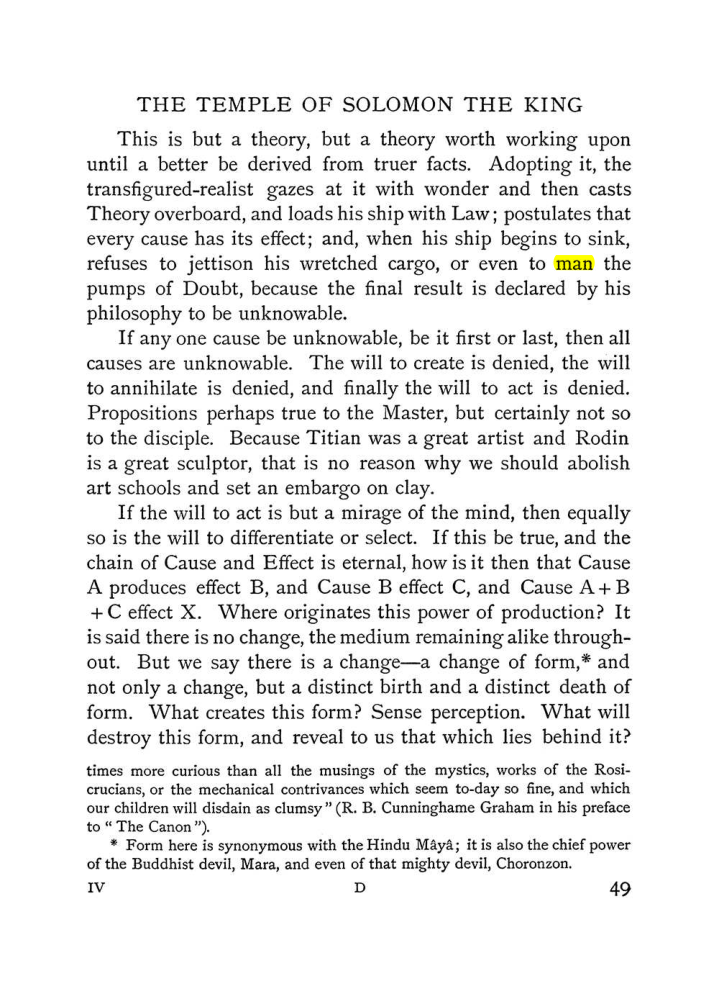
Highlights use the original PDF text layer. OCR-only matches may not be visible on the scan.
Transcription
Download text ↓raw extractionoriginal embedded textReview: unreviewed
THE TEMPLE OF SOLOMON THE KING
This is but a theory, but a theory worth working upon
until a better be derived from truer facts. Adopting it, the
transfigured-realist gazes at it with wonder and then casts
Theory overboard, and loads his ship with Law; postulates that
every cause has its effect; and, when his ship begins to sink,
refuses to jettison his wretched cargo, or even to man the
pumps of Doubt, because the final result is declared by his
philosophy to be unknowable.
If any one cause be unknowable, be it first or last, then all
causes are unknowable. The will to create is denied, the will
to annihilate is denied, and finally the will to act is denied.
Propositions perhaps true to the Master, but certainly not so
to the disciple. Because Titian was a great artist and Rodin
is a great sculptor, that is no reason why we should abolish
art schools and set an embargo on clay.
If the will to act is but a mirage of the mind, then equally
so is the will to differentiate or select. If this be true, and the
chain of Cause and Effect is eternal, how is it then that Cause
A produces effect B, and Cause B effect C, and Cause A+B
+C effect X. Where originates this power of production? It
is said there is no change, the medium remaining alike through-
out. But we say there is a change—a change of form,* and
not only a change, but a distinct birth and a distinct death of
form. What creates this form? Sense perception. What will
destroy this form, and reveal to us that which lies behind it?
times more curious than all the musings of the mystics, works of the Rosi-
crucians, or the mechanical contrivances which seem to-day so fine, and which
our children will disdain as clumsy” (R. B, Cunninghame Graham in his preface
to “ The Canon”).
* Form here is synonymous with the Hindu Mayda; it is also the chief power
of the Buddhist devil, Mara, and even of that mighty devil, Choronzon.
IV D 49
Page provenance & review flags
Stable page ID: 8af424f3c6f02f3b8e8db2b3:p00061
Line breaks are preserved. Reading order and OCR accuracy may need review.
Printed page label has not been verified.
- No automated review flags. This does not establish transcription accuracy.