1910 · CLOSE READING
The Equinox (Volume I, Number IV)
The Equinox (Volume I, Number IV) (1910), PDF p. 358
Original page
Enlarge ↗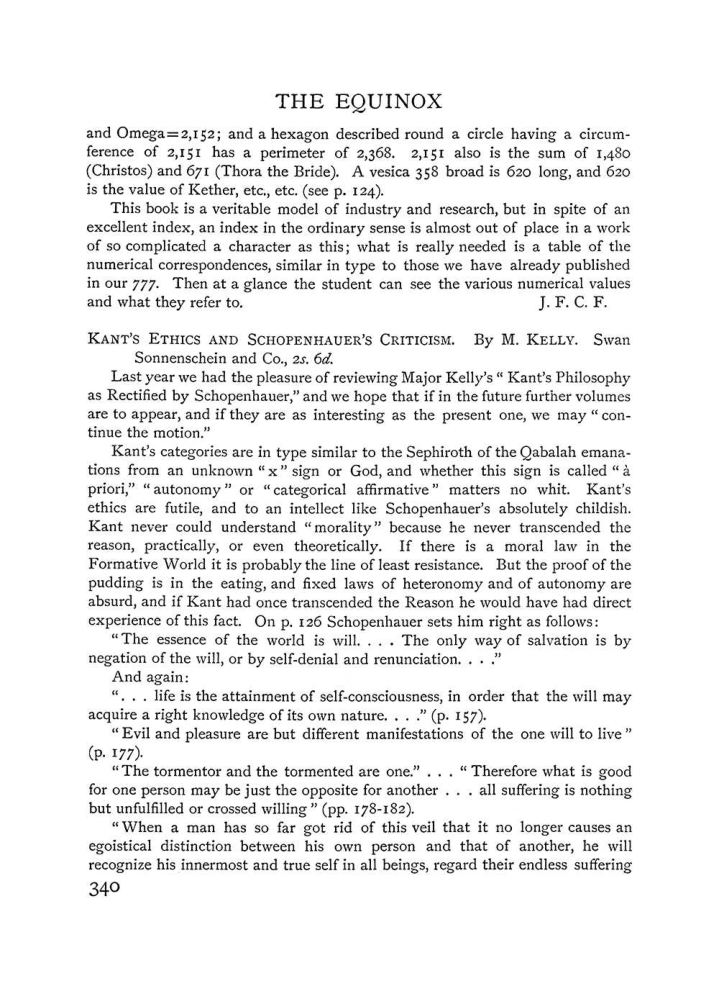
Highlights use the original PDF text layer. OCR-only matches may not be visible on the scan.
Transcription
Download text ↓raw extractionoriginal embedded textReview: unreviewed
THE EQUINOX
and Omega=2,152; and a hexagon described round a circle having a circum-
ference of 2,151 has a perimeter of 2,368. 2,151 also is the sum of 1,480
(Christos) and 671 (Thora the Bride). A vesica 358 broad is 620 long, and 620
is the value of Kether, etc, etc. (see p. 124).
This book is a veritable model of industry and research, but in spite of an
excellent index, an index in the ordinary sense is almost out of place in a work
of so complicated a character as this; what is really needed is a table of the
numerical correspondences, similar in type to those we have already published
in our 777. Then at a glance the student can see the various numerical values
and what they refer to. J.F.CF.
KantT’s ETHICS AND SCHOPENHAUER’S CRITICISM. By M. KELLY. Swan
Sonnenschein and Co., 2s. 6a.
Last year we had the pleasure of reviewing Major Kelly’s “ Kant’s Philosophy
as Rectified by Schopenhauer,” and we hope that if in the future further volumes
are to appear, and if they are as interesting as the present one, we may “con-
tinue the motion.”
Kant’s categories are in type similar to the Sephiroth of the Qabalah emana-
tions from an unknown “x” sign or God, and whether this sign is called “a
priori,” “autonomy” or “categorical affirmative” matters no whit. Kant’s
ethics are futile, and to an intellect like Schopenhauer’s absolutely childish.
Kant never could understand “morality” because he never transcended the
reason, practically, or even theoretically. If there is a moral law in the
Formative World it is probably the line of least resistance. But the proof of the
pudding is in the eating, and fixed laws of heteronomy and of autonomy are
absurd, and if Kant had once transcended the Reason he would have had direct
experience of this fact. On p. 126 Schopenhauer sets him right as follows:
“The essence of the world is will... . The only way of salvation is by
negation of the will, or by self-denial and renunciation. . . .”
And again:
“, .. life is the attainment of self-consciousness, in order that the will may
acquire a right knowledge of its own nature. . . .” (p. 157).
“Evil and pleasure are but different manifestations of the one will to live”
(p. 177).
“The tormentor and the tormented are one.” . . . “ Therefore what is good
for one person may be just the opposite for another . . . all suffering is nothing
but unfulfilled or crossed willing” (pp. 178-182).
“When a man has so far got rid of this veil that it no longer causes an
egoistical distinction between his own person and that of another, he will
recognize his innermost and true self in all beings, regard their endless suffering
340
Page provenance & review flags
Stable page ID: 8af424f3c6f02f3b8e8db2b3:p00358
Line breaks are preserved. Reading order and OCR accuracy may need review.
Printed page label has not been verified.
- No automated review flags. This does not establish transcription accuracy.