1910 · CLOSE READING
The Equinox (Volume I, Number IV)
The Equinox (Volume I, Number IV) (1910), PDF p. 203
Original page
Enlarge ↗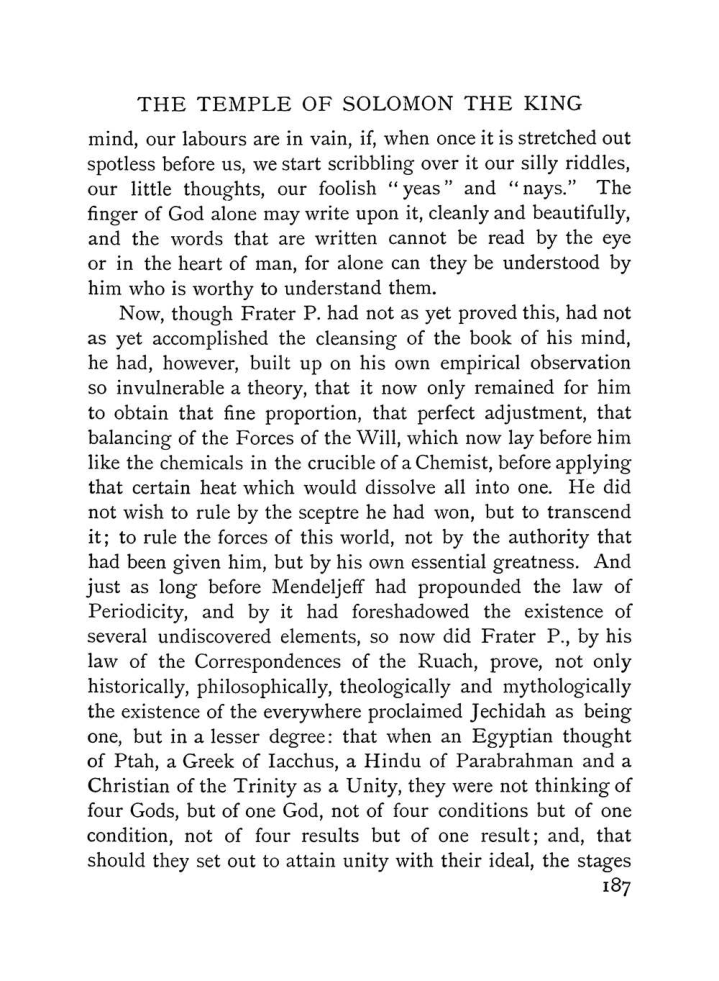
Highlights use the original PDF text layer. OCR-only matches may not be visible on the scan.
Transcription
Download text ↓raw extractionoriginal embedded textReview: unreviewed
THE TEMPLE OF SOLOMON THE KING
mind, our labours are in vain, if, when once it is stretched out
spotless before us, we start scribbling over it our silly riddles,
our little thoughts, our foolish “yeas” and “nays.” The
finger of God alone may write upon it, cleanly and beautifully,
and the words that are written cannot be read by the eye
or in the heart of man, for alone can they be understood by
him who is worthy to understand them.
Now, though Frater P. had not as yet proved this, had not
as yet accomplished the cleansing of the book of his mind,
he had, however, built up on his own empirical observation
so invulnerable a theory, that it now only remained for him
to obtain that fine proportion, that perfect adjustment, that
balancing of the Forces of the Will, which now lay before him
like the chemicals in the crucible ofaChemist, before applying
that certain heat which would dissolve all into one. He did
not wish to rule by the sceptre he had won, but to transcend
it; to rule the forces of this world, not by the authority that
had been given him, but by his own essential greatness. And
just as long before Mendeljeff had propounded the law of
Periodicity, and by it had foreshadowed the existence of
several undiscovered elements, so now did Frater P., by his
law of the Correspondences of the Ruach, prove, not only
historically, philosophically, theologically and mythologically
the existence of the everywhere proclaimed Jechidah as being
one, but in a lesser degree: that when an Egyptian thought
of Ptah, a Greek of Iacchus, a Hindu of Parabrahman and a
Christian of the Trinity as a Unity, they were not thinking of
four Gods, but of one God, not of four conditions but of one
condition, not of four results but of one result; and, that
should they set out to attain unity with their ideal, the stages
187
Page provenance & review flags
Stable page ID: 8af424f3c6f02f3b8e8db2b3:p00203
Line breaks are preserved. Reading order and OCR accuracy may need review.
Printed page label has not been verified.
- No automated review flags. This does not establish transcription accuracy.