1910 · CLOSE READING
The Equinox (Volume I, Number IV)
The Equinox (Volume I, Number IV) (1910), PDF p. 199
Original page
Enlarge ↗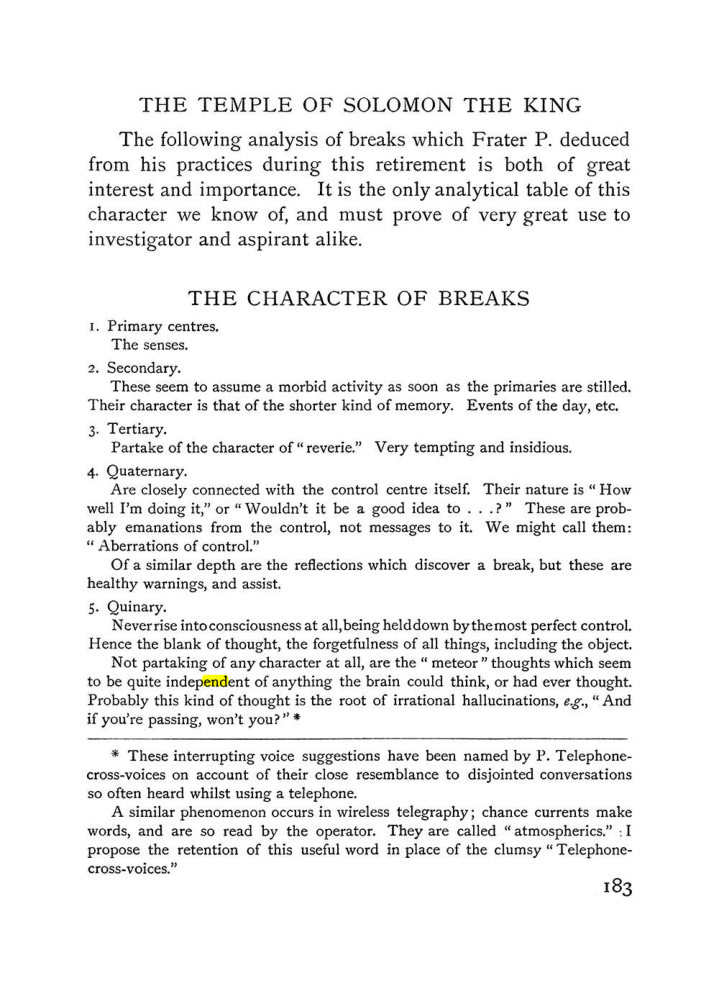
Highlights use the original PDF text layer. OCR-only matches may not be visible on the scan.
Transcription
Download text ↓raw extractionoriginal embedded textReview: unreviewed
THE TEMPLE OF SOLOMON THE KING
The following analysis of breaks which Frater P. deduced
from his practices during this retirement is both of great
interest and importance. It is the only analytical table of this
character we know of, and must prove of very great use to
investigator and aspirant alike.
THE CHARACTER OF BREAKS
1. Primary centres,
The senses.
2. Secondary.
These seem to assume a morbid activity as soon as the primaries are stilled.
Their character is that of the shorter kind of memory. Events of the day, etc.
3. Tertiary.
Partake of the character of “reverie.” Very tempting and insidious.
4. Quaternary.
Are closely connected with the control centre itself. Their nature is “How
well I’m doing it,” or “Wouldn’t it be a good idea to. ..?” These are prob-
ably emanations from the control, not messages to it. We might call them:
“ Aberrations of control.”
Of a similar depth are the reflections which discover a break, but these are
healthy warnings, and assist.
5. Quinary,
Neverrise intoconsciousness at all,being helddown by themost perfect control.
Hence the blank of thought, the forgetfulness of all things, including the object.
Not partaking of any character at all, are the “ meteor ” thoughts which seem
to be quite independent of anything the brain could think, or had ever thought.
Probably this kind of thought is the root of irrational hallucinations, e.g., “And
if you’re passing, won’t you?” *
* These interrupting voice suggestions have been named by P. Telephone-
cross-voices on account of their close resemblance to disjointed conversations
so often heard whilst using a telephone.
A similar phenomenon occurs in wireless telegraphy; chance currents make
words, and are so read by the operator. They are called “atmospherics.” :I
propose the retention of this useful word in place of the clumsy “Telephone-
cross-voices.”
183,
Page provenance & review flags
Stable page ID: 8af424f3c6f02f3b8e8db2b3:p00199
Line breaks are preserved. Reading order and OCR accuracy may need review.
Printed page label has not been verified.
- No automated review flags. This does not establish transcription accuracy.