1910 · CLOSE READING
The Equinox (Volume I, Number IV)
The Equinox (Volume I, Number IV) (1910), PDF p. 152
Original page
Enlarge ↗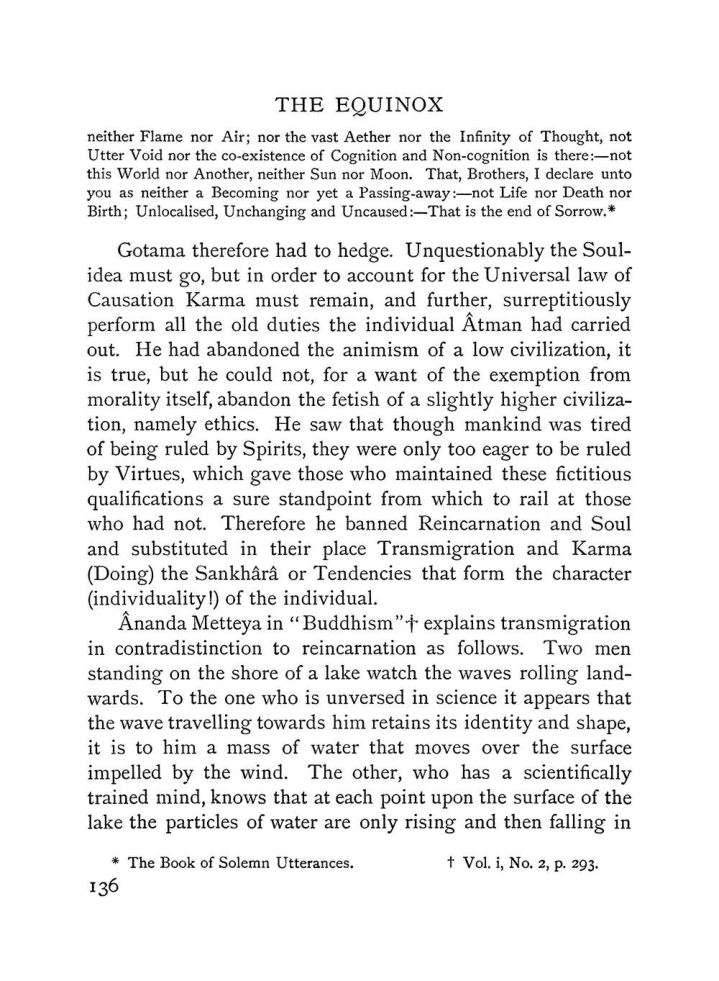
Highlights use the original PDF text layer. OCR-only matches may not be visible on the scan.
Transcription
Download text ↓raw extractionoriginal embedded textReview: unreviewed
THE EQUINOX
neither Flame nor Air; nor the vast Aether nor the Infinity of Thought, not
Utter Void nor the co-existence of Cognition and Non-cognition is there:—not
this World nor Another, neither Sun nor Moon. That, Brothers, I declare unto
you as neither a Becoming nor yet a Passing-away:—not Life nor Death nor
Birth; Unlocalised, Unchanging and Uncaused:—That is the end of Sorrow.*
Gotama therefore had to hedge. Unquestionably the Soul-
idea must go, but in order to account for the Universal law of
Causation Karma must remain, and further, surreptitiously
perform all the old duties the individual Atman had carried
out. He had abandoned the animism of a low civilization, it
is true, but he could not, for a want of the exemption from
morality itself, abandon the fetish of a slightly higher civiliza-
tion, namely ethics. He saw that though mankind was tired
of being ruled by Spirits, they were only too eager to be ruled
by Virtues, which gave those who maintained these fictitious
qualifications a sure standpoint from which to rail at those
who had not. Therefore he banned Reincarnation and Soul
and substituted in their place Transmigration and Karma
(Doing) the Sankhara or Tendencies that form the character
(individuality!) of the individual.
Ananda Metteya in “ Buddhism”+ explains transmigration
in contradistinction to reincarnation as follows. Two men
standing on the shore of a lake watch the waves rolling land-
wards. To the one who is unversed in science it appears that
the wave travelling towards him retains its identity and shape,
it is to him a mass of water that moves over the surface
impelled by the wind. The other, who has a scientifically
trained mind, knows that at each point upon the surface of the
lake the particles of water are only rising and then falling in
* The Book of Solemn Utterances, t Vol. i, No. 2, p. 293.
136
Page provenance & review flags
Stable page ID: 8af424f3c6f02f3b8e8db2b3:p00152
Line breaks are preserved. Reading order and OCR accuracy may need review.
Printed page label has not been verified.
- No automated review flags. This does not establish transcription accuracy.