1910 · CLOSE READING
The Equinox (Volume I, Number IV)
The Equinox (Volume I, Number IV) (1910), PDF p. 151
Original page
Enlarge ↗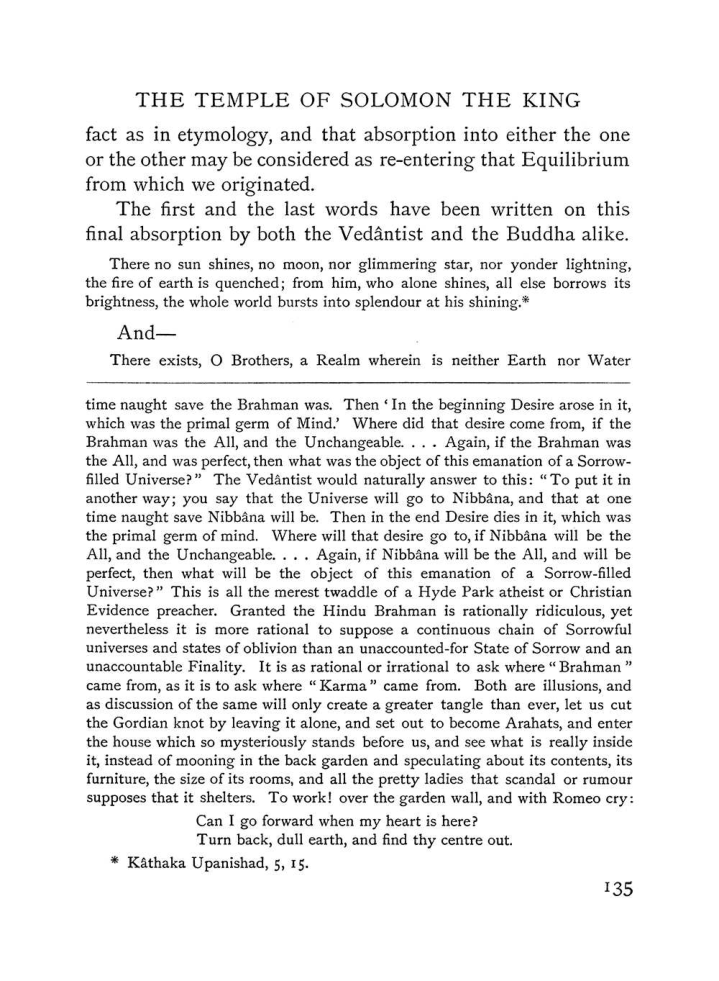
Highlights use the original PDF text layer. OCR-only matches may not be visible on the scan.
Transcription
Download text ↓raw extractionoriginal embedded textReview: unreviewed
THE TEMPLE OF SOLOMON THE KING
fact as in etymology, and that absorption into either the one
or the other may be considered as re-entering that Equilibrium
from which we originated.
The first and the last words have been written on this
final absorption by both the Vedantist and the Buddha alike.
There no sun shines, no moon, nor glimmering star, nor yonder lightning,
the fire of earth is quenched; from him, who alone shines, all else borrows its
brightness, the whole world bursts into splendour at his shining.*
And—
There exists, O Brothers, a Realm wherein is neither Earth nor Water
time naught save the Brahman was. Then ‘In the beginning Desire arose in it,
which was the primal germ of Mind.” Where did that desire come from, if the
Brahman was the All, and the Unchangeable. .. . Again, if the Brahman was
the All, and was perfect, then what was the object of this emanation of a Sorrow-
filled Universe?” The Vedantist would naturally answer to this: “To put it in
another way; you say that the Universe will go to Nibbana, and that at one
time naught save Nibbana will be. Then in the end Desire dies in it, which was
the primal germ of mind. Where will that desire go to, if Nibbana will be the
All, and the Unchangeable. . . . Again, if Nibbana will be the All, and will be
perfect, then what will be the object of this emanation of a Sorrow-filled
Universe?” This is all the merest twaddle of a Hyde Park atheist or Christian
Evidence preacher. Granted the Hindu Brahman is rationally ridiculous, yet
nevertheless it is more rational to suppose a continuous chain of Sorrowful
universes and states of oblivion than an unaccounted-for State of Sorrow and an
unaccountable Finality. It is as rational or irrational to ask where “ Brahman ”
came from, as it is to ask where “Karma” came from. Both are illusions, and
as discussion of the same will only create a greater tangle than ever, let us cut
the Gordian knot by leaving it alone, and set out to become Arahats, and enter
the house which so mysteriously stands before us, and see what is really inside
it, instead of mooning in the back garden and speculating about its contents, its
furniture, the size of its rooms, and all the pretty ladies that scandal or rumour
supposes that it shelters. To work! over the garden wall, and with Romeo cry:
Can I go forward when my heart is here?
Turn back, dull earth, and find thy centre out.
* Kathaka Upanishad, 5, 15.
135
Page provenance & review flags
Stable page ID: 8af424f3c6f02f3b8e8db2b3:p00151
Line breaks are preserved. Reading order and OCR accuracy may need review.
Printed page label has not been verified.
- No automated review flags. This does not establish transcription accuracy.