1910 · CLOSE READING
The Equinox (Volume I, Number IV)
The Equinox (Volume I, Number IV) (1910), PDF p. 144
Original page
Enlarge ↗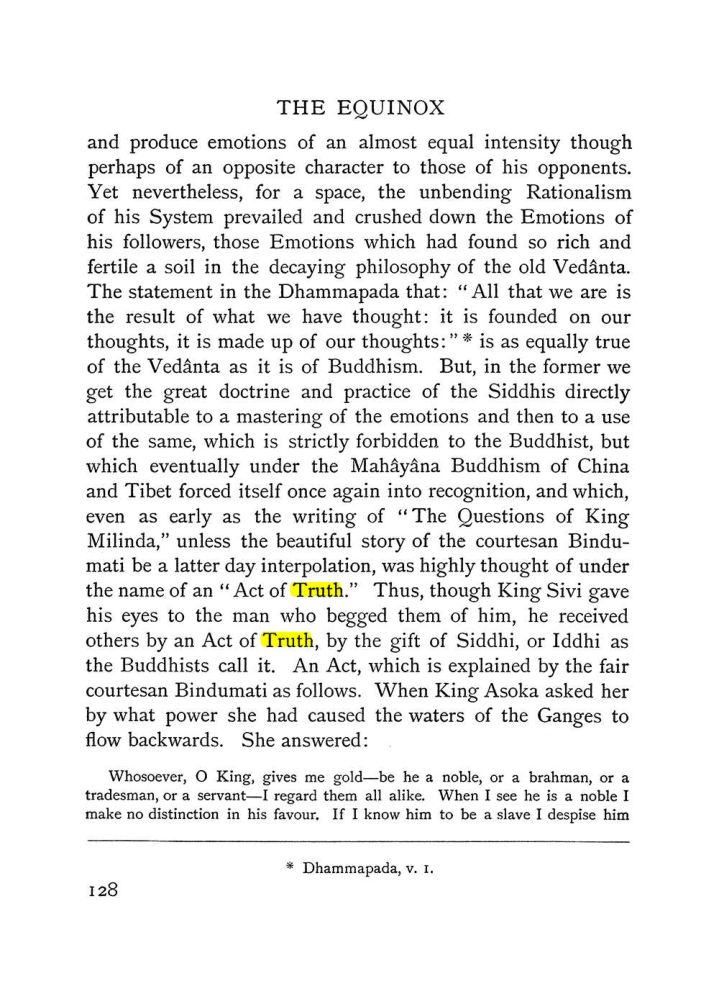
Highlights use the original PDF text layer. OCR-only matches may not be visible on the scan.
Transcription
Download text ↓raw extractionoriginal embedded textReview: unreviewed
THE EQUINOX
and produce emotions of an almost equal intensity though
perhaps of an opposite character to those of his opponents.
Yet nevertheless, for a space, the unbending Rationalism
of his System prevailed and crushed down the Emotions of
his followers, those Emotions which had found so rich and
fertile a soil in the decaying philosophy of the old Vedanta.
The statement in the Dhammapada that: “ All that we are is
the result of what we have thought: it is founded on our
thoughts, it is made up of our thoughts:” * is as equally true
of the Vedanta as it is of Buddhism. But, in the former we
get the great doctrine and practice of the Siddhis directly
attributable to a mastering of the emotions and then to a use
of the same, which is strictly forbidden to the Buddhist, but
which eventually under the Mahayana Buddhism of China
and Tibet forced itself once again into recognition, and which,
even as early as the writing of ‘““The Questions of King
Milinda,” unless the beautiful story of the courtesan Bindu-
mati be a latter day interpolation, was highly thought of under
the name of an “ Act of Truth.” Thus, though King Sivi gave
his eyes to the man who begged them of him, he received
others by an Act of Truth, by the gift of Siddhi, or Iddhi as
the Buddhists call it. An Act, which is explained by the fair
courtesan Bindumati as follows. When King Asoka asked her
by what power she had caused the waters of the Ganges to
flow backwards. She answered:
Whosoever, O King, gives me gold—be he a noble, or a brahman, or a
tradesman, or a servant—I regard them all alike. When I see he is a noble I
make no distinction in his favour, If I know him to be a slave I despise him
* Dhammapada, v. I.
128
Page provenance & review flags
Stable page ID: 8af424f3c6f02f3b8e8db2b3:p00144
Line breaks are preserved. Reading order and OCR accuracy may need review.
Printed page label has not been verified.
- No automated review flags. This does not establish transcription accuracy.