1910 · CLOSE READING
The Equinox (Volume I, Number IV)
The Equinox (Volume I, Number IV) (1910), PDF p. 143
Original page
Enlarge ↗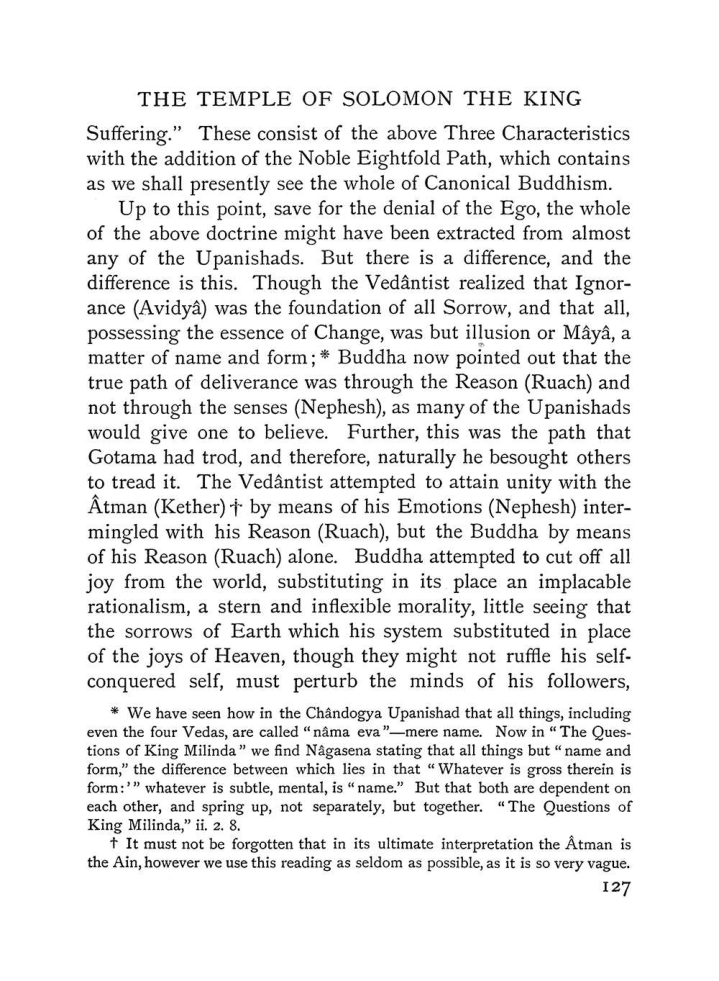
Highlights use the original PDF text layer. OCR-only matches may not be visible on the scan.
Transcription
Download text ↓raw extractionoriginal embedded textReview: unreviewed
THE TEMPLE OF SOLOMON THE KING
Suffering.” These consist of the above Three Characteristics
with the addition of the Noble Eightfold Path, which contains
as we shall presently see the whole of Canonical Buddhism.
Up to this point, save for the denial of the Ego, the whole
of the above doctrine might have been extracted from almost
any of the Upanishads. But there is a difference, and the
difference is this. Though the Vedantist realized that Ignor-
ance (Avidy4) was the foundation of all Sorrow, and that all,
possessing the essence of Change, was but illusion or Maya, a
matter of name and form;* Buddha now pointed out that the
true path of deliverance was through the Reason (Ruach) and
not through the senses (Nephesh), as many of the Upanishads
would give one to believe. Further, this was the path that
Gotama had trod, and therefore, naturally he besought others
to tread it. The Vedantist attempted to attain unity with the
Atman (Kether) {+ by means of his Emotions (Nephesh) inter-
mingled with his Reason (Ruach), but the Buddha by means
of his Reason (Ruach) alone. Buddha attempted to cut off all
joy from the world, substituting in its place an implacable
rationalism, a stern and inflexible morality, little seeing that
the sorrows of Earth which his system substituted in place
of the joys of Heaven, though they might not ruffle his self-
conquered self, must perturb the minds of his followers,
* We have seen how in the Chandogya Upanishad that all things, including
even the four Vedas, are called “nama eva”—mere name. Now in “The Ques-
tions of King Milinda” we find Nagasena stating that all things but “name and
form,” the difference between which lies in that “Whatever is gross therein is
form:’” whatever is subtle, mental, is “name.” But that both are dependent on
each other, and spring up, not separately, but together. “The Questions of
King Milinda,” ii. 2. 8,
+ It must not be forgotten that in its ultimate interpretation the Atman is
the Ain, however we use this reading as seldom as possible, as it is so very vague.
127
Page provenance & review flags
Stable page ID: 8af424f3c6f02f3b8e8db2b3:p00143
Line breaks are preserved. Reading order and OCR accuracy may need review.
Printed page label has not been verified.
- No automated review flags. This does not establish transcription accuracy.