1910 · CLOSE READING
The Equinox (Volume I, Number IV)
The Equinox (Volume I, Number IV) (1910), PDF p. 116
Original page
Enlarge ↗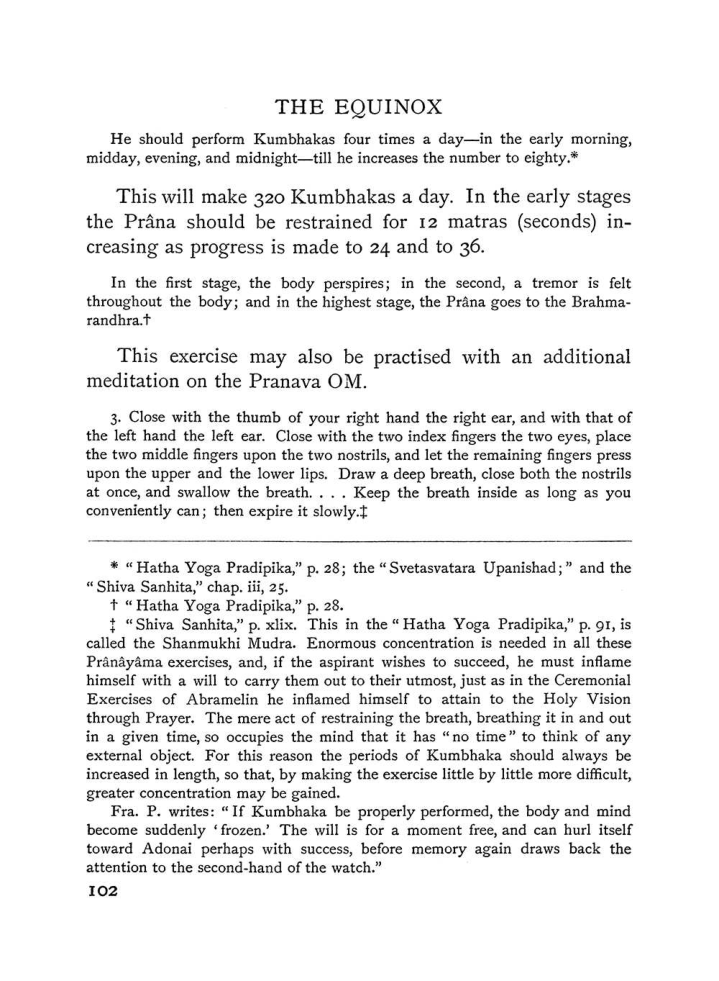
Highlights use the original PDF text layer. OCR-only matches may not be visible on the scan.
Transcription
Download text ↓raw extractionoriginal embedded textReview: unreviewed
THE EQUINOX
He should perform Kumbhakas four times a day—in the early morning,
midday, evening, and midnight—till he increases the number to eighty.*
This will make 320 Kumbhakas a day. In the early stages
the Prana should be restrained for 12 matras (seconds) in-
creasing as progress is made to 24 and to 36.
In the first stage, the body perspires; in the second, a tremor is felt
throughout the body; and in the highest stage, the Prana goes to the Brahma-
randhra.t
This exercise may also be practised with an additional
meditation on the Pranava OM.
3. Close with the thumb of your right hand the right ear, and with that of
the left hand the left ear. Close with the two index fingers the two eyes, place
the two middle fingers upon the two nostrils, and let the remaining fingers press
upon the upper and the lower lips. Draw a deep breath, close both the nostrils
at once, and swallow the breath. . . . Keep the breath inside as long as you
conveniently can; then expire it slowly.t
* “Hatha Yoga Pradipika,” p. 28; the “Svetasvatara Upanishad;” and the
“Shiva Sanhita,” chap. iii, 25.
+ “Hatha Yoga Pradipika,” p. 28.
{ “Shiva Sanhita,” p. xlix. This in the “Hatha Yoga Pradipika,” p. 91, is
called the Shanmukhi Mudra. Enormous concentration is needed in all these
Pranayd4ma exercises, and, if the aspirant wishes to succeed, he must inflame
himself with a will to carry them out to their utmost, just as in the Ceremonial
Exercises of Abramelin he inflamed himself to attain to the Holy Vision
through Prayer. The mere act of restraining the breath, breathing it in and out
in a given time, so occupies the mind that it has “no time” to think of any
external object. For this reason the periods of Kumbhaka should always be
increased in length, so that, by making the exercise little by little more difficult,
greater concentration may be gained.
Fra. P. writes: “If Kumbhaka be properly performed, the body and mind
become suddenly ‘frozen.’ The will is for a moment free, and can hurl itself
toward Adonai perhaps with success, before memory again draws back the
attention to the second-hand of the watch.”
102
Page provenance & review flags
Stable page ID: 8af424f3c6f02f3b8e8db2b3:p00116
Line breaks are preserved. Reading order and OCR accuracy may need review.
Printed page label has not been verified.
- No automated review flags. This does not establish transcription accuracy.