1910 · CLOSE READING
The Equinox (Volume I, Number IV)
The Equinox (Volume I, Number IV) (1910), PDF p. 114
Original page
Enlarge ↗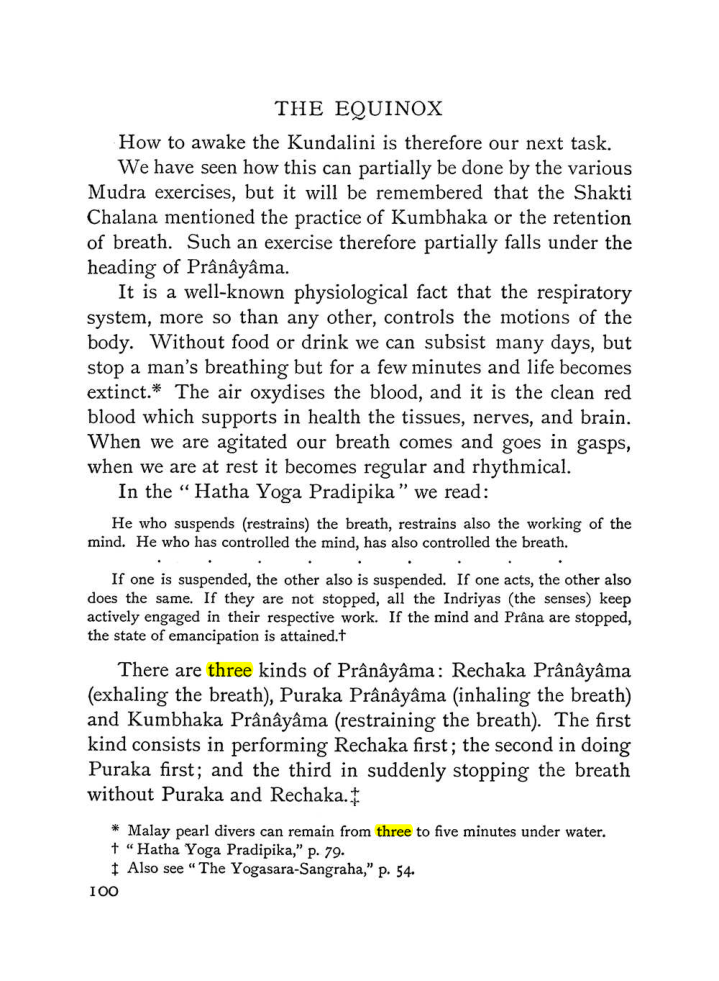
Highlights use the original PDF text layer. OCR-only matches may not be visible on the scan.
Transcription
Download text ↓raw extractionoriginal embedded textReview: unreviewed
THE EQUINOX
How to awake the Kundalini is therefore our next task.
We have seen how this can partially be done by the various
Mudra exercises, but it will be remembered that the Shakti
Chalana mentioned the practice of Kumbhaka or the retention
of breath. Such an exercise therefore partially falls under the
heading of Pranayama.
It is a well-known physiological fact that the respiratory
system, more so than any other, controls the motions of the
body. Without food or drink we can subsist many days, but
stop a man’s breathing but for a few minutes and life becomes
extinct.* The air oxydises the blood, and it is the clean red
blood which supports in health the tissues, nerves, and brain.
When we are agitated our breath comes and goes in gasps,
when we are at rest it becomes regular and rhythmical.
In the “ Hatha Yoga Pradipika” we read:
He who suspends (restrains) the breath, restrains also the working of the
mind. He who has controlled the mind, has also controlled the breath.
If one is suspended, the other also iis suspended. If one acts, the other also
does the same. If they are not stopped, all the Indriyas (the senses) keep
actively engaged in their respective work. If the mind and Prana are stopped,
the state of emancipation is attained.t
There are three kinds of Pranayama: Rechaka Pranayama
(exhaling the breath), Puraka Pranayama (inhaling the breath)
and Kumbhaka Pranaydma (restraining the breath). The first
kind consists in performing Rechaka first; the second in doing
Puraka first; and the third in suddenly stopping the breath
without Puraka and Rechaka.t
* Malay pearl divers can remain from three to five minutes under water.
+ “Hatha Yoga Pradipika,” p. 79.
t Also see “The Yogasara-Sangraha,” p. 54.
100
Page provenance & review flags
Stable page ID: 8af424f3c6f02f3b8e8db2b3:p00114
Line breaks are preserved. Reading order and OCR accuracy may need review.
Printed page label has not been verified.
- No automated review flags. This does not establish transcription accuracy.