1910 · CLOSE READING
The Equinox (Volume I, Number IV)
The Equinox (Volume I, Number IV) (1910), PDF p. 112
Original page
Enlarge ↗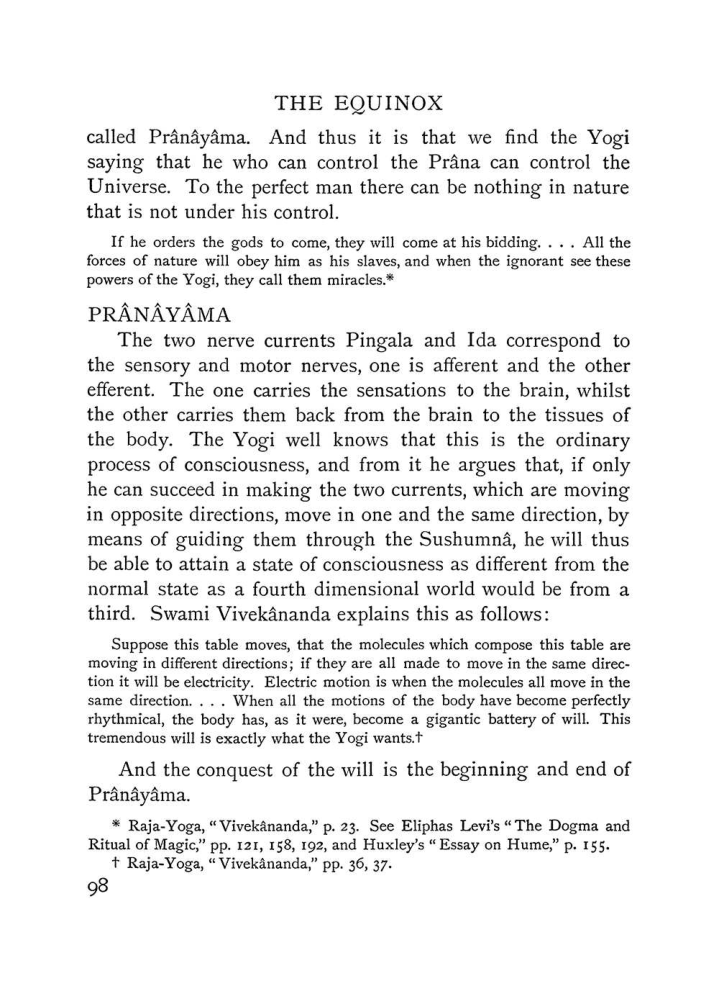
Highlights use the original PDF text layer. OCR-only matches may not be visible on the scan.
Transcription
Download text ↓raw extractionoriginal embedded textReview: unreviewed
THE EQUINOX
called Pranayama. And thus it is that we find the Yogi
saying that he who can control the Prana can control the
Universe. To the perfect man there can be nothing in nature
that is not under his control.
If he orders the gods to come, they will come at his bidding. . . . All the
forces of nature will obey him as his slaves, and when the ignorant see these
powers of the Yogi, they call them miracles.*
PRANAYAMA
The two nerve currents Pingala and Ida correspond to
the sensory and motor nerves, one is afferent and the other
efferent. The one carries the sensations to the brain, whilst
the other carries them back from the brain to the tissues of
the body. The Yogi well knows that this is the ordinary
process of consciousness, and from it he argues that, if only
he can succeed in making the two currents, which are moving
in opposite directions, move in one and the same direction, by
means of guiding them through the Sushumné, he will thus
be able to attain a state of consciousness as different from the
normal state as a fourth dimensional world would be from a
third. Swami Vivekdnanda explains this as follows:
Suppose this table moves, that the molecules which compose this table are
moving in different directions; if they are all made to move in the same direc-
tion it will be electricity. Electric motion is when the molecules all move in the
same direction. . . . When all the motions of the body have become perfectly
rhythmical, the body has, as it were, become a gigantic battery of will. This
tremendous will is exactly what the Yogi wants.t
And the conquest of the will is the beginning and end of
Pranayama.
* Raja-Yoga, “ Vivekananda,” p. 23. See Eliphas Levi’s “The Dogma and
Ritual of Magic,” pp. 121, 158, 192, and Huxley’s “Essay on Hume,” p. 155.
+ Raja-Yoga, “ Vivekananda,” pp. 36, 37-
98
Page provenance & review flags
Stable page ID: 8af424f3c6f02f3b8e8db2b3:p00112
Line breaks are preserved. Reading order and OCR accuracy may need review.
Printed page label has not been verified.
- No automated review flags. This does not establish transcription accuracy.