1930 · CLOSE READING
Magick in Theory and Practice (Section 3)
Magick in Theory and Practice (Section 3) (1930), PDF p. 95
Original page
Enlarge ↗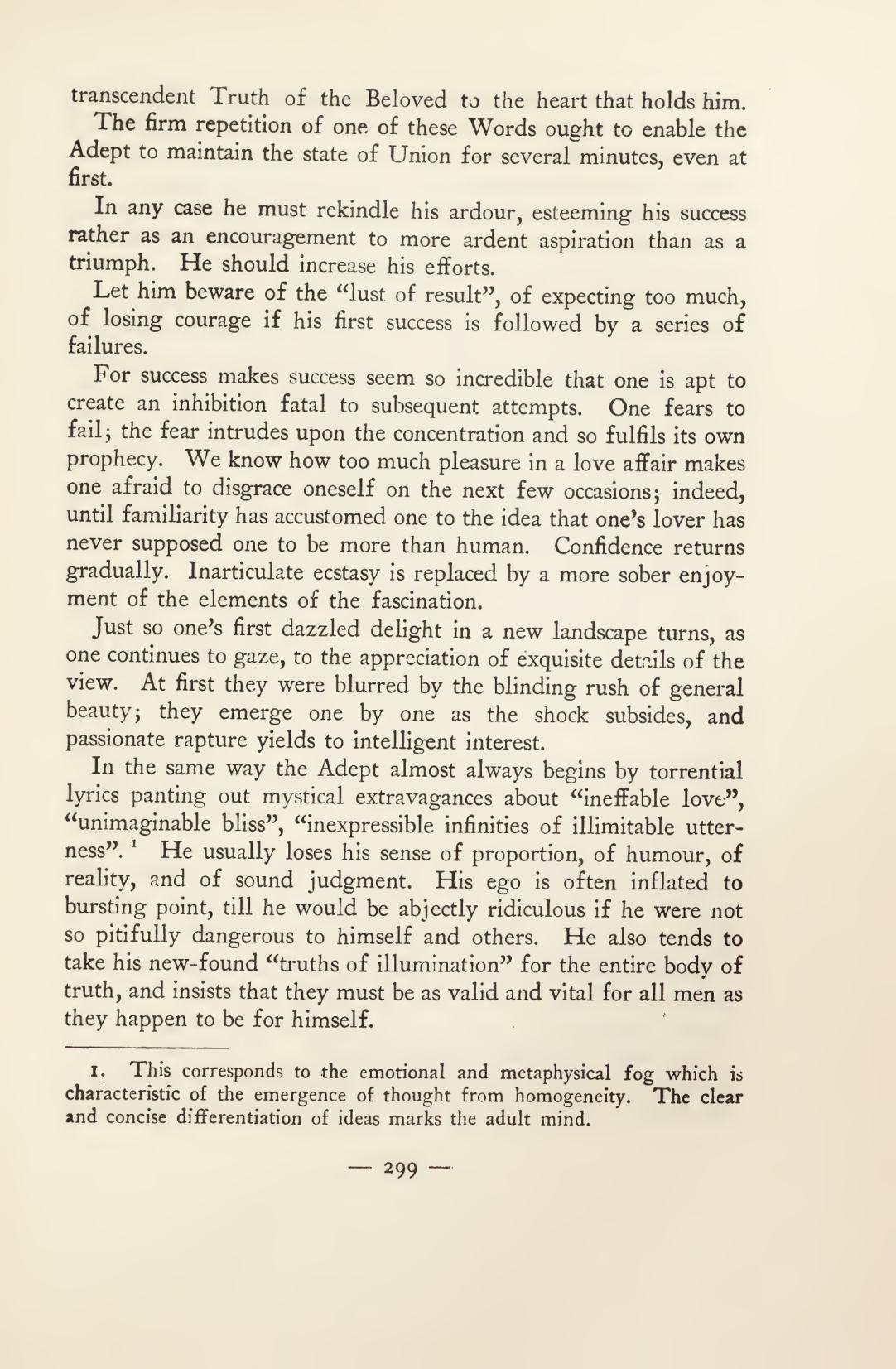
Highlights use the original PDF text layer. OCR-only matches may not be visible on the scan.
Transcription
Download text ↓raw extractionoriginal embedded textReview: unreviewed
transcendent Truth of the Beloved to the heart that holds him.
The firm répétition of one of these Words ought to enable the
Adept to maintain the State of Union for several minutes, even at
first.
In any case he must rekindle his ardour, esteeming his success
rather as an encouragement to more ardent aspiration than as a
triumph. He should increase his efforts.
Let him beware of the “lust of resuit”, of expecting too much,
of losing courage if his first success is followed by a sériés of
failures.
For success makes success seem so incredible that one is apt to
create an inhibition fatal to subséquent attempts. One fears to
failj the fear intrudes upon the concentration and so fulfils its own
prophecy. We know how too much pleasure in a love affair makes
one afraid to disgrâce oneself on the next few occasions; indeed,
until familiarity has accustomed one to the idea that one’s lover has
never supposed one to be more than human. Confidence returns
gradually. Inarticulate ecstasy is replaced by a more sober enjoy-
ment of the éléments of the fascination.
Just so one’s first dazzled delight in a new landscape turns, as
one continues to gaze, to the appréciation of exquisite details of the
view. At first they were blurred by the blinding rush of general
beauty ; they emerge one by one as the shock subsides, and
passionate rapture yields to intelligent interest.
In the same way the Adept almost always begins by torrential
lyrics panting out mystical extravagances about “ineffable love”,
“unimaginable bliss”, “inexpressible infinities of illimitabie utter-
ness”. 1 He usually loses his sense of proportion, of humour, of
reality, and of Sound judgment. His ego is often inflated to
bursting point, till he would be abjectly ridiculous if he were not
so pitifully dangerous to himself and others. He also tends to
take his new-found “truths of illumination” for the entire body of
truth, and insists that they must be as valid and vital for ail men as
they happen to be for himself.
I. This corresponds to the emotional and metaphysical fog which is
characteristic of the emergence of thought from homogeneity. The clear
and concise différentiation of ideas marks the adult mind.
— 299
Page provenance & review flags
Stable page ID: 8716dc3e5e58c785b9453767:p00095
Line breaks are preserved. Reading order and OCR accuracy may need review.
Printed page label has not been verified.
- No automated review flags. This does not establish transcription accuracy.