1930 · CLOSE READING
Magick in Theory and Practice (Section 3)
Magick in Theory and Practice (Section 3) (1930), PDF p. 75
Original page
Enlarge ↗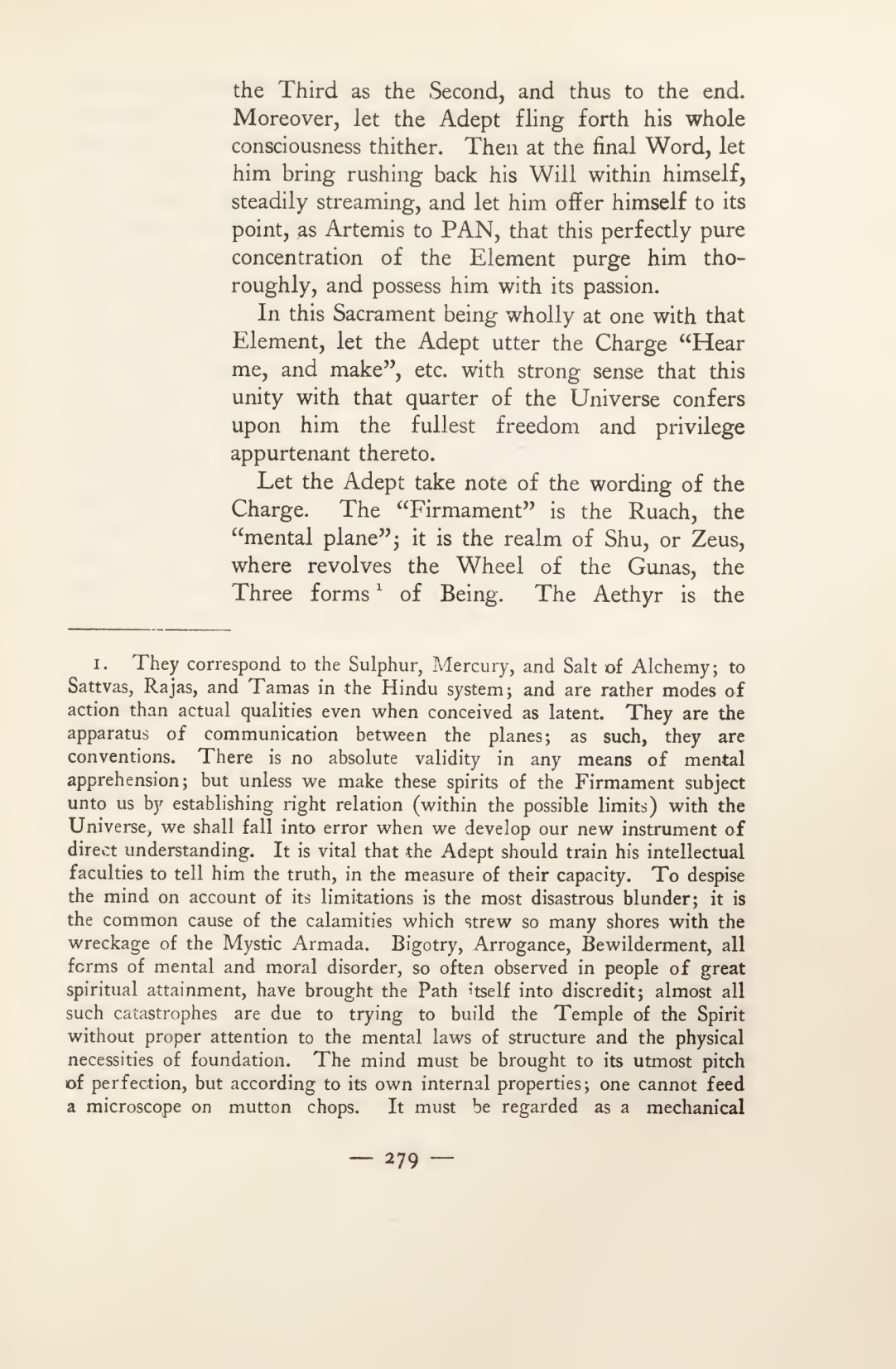
Highlights use the original PDF text layer. OCR-only matches may not be visible on the scan.
Transcription
Download text ↓raw extractionoriginal embedded textReview: unreviewed
the Third as the Second, and thus to the end.
Moreover, let the Adept fling forth his whole
consciousness thither. Then at the final Word, let
him bring rushing back his Will within himself,
steadily streaming, and let him offer himself to its
point, as Artémis to PAN, that this perfectly pure
concentration of the Elément purge him tho-
roughly, and possess him with its passion.
In this Sacrament being wholly at one with that
Elément, let the Adept utter the Charge “Hear
me, and make”, etc. with strong sense that this
unity with that quarter of the Universe confers
upon him the fullest freedom and privilège
appurtenant thereto.
Let the Adept take note of the wording of the
Charge. The “Firmament” is the Ruach, the
“mental plane” ; it is the realm of Shu, or Zeus,
where revolves the Wheel of the Gunas, the
Three forms1 of Being. The Aethyr is the
I* They correspond to the Sulphur, Mercury, and Sait of Alchemy; to
Sattvas, Rajas, and Tamas in the Hindu System; and are rather modes of
action than actual qualities even when conceived as latent. They are the
apparatus of communication between the planes; as such, they are
conventions. There is no absolute validity in any means of mental
appréhension; but unless we make these spirits of the Firmament subject
unto us by establishing right relation (within the possible limits) with the
Universe, we shall fall into error when we develop our new instrument of
direct understanding. It is vital that the Adept should train his inteilectual
faculties to tell him the truth, in the measure of their capacity. To despise
the mind on account of its limitations is the most disastrous blunder; it is
the common cause of the calamities which strew so many shores with the
wreckage of the Mystic Armada. Bigotry, Arrogance, Éewilderment, ail
fcrms of mental and moral disorder, so often observed in people of great
spiritual attainment, hâve brought the Path ’tself into discrédit; almost ail
such catastrophes are due to trying to build the Temple of the Spirit
without proper attention to the mental laws of structure and the physical
necessities of foundation. The mind must be brought to its utmost pitch
of perfection, but according to its own internai properties; one cannot feed
a microscope on mutton chops. It must be regarded as a mechanical
— 279 —
Page provenance & review flags
Stable page ID: 8716dc3e5e58c785b9453767:p00075
Line breaks are preserved. Reading order and OCR accuracy may need review.
Printed page label has not been verified.
- No automated review flags. This does not establish transcription accuracy.