1930 · CLOSE READING
Magick in Theory and Practice (Section 3)
Magick in Theory and Practice (Section 3) (1930), PDF p. 5
Original page
Enlarge ↗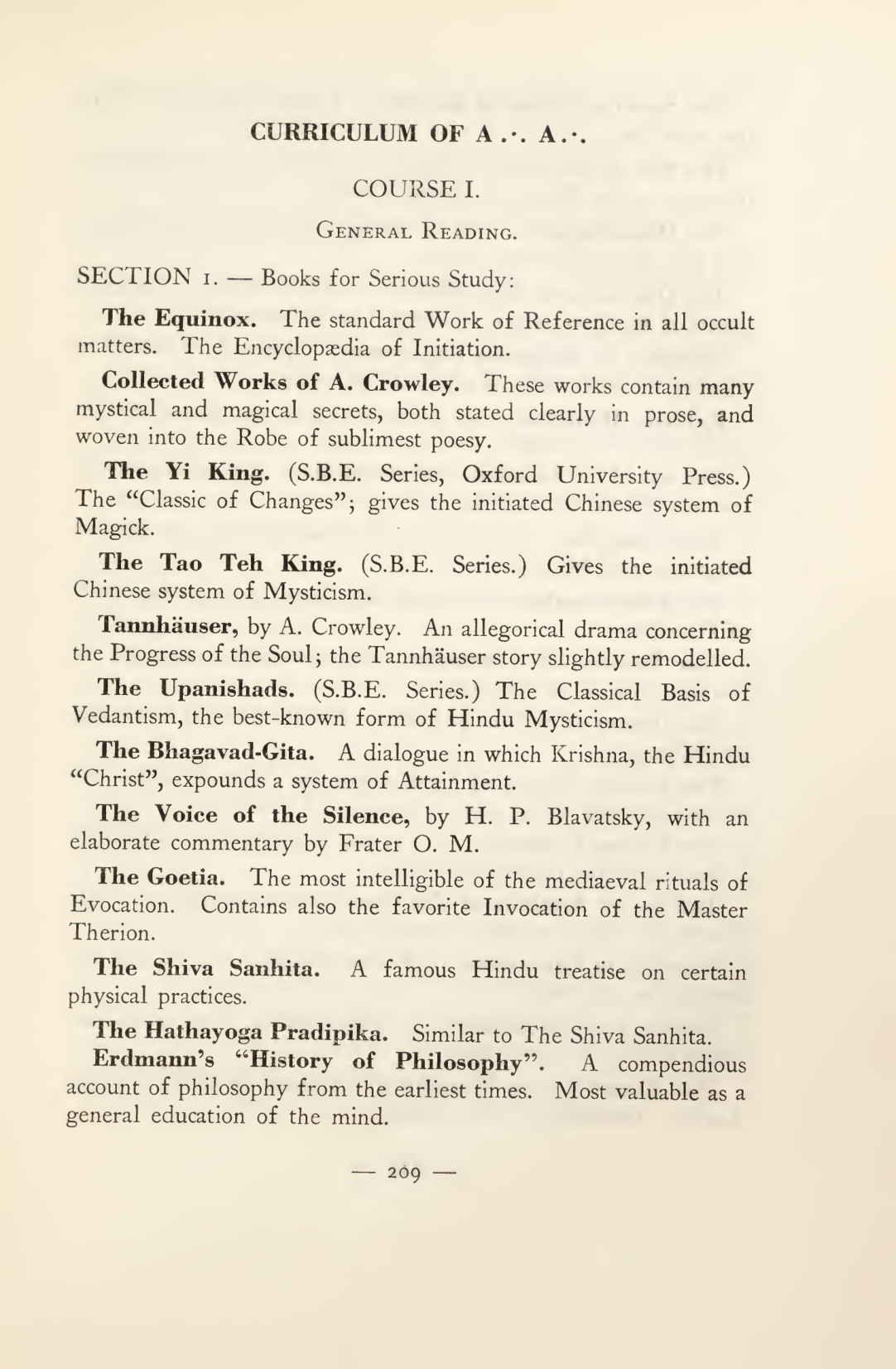
Highlights use the original PDF text layer. OCR-only matches may not be visible on the scan.
Transcription
Download text ↓raw extractionoriginal embedded textReview: unreviewed
CURRICULUM OF A A.-.
COURSE I.
General Reading.
SECTION i. — Books for Serious Study:
The Equinox. The standard Work of Reference in ail occult
matters. The Encyclopædia of Initiation.
Collectée! Works of A. Crowley. These Works contain many
mystical and magical secrets, both stated clearly in prose, and
woven into the Robe of sublimest poesy.
The Yi King. (S.B.E. Sériés, Oxford University Press.)
The “Classic of Changes”; gives the initiated Chinese System of
Magick.
The Tao Teh King. (S. B .E. Sériés.) Gives the initiated
Chinese System of Mysticism.
Fannhanser, by A. Crowley. An allegorical drama concerning
the Progress of the Soûl; the Tannhauser story slightly remodelled.
The Upanishads. (S.B.E. Sériés.) The Classical Basis of
Vedantism, the best-known form of Hindu Mysticism.
The Rhagavad-Gita. A dialogue in which Krishna, the Hindu
“Christ”, expounds a System of Attainment.
The Yoice of the Silence, by H. P. Blavatsky, with an
elaborate commentary by Frater O. M.
The Goetia. The most intelligible of the mediaeval rituals of
Evocation. Contains also the favorite Invocation of the Master
Therion.
The Shiva Sanhita. A famous Hindu treatise on certain
physical practices.
The Hathayoga Pradipika. Similar to The Shiva Sanhita.
Erdmann’s “History of Philosophy”. A compendious
account of philosophy from the earliest times. Most valuable as a
general éducation of the mind.
— 209 —
Page provenance & review flags
Stable page ID: 8716dc3e5e58c785b9453767:p00005
Line breaks are preserved. Reading order and OCR accuracy may need review.
Printed page label has not been verified.
- No automated review flags. This does not establish transcription accuracy.