1930 · CLOSE READING
Magick in Theory and Practice (Section 3)
Magick in Theory and Practice (Section 3) (1930), PDF p. 43
Original page
Enlarge ↗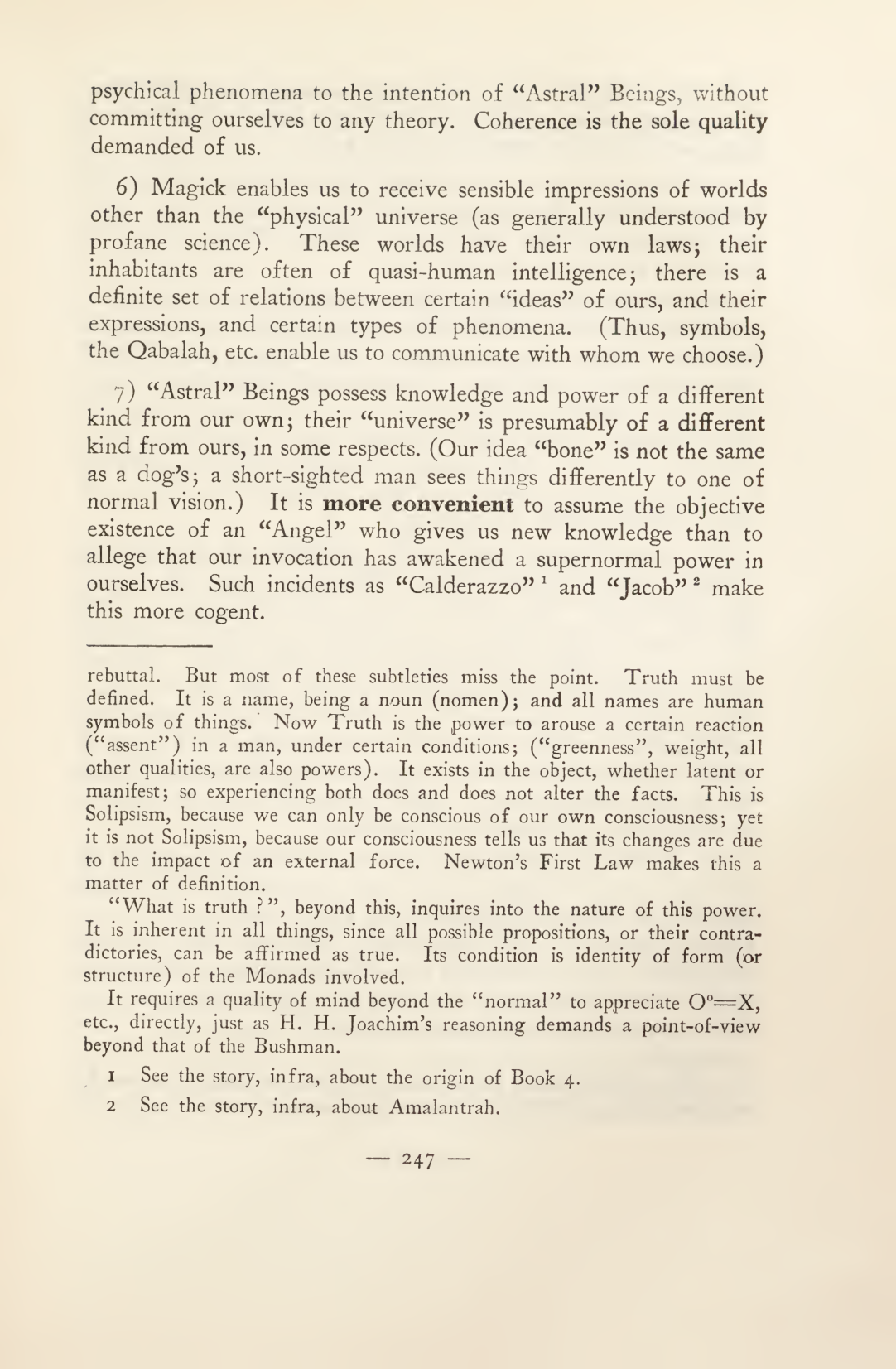
Highlights use the original PDF text layer. OCR-only matches may not be visible on the scan.
Transcription
Download text ↓raw extractionoriginal embedded textReview: unreviewed
psychical phenomena to the intention of “Astral” Beings, without
committing ourselves to any theory. Cohérence is the sole quality
demanded of us.
6) Magick enables us to receive sensible impressions of worlds
other than the “physical” universe (as generally understood by
profane science). These worlds hâve their own laws; their
inhabitants are often of quasi-human intelligence ; there is a
definite set of relations between certain “ideas” of ours, and their
expressions, and certain types of phenomena. (Thus, symbols,
the Qabalah, etc. enable us to communicate with whom we choose.)
7) “Astral” Beings possess knowledge and power of a different
kind from our own; their “universe” is presumably of a different
kind from ours, in some respects. (Our idea “bone” is not the same
as a dog’s; a short-sighted man sees things differently to one of
normal vision.) It is more convenient to assume the objective
existence of an “Angel” who gives us new knowledge than to
allégé that our invocation has awakened a supernormal power in
ourselves. Such incidents as “Calderazzo” 1 and “Jacob” 2 make
this more cogent.
rebuttal. But most of these subtleties miss the point. Truth must be
defined. It is a name, being a noun (nomen); and ail names are human
symbols of things. Now Truth is the power to arouse a certain reaction
(“assent”) in a man, under certain conditions; (“greenness”, weight, ail
other qualities, are also powers). It exists in the object, whether latent or
manifest; so experiencing both does and does not alter the facts. This is
Solipsism, because we can only be conscious of our own consciousness; yet
it is not Solipsism, because our consciousness tells us that its changes are due
to the impact of an external force. Newton’s First Law makes this a
matter of définition.
“What is truth ? ”, beyond this, inquires into the nature of this power.
It is inhérent in ail things, since ail possible propositions, or their contra-
dictories, can be affirmed as true. Its condition is identity of form (or
Structure) of the Monads involved.
It requires a quality of mind beyond the <£normal” to appreciate 0°=X,
etc., directly, just as H. H. Joachim’s reasoning demands a point-of-view
beyond that of the Bushman.
1 See the story, infra, about the origin of Book 4.
2 See the story, infra, about Amalantrah.
247
Page provenance & review flags
Stable page ID: 8716dc3e5e58c785b9453767:p00043
Line breaks are preserved. Reading order and OCR accuracy may need review.
Printed page label has not been verified.
- No automated review flags. This does not establish transcription accuracy.