1930 · CLOSE READING
Magick in Theory and Practice (Section 3)
Magick in Theory and Practice (Section 3) (1930), PDF p. 39
Original page
Enlarge ↗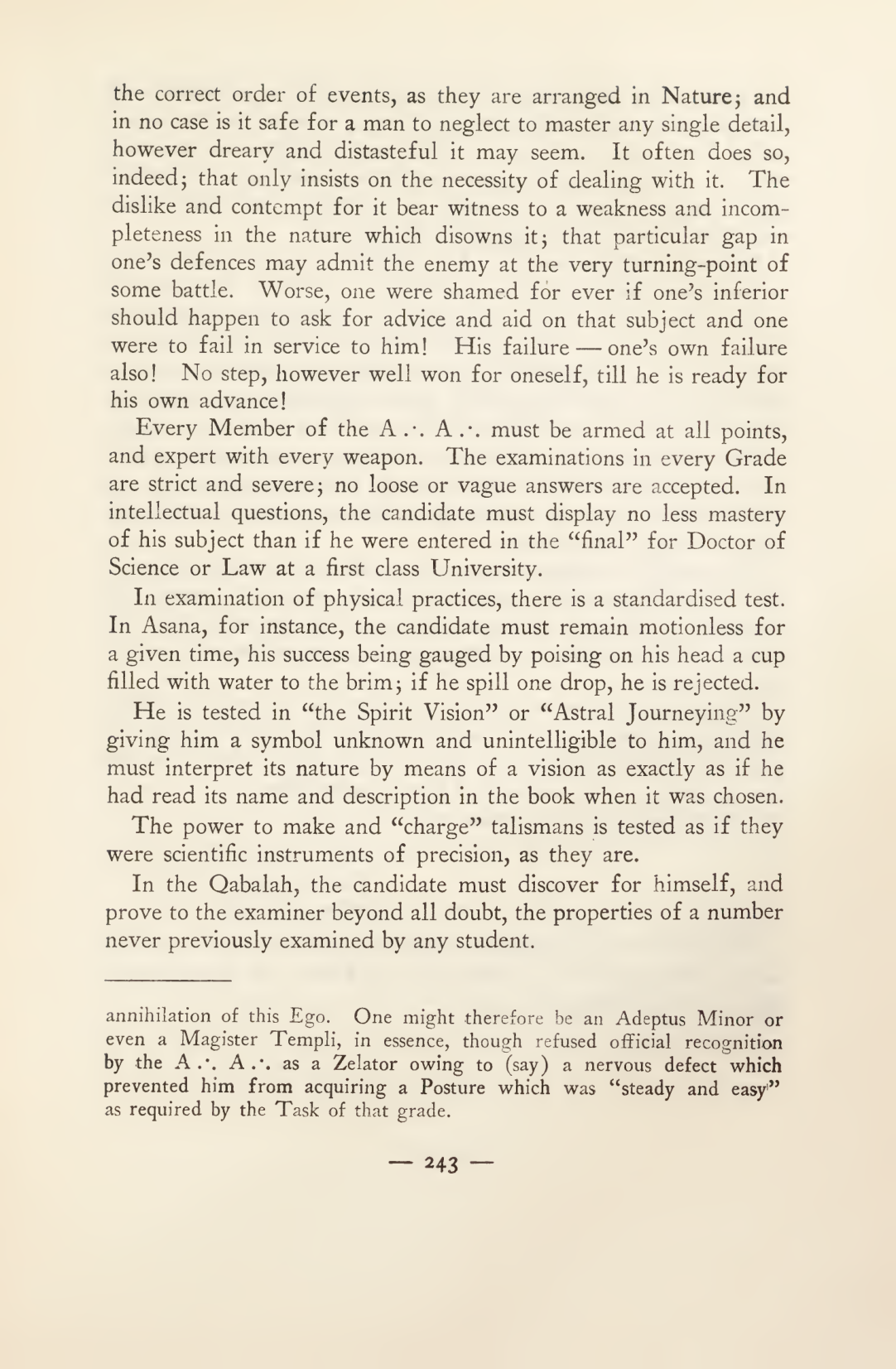
Highlights use the original PDF text layer. OCR-only matches may not be visible on the scan.
Transcription
Download text ↓raw extractionoriginal embedded textReview: unreviewed
the correct order of events, as they are arranged in Nature ; and
in no case is it safe for a man to neglect to master any single detail,
however dreary and distasteful it may seem. It often does so,
indeedj that only insists on the necessity of dealing with it. The
dislike and contempt for it bear witness to a weakness and incom-
pleteness in the nature which disowns it ; that particular gap in
one’s defences may admit the enemy at the very turning-point of
some battle. Worse, one were shamed for ever if one?s inferior
should happen to ask for advice and aid on that subject and one
were to fail in service to him! His failure — one’s own failure
also! No step, however well won for oneself, till he is ready for
his own advance!
Every Member of the A A must be armed at ail points,
and expert with every weapon. The examinations in every Grade
are strict and severej no loose or vague answers are accepted. In
inteliectual questions, the candidate must display no less mastery
of his subject than if he were entered in the “final” for Doctor of
Science or Law at a first class University.
In examination of physical practices, there is a standardised test.
In Asana, for instance, the candidate must remain motionless for
a given time, his success being gauged by poising on his head a cup
filled with water to the brim; if he spill one drop, he is rejected.
He is tested in “the Spirit Vision” or “Astral Journeying” by
giving him a symbol unknown and unintelligible to him, and he
must interpret its nature by means of a vision as exactly as if he
had read its name and description in the book when it was chosen.
The power to make and “charge” talismans is tested as if they
were scientific instruments of précision, as they are.
In the Qabalah, the candidate must discover for himself, and
prove to the examiner beyond ail doubt, the properties of a number
never previously examined by any student.
annihilation of this Ego. One might therefore be an Adeptus Minor or
even a Magister Templi, in essence, though refused official récognition
by the A A as a Zelator owing to (say) a nervous defect which
prevented him from acquiring a Posture which was “steady and easy1”
as required by the Task of that grade.
— 243
Page provenance & review flags
Stable page ID: 8716dc3e5e58c785b9453767:p00039
Line breaks are preserved. Reading order and OCR accuracy may need review.
Printed page label has not been verified.
- No automated review flags. This does not establish transcription accuracy.