1930 · CLOSE READING
Magick in Theory and Practice (Section 3)
Magick in Theory and Practice (Section 3) (1930), PDF p. 10
Original page
Enlarge ↗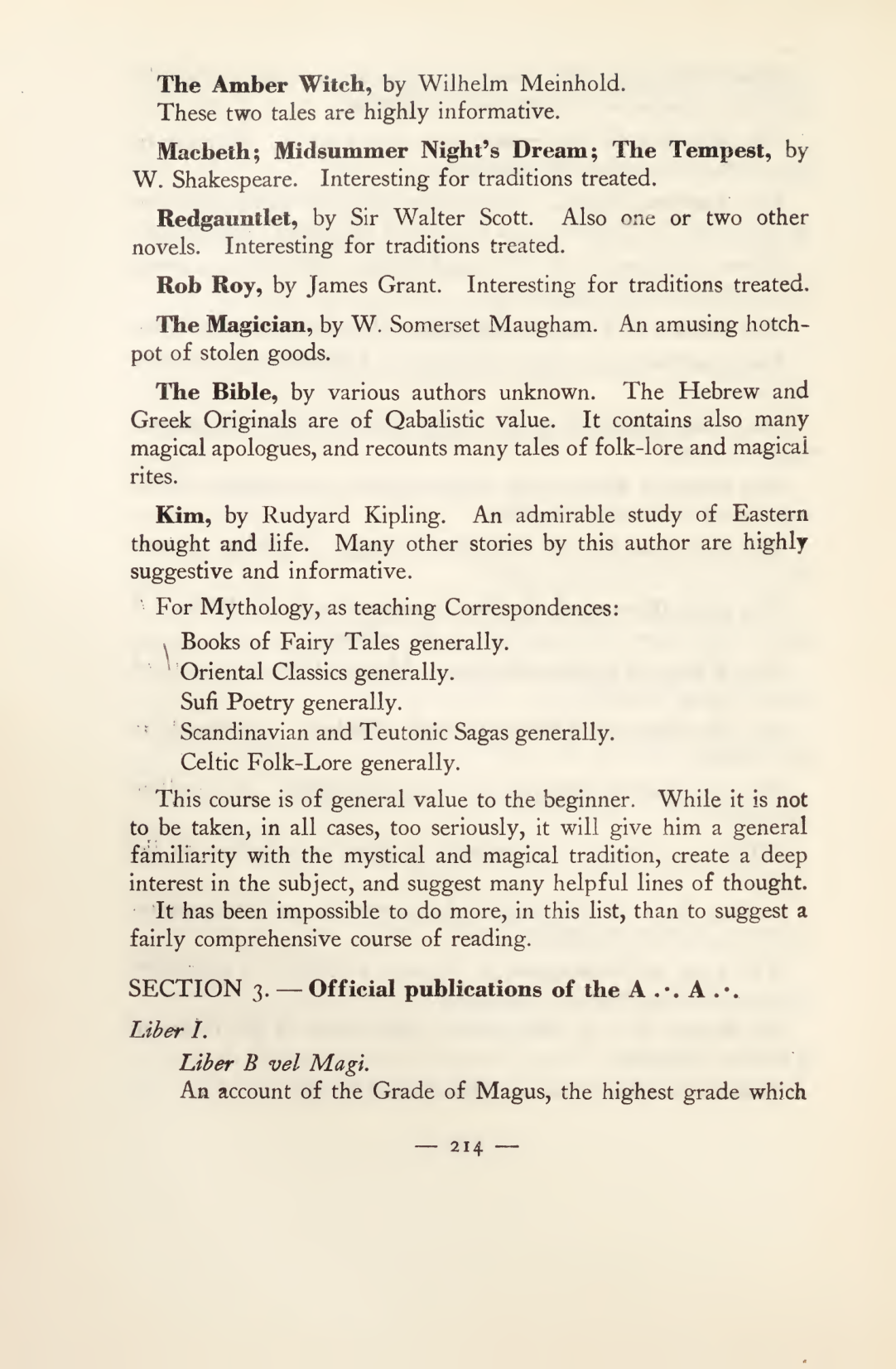
Highlights use the original PDF text layer. OCR-only matches may not be visible on the scan.
Transcription
Download text ↓raw extractionoriginal embedded textReview: unreviewed
t
The Amber Witch, by Wilhelm Meinhold.
These two taies are highly informative.
Macbeth; Midsummer Night’s Dream; The Tempest, by
W. Shakespeare. Interesting for traditions treated.
Redgaimtlet, by Sir Walter Scott. Also one or two other
novels. Interesting for traditions treated.
Rob Roy, by James Grant. Interesting for traditions treated.
The Magician, by W. Somerset Maugham. An amusing hotch-
pot of stolen goods.
The Bible, by various authors unknown. The Hebrew and
Greek Originals are of Qabalistic value. It contains also many
magical apologues, and recounts many taies of folk-lore and magical
rites.
Kim, by Rudyard Kipling. An admirable study of Eastern
thought and life. Many other stories by this author are highly
suggestive and informative.
For Mythology, as teaching Correspondences:
Books of Fairy Taies generally.
Oriental Classics generally.
Sufi Poetry generally.
' Scandinavian and Teutonic Sagas generally.
Celtic Folk-Lore generally.
This course is of general value to the beginner. While it is not
to be taken, in ail cases, too seriously, it will give him a general
fàmiliarity with the mystical and magical tradition, create a deep
interest in the subject, and suggest many helpful lines of thought.
It has been impossible to do more, in this list, than to suggest a
fairly comprehensive course of reading.
SECTION 3. — Official publications of the A A
Liber 7.
Liber B vel Magi.
An account of the Grade of Magus, the highest grade which
— 214 —
Page provenance & review flags
Stable page ID: 8716dc3e5e58c785b9453767:p00010
Line breaks are preserved. Reading order and OCR accuracy may need review.
Printed page label has not been verified.
- No automated review flags. This does not establish transcription accuracy.