1904 · CLOSE READING
Mr. Crowley and The Creeds
Mr. Crowley and The Creeds (1904), PDF p. 2
Original page
Enlarge ↗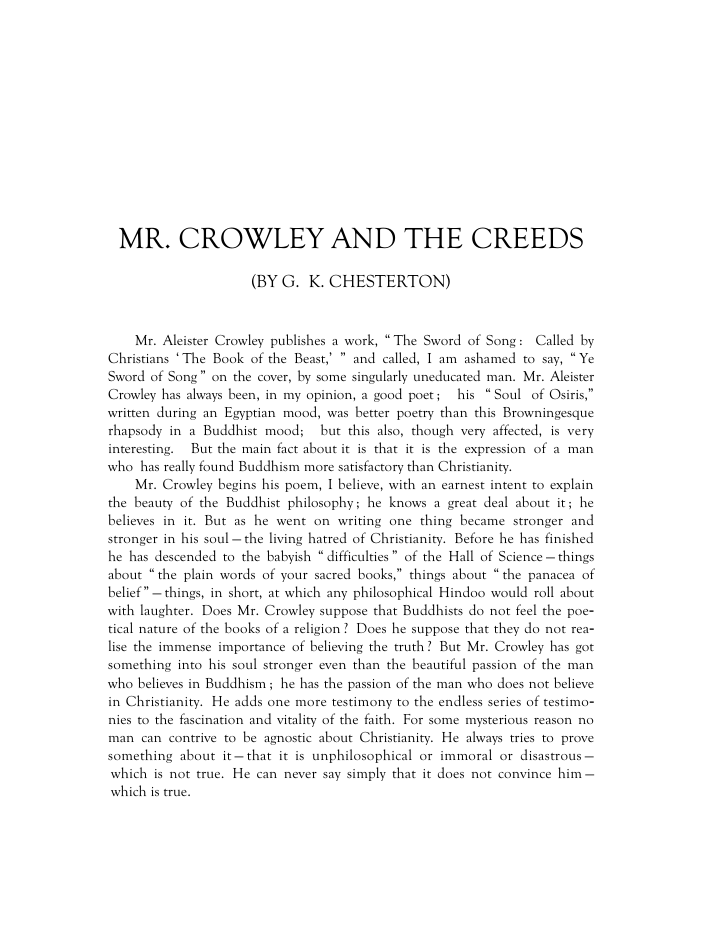
Highlights use the original PDF text layer. OCR-only matches may not be visible on the scan.
Transcription
Download text ↓raw extractionoriginal embedded textReview: unreviewed
MR. CROWLEY AND THE CREEDS
(BY G. K. CHESTERTON)
Mr. Aleister Crowley publishes a work, “ The Sword of Song : Called by
Christians ‘ The Book of the Beast,’ ” and called, I am ashamed to say, “ Ye
Sword of Song ” on the cover, by some singularly uneducated man. Mr. Aleister
Crowley has always been, in my opinion, a good poet ; his “ Soul of Osiris,”
written during an Egyptian mood, was better poetry than this Browningesque
rhapsody in a Buddhist mood ; but this also, though very affected, is very
interesting. But the main fact about it is that it is the expression of a man
who has really found Buddhism more satisfactory than Christianity.
Mr. Crowley begins his poem, I believe, with an earnest intent to explain
the beauty of the Buddhist philosophy ; he knows a great deal about it ; he
believes in it. But as he went on writing one thing became stronger and
stronger in his soul — the living hatred of Christianity. Before he has finished
he has descended to the babyish “ difficulties ” of the Hall of Science — things
about “ the plain words of your sacred books,” things about “ the panacea of
belief ” — things, in short, at which any philosophical Hindoo would roll about
with laughter. Does Mr. Crowley suppose that Buddhists do not feel the poe-
tical nature of the books of a religion ? Does he suppose that they do not rea-
lise the immense importance of believing the truth ? But Mr. Crowley has got
something into his soul stronger even than the beautiful passion of the man
who believes in Buddhism ; he has the passion of the man who does not believe
in Christianity. He adds one more testimony to the endless series of testimo-
nies to the fascination and vitality of the faith. For some mysterious reason no
man can contrive to be agnostic about Christianity. He always tries to prove
something about it — that it is unphilosophical or immoral or disastrous —
which is not true. He can never say simply that it does not convince him —
which is true.
Page provenance & review flags
Stable page ID: 841d6a149fb5a7a6368c295e:p00002
Line breaks are preserved. Reading order and OCR accuracy may need review.
Printed page label has not been verified.
- No automated review flags. This does not establish transcription accuracy.