1909 · CLOSE READING
The Equinox (Volume I, Number I)
The Equinox (Volume I, Number I) (1909), PDF p. 96
Original page
Enlarge ↗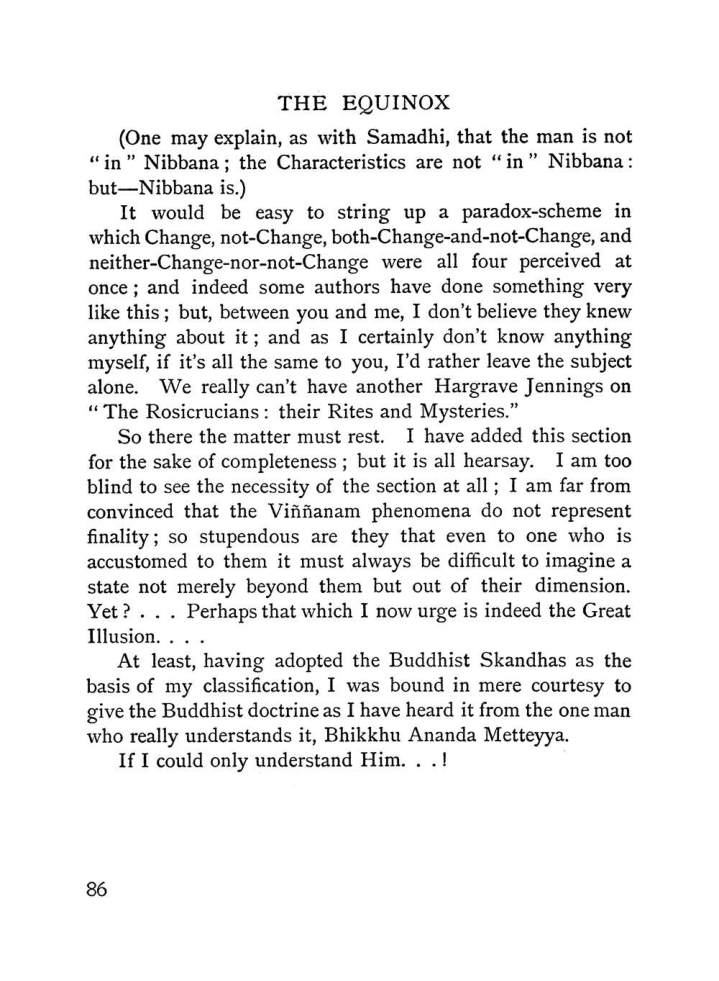
Highlights use the original PDF text layer. OCR-only matches may not be visible on the scan.
Transcription
Download text ↓raw extractionoriginal embedded textReview: unreviewed
THE EQUINOX
(One may explain, as with Samadhi, that the man is not
“in” Nibbana; the Characteristics are not “in” Nibbana:
but—Nibbana is.)
It would be easy to string up a paradox-scheme in
which Change, not-Change, both-Change-and-not-Change, and
neither-Change-nor-not-Change were all four perceived at
once; and indeed some authors have done something very
like this; but, between you and me, I don’t believe they knew
anything about it; and as I certainly don’t know anything
myself, if it’s all the same to you, I’d rather leave the subject
alone. We really can’t have another Hargrave Jennings on
“The Rosicrucians: their Rites and Mysteries.”
So there the matter must rest. I have added this section
for the sake of completeness ; but it is all hearsay. I am too
blind to see the necessity of the section at all; I am far from
convinced that the Vififianam phenomena do not represent
finality; so stupendous are they that even to one who is
accustomed to them it must always be difficult to imagine a
state not merely beyond them but out of their dimension.
Yet? ... Perhaps that which I now urge is indeed the Great
Illusion. . . .
At least, having adopted the Buddhist Skandhas as the
basis of my classification, I was bound in mere courtesy to
give the Buddhist doctrine as I have heard it from the one man
who really understands it, Bhikkhu Ananda Metteyya.
IfI could only understand Him. . .!
86
Page provenance & review flags
Stable page ID: 7a1ccfa408b1d9012e23c50d:p00096
Line breaks are preserved. Reading order and OCR accuracy may need review.
Printed page label has not been verified.
- No automated review flags. This does not establish transcription accuracy.