1909 · CLOSE READING
The Equinox (Volume I, Number I)
The Equinox (Volume I, Number I) (1909), PDF p. 75
Original page
Enlarge ↗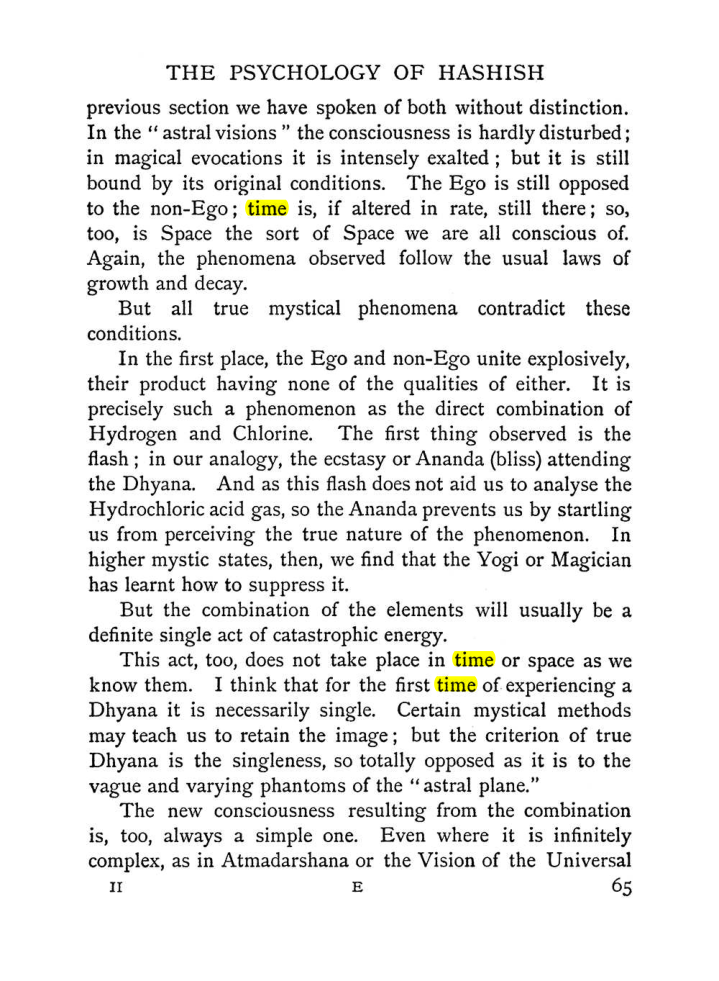
Highlights use the original PDF text layer. OCR-only matches may not be visible on the scan.
Transcription
Download text ↓raw extractionoriginal embedded textReview: unreviewed
THE PSYCHOLOGY OF HASHISH
previous section we have spoken of both without distinction.
In the “astral visions ” the consciousness is hardly disturbed;
in magical evocations it is intensely exalted; but it is still
bound by its original conditions. The Ego is still opposed
to the non-Ego; time is, if altered in rate, still there; so,
too, is Space the sort of Space we are all conscious of.
Again, the phenomena observed follow the usual laws of
growth and decay.
But all true mystical phenomena contradict these
conditions.
In the first place, the Ego and non-Ego unite explosively,
their product having none of the qualities of either. It is
precisely such a phenomenon as the direct combination of
Hydrogen and Chlorine. The first thing observed is the
flash; in our analogy, the ecstasy or Ananda (bliss) attending
the Dhyana. And as this flash does not aid us to analyse the
Hydrochloric acid gas, so the Ananda prevents us by startling
us from perceiving the true nature of the phenomenon. In
higher mystic states, then, we find that the Yogi or Magician
has learnt how to suppress it.
But the combination of the elements will usually be a
definite single act of catastrophic energy.
This act, too, does not take place in time or space as we
know them. I think that for the first time of experiencing a
Dhyana it is necessarily single. Certain mystical methods
may teach us to retain the image; but the criterion of true
Dhyana is the singleness, so totally opposed as it is to the
vague and varying phantoms of the “astral plane.”
The new consciousness resulting from the combination
is, too, always a simple one. Even where it is infinitely
complex, as in Atmadarshana or the Vision of the Universal
II E 65
Page provenance & review flags
Stable page ID: 7a1ccfa408b1d9012e23c50d:p00075
Line breaks are preserved. Reading order and OCR accuracy may need review.
Printed page label has not been verified.
- No automated review flags. This does not establish transcription accuracy.