1909 · CLOSE READING
The Equinox (Volume I, Number I)
The Equinox (Volume I, Number I) (1909), PDF p. 53
Original page
Enlarge ↗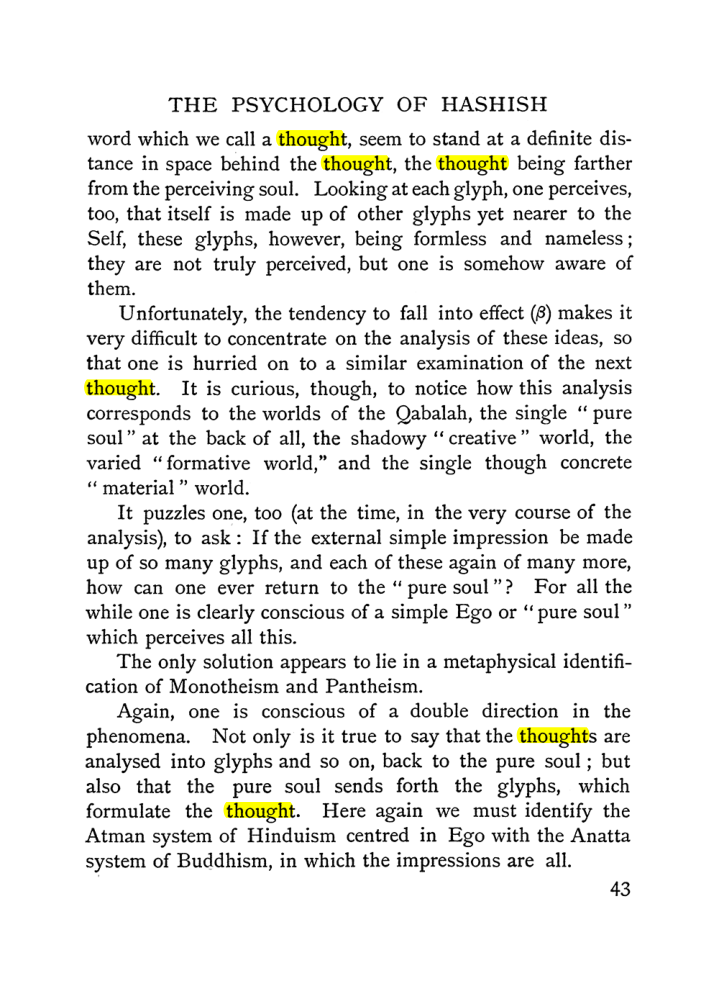
Highlights use the original PDF text layer. OCR-only matches may not be visible on the scan.
Transcription
Download text ↓raw extractionoriginal embedded textReview: unreviewed
THE PSYCHOLOGY OF HASHISH
word which we call a thought, seem to stand at a definite dis-
tance in space behind the thought, the thought being farther
from the perceiving soul. Looking at each glyph, one perceives,
too, that itself is made up of other glyphs yet nearer to the
Self, these glyphs, however, being formless and nameless;
they are not truly perceived, but one is somehow aware of
them.
Unfortunately, the tendency to fall into effect (6) makes it
very difficult to concentrate on the analysis of these ideas, so
that one is hurried on to a similar examination of the next
thought. It is curious, though, to notice how this analysis
corresponds to the worlds of the Qabalah, the single ‘“ pure
soul” at the back of all, the shadowy “creative” world, the
varied “formative world,” and the single though concrete
“ material ” world.
It puzzles one, too (at the time, in the very course of the
analysis), to ask: If the external simple impression be made
up of so many glyphs, and each of these again of many more,
how can one ever return to the “ pure soul”? For all the
while one is clearly conscious of a simple Ego or “ pure soul”
which perceives all this.
The only solution appears to lie in a metaphysical identifi-
cation of Monotheism and Pantheism.
Again, one is conscious of a double direction in the
phenomena. Not only is it true to say that the thoughts are
analysed into glyphs and so on, back to the pure soul; but
also that the pure soul sends forth the glyphs, which
formulate the thought. Here again we must identify the
Atman system of Hinduism centred in Ego with the Anatta
system of Buddhism, in which the impressions are all.
43
Page provenance & review flags
Stable page ID: 7a1ccfa408b1d9012e23c50d:p00053
Line breaks are preserved. Reading order and OCR accuracy may need review.
Printed page label has not been verified.
- No automated review flags. This does not establish transcription accuracy.