1909 · CLOSE READING
The Equinox (Volume I, Number I)
The Equinox (Volume I, Number I) (1909), PDF p. 411
Original page
Enlarge ↗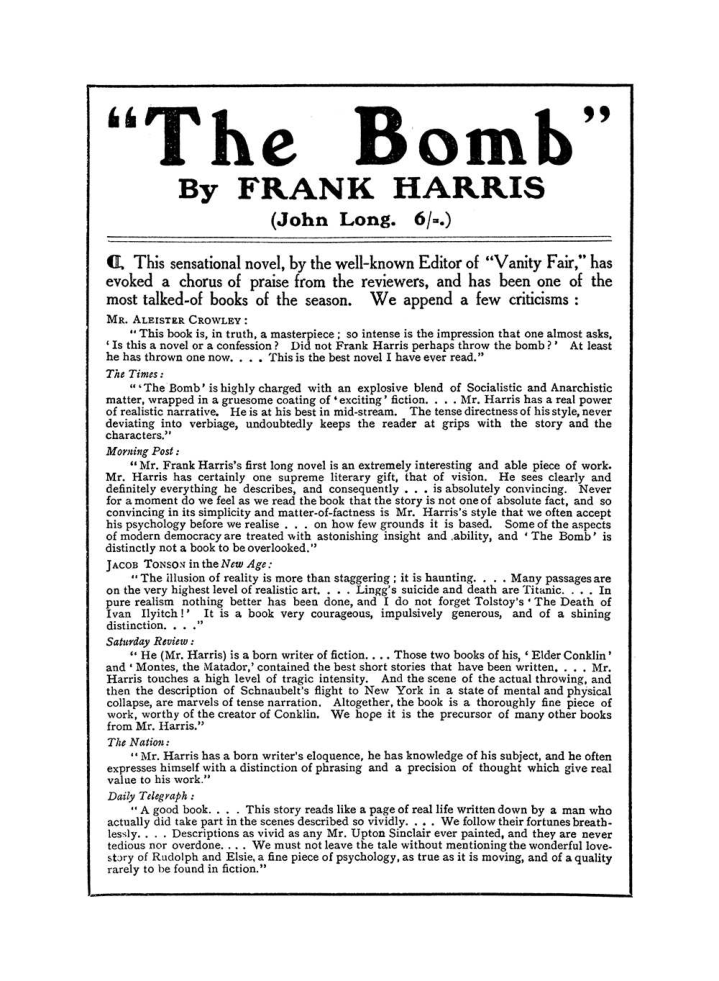
Highlights use the original PDF text layer. OCR-only matches may not be visible on the scan.
Transcription
Download text ↓raw extractionoriginal embedded textReview: unreviewed
“The Bomb’
By FRANK HARRIS
(John Long. 6/:.)
G, This sensational novel, by the well-known Editor of “Vanity Fair,” has
evoked a chorus of praise from the reviewers, and has been one of the
most talked-of books of the season. We append a few criticisms :
Mr. ALeIster CROWLEY:
“ This book is, in truth, a masterpiece ; so intense is the impression that one almost asks,
‘Is this a novel or a confession? Did not Frank Harris perhaps throw the bomb?’ At least
he has thrown one now. . . . This is the best novel I have ever read.”
The Times:
“*The Bomb’ is highly charged with an explosive blend of Socialistic and Anarchistic
matter, wrapped in a gruesome coating of ‘exciting’ fiction. . . . Mr. Harris has a real power
of realistic narrative, He is at his best in mid-stream, The tense directness of his style, never
deviating into verbiage, undoubtedly keeps the reader at grips with the story and the
characters.”"
Morning Post:
“Mr, Frank Harris’s first long novel is an extremely interesting and able piece of work.
Mr. Harris has certainly one supreme literary gift, that of vision. He sees clearly and
definitely everything he describes, and consequently . . . is absolutely convincing. Never
for a moment do we feel as we read the book that the story is not one of absolute fact, and so
convincing in its simplicity and matter-of-factness is Mr. Harris's style that we often accept
his psychology before we realise. . . on how few grounds it is based. Some of the aspects
of modern democracy are treated with astonishing insight and .ability, and ‘The Bomb’ is
distinctly not a book to be overlooked.””
Jacos Tonsow inthe New Age:
«The illusion of reality is more than staggering; it is haunting. . . . Many passagesare
on the very highest level of realistic art. . . . Lingg’s suicide and death are Titanic. In
pure realism nothing better has been done, and I do not forget Tolstoy’s ‘ The De: of
Ivan Ilyitch!’ It is a book very courageous, impulsively generous, and of a shining
distinction. . . .”
Saturday Review :
“ He (Mr, Harris) is a born writer of fiction, ...Those two books of his, ‘ Elder Conklin’
and ‘ Montes, the Matador,’ contained the best short stories that have been written, .. . Mr.
Harris touches a high level of tragic intensity. And the scene of the actual throwing, and
then the description of Schnaubelt's flight to New York in a state of mental and physical
collapse, are marvels of tense narration, Altogether, the book is a thoroughly fine piece of
work, worthy of the creator of Conklin. We hope it is the precursor of many other books
from Mr. Harris.”
The Nation:
«Mr. Harris has a born writer's eloquence, he has knowledge of his subject, and he often
expresses himself with a distinction of phrasing and a precision of thought which give real
value to his work.”
Daily Telegraph :
"A good book. . . . This story reads like a page of real life written down by a man who
actually did take part in the scenes described so vividly. . . . We follow their fortunes breath-
lessly. . . . Descriptions as vivid as any Mr. Upton Sinclair ever painted, and they are never
tedious nor overdone. .. . We must not leave the tale without mentioning
the wonderful love-
story of Rudolph and Eisie,a fine piece of psychology, as true as it is moving, and of a quality
rarély to be found in fiction.”
Page provenance & review flags
Stable page ID: 7a1ccfa408b1d9012e23c50d:p00411
Line breaks are preserved. Reading order and OCR accuracy may need review.
Printed page label has not been verified.
- No automated review flags. This does not establish transcription accuracy.