1909 · CLOSE READING
The Equinox (Volume I, Number I)
The Equinox (Volume I, Number I) (1909), PDF p. 394
Original page
Enlarge ↗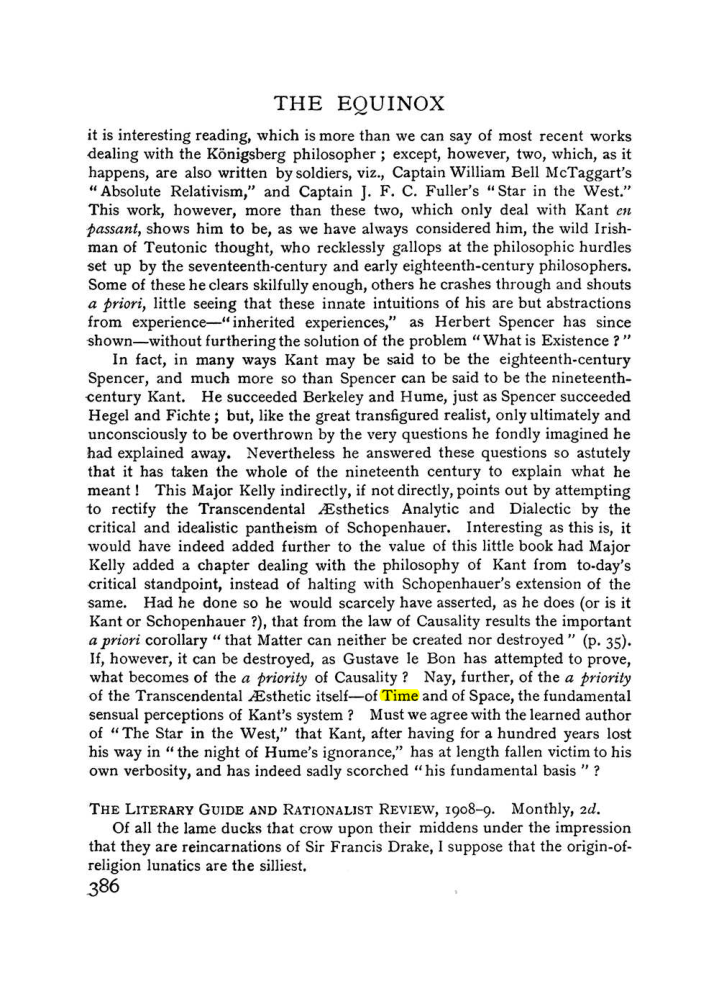
Highlights use the original PDF text layer. OCR-only matches may not be visible on the scan.
Transcription
Download text ↓raw extractionoriginal embedded textReview: unreviewed
THE EQUINOX
it is interesting reading, which is more than we can say of most recent works
dealing with the Kénigsberg philosopher; except, however, two, which, as it
happens, are also written by soldiers, viz., Captain William Bell McTaggart’s
“Absolute Relativism,” and Captain J. F. C. Fuller’s “Star in the West.”
This work, however, more than these two, which only deal with Kant en
passant, shows him to be, as we have always considered him, the wild Irish-
man of Teutonic thought, who recklessly gallops at the philosophic hurdles
set up by the seventeenth-century and early eighteenth-century philosophers,
Some of these he clears skilfully enough, others he crashes through and shouts
@ priori, little seeing that these innate intuitions of his are but abstractions
from experience—‘ inherited experiences,” as Herbert Spencer has since
shown—without furthering the solution of the problem “ What is Existence ?”
In fact, in many ways Kant may be said to be the eighteenth-century
Spencer, and much more so than Spencer can be said to be the nineteenth-
century Kant. He succeeded Berkeley and Hume, just as Spencer succeeded
Hegel and Fichte ; but, like the great transfigured realist, only ultimately and
unconsciously to be overthrown by the very questions he fondly imagined he
had explained away. Nevertheless he answered these questions so astutely
that it has taken the whole of the nineteenth century to explain what he
meant! This Major Kelly indirectly, if not directly, points out by attempting
to rectify the Transcendental A®sthetics Analytic and Dialectic by the
critical and idealistic pantheism of Schopenhauer. Interesting as this is, it
would have indeed added further to the value of this little book had Major
Kelly added a chapter dealing with the philosophy of Kant from to-day’s
critical standpoint, instead of halting with Schopenhauer’s extension of the
same, Had he done so he would scarcely have asserted, as he does (or is it
Kant or Schopenhauer ?), that from the law of Causality results the important
a priori corollary “ that Matter can neither be created nor destroyed” (p. 35).
If, however, it can be destroyed, as Gustave le Bon has attempted to prove,
what becomes of the a priority of Causality? Nay, further, of the a priority
of the Transcendental Esthetic itself{—of Time and of Space, the fundamental
sensual perceptions of Kant’s system ? Must we agree with the learned author
of “The Star in the West,” that Kant, after having for a hundred years lost
his way in “the night of Hume’s ignorance,” has at length fallen victim to his
own verbosity, and has indeed sadly scorched “his fundamental basis ” ?
THE LITERARY GUIDE AND RATIONALIST REVIEW, 1908-9. Monthly, 2d.
Of all the lame ducks that crow upon their middens under the impression
that they are reincarnations of Sir Francis Drake, I suppose that the origin-of-
religion lunatics are the silliest,
386
Page provenance & review flags
Stable page ID: 7a1ccfa408b1d9012e23c50d:p00394
Line breaks are preserved. Reading order and OCR accuracy may need review.
Printed page label has not been verified.
- No automated review flags. This does not establish transcription accuracy.