1909 · CLOSE READING
The Equinox (Volume I, Number I)
The Equinox (Volume I, Number I) (1909), PDF p. 306
Original page
Enlarge ↗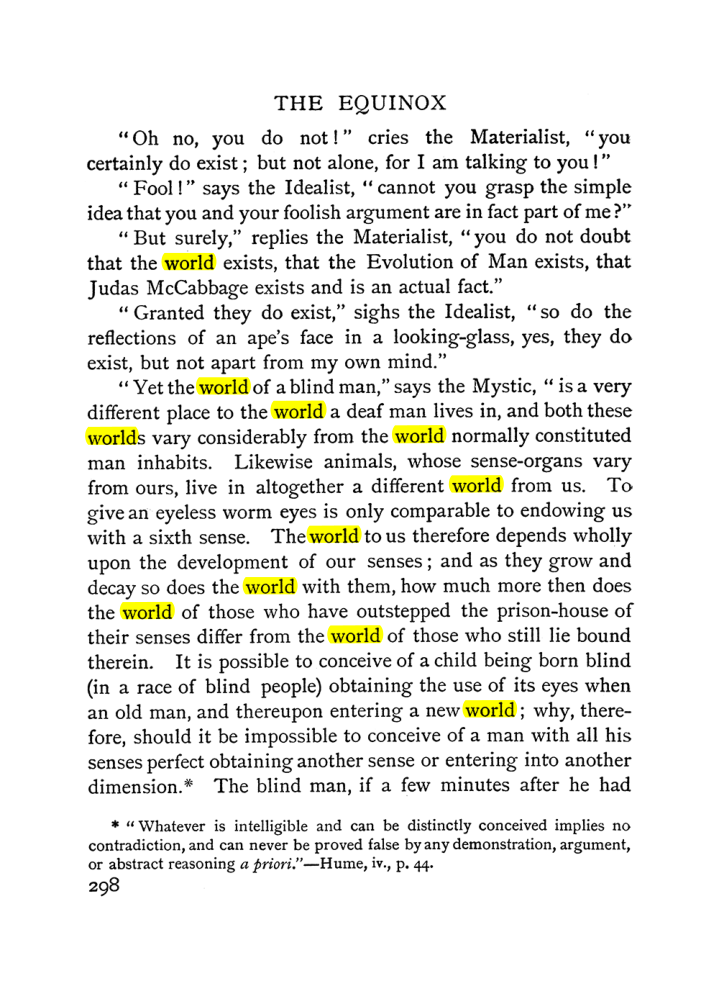
Highlights use the original PDF text layer. OCR-only matches may not be visible on the scan.
Transcription
Download text ↓raw extractionoriginal embedded textReview: unreviewed
THE EQUINOX
“Oh no, you do not!” cries the Materialist, “you
certainly do exist; but not alone, for I am talking to you!”
“Fool!” says the Idealist, ‘cannot you grasp the simple
idea that you and your foolish argument are in fact part of me?”
“But surely,” replies the Materialist, “you do not doubt
that the world exists, that the Evolution of Man exists, that
Judas McCabbage exists and is an actual fact.”
“Granted they do exist,” sighs the Idealist, “‘so do the
reflections of an ape’s face in a looking-glass, yes, they do
exist, but not apart from my own mind.”
“ Yet the world of a blind man,” says the Mystic, “isa very
different place to the world a deaf man lives in, and both these
worlds vary considerably from the world normally constituted
man inhabits. Likewise animals, whose sense-organs vary
from ours, live in altogether a different world from us. To
give an eyeless worm eyes is only comparable to endowing us
with a sixth sense. The world tous therefore depends wholly
upon the development of our senses; and as they grow and
decay so does the world with them, how much more then does
the world of those who have outstepped the prison-house of
their senses differ from the world of those who still lie bound
therein. It is possible to conceive of a child being born blind
(in a race of blind people) obtaining the use of its eyes when
an old man, and thereupon entering a new world; why, there-
fore, should it be impossible to conceive of a man with all his
senses perfect obtaining another sense or entering into another
dimension.* The blind man, if a few minutes after he had
* “Whatever is intelligible and can be distinctly conceived implies no
contradiction, and can never be proved false by any demonstration, argument,
or abstract reasoning a priori.” —Hume, iv., p. 44.
298
Page provenance & review flags
Stable page ID: 7a1ccfa408b1d9012e23c50d:p00306
Line breaks are preserved. Reading order and OCR accuracy may need review.
Printed page label has not been verified.
- No automated review flags. This does not establish transcription accuracy.