1930 · CLOSE READING
Magick in Theory and Practice (Section 4)
Magick in Theory and Practice (Section 4) (1930), PDF p. 39
Original page
Enlarge ↗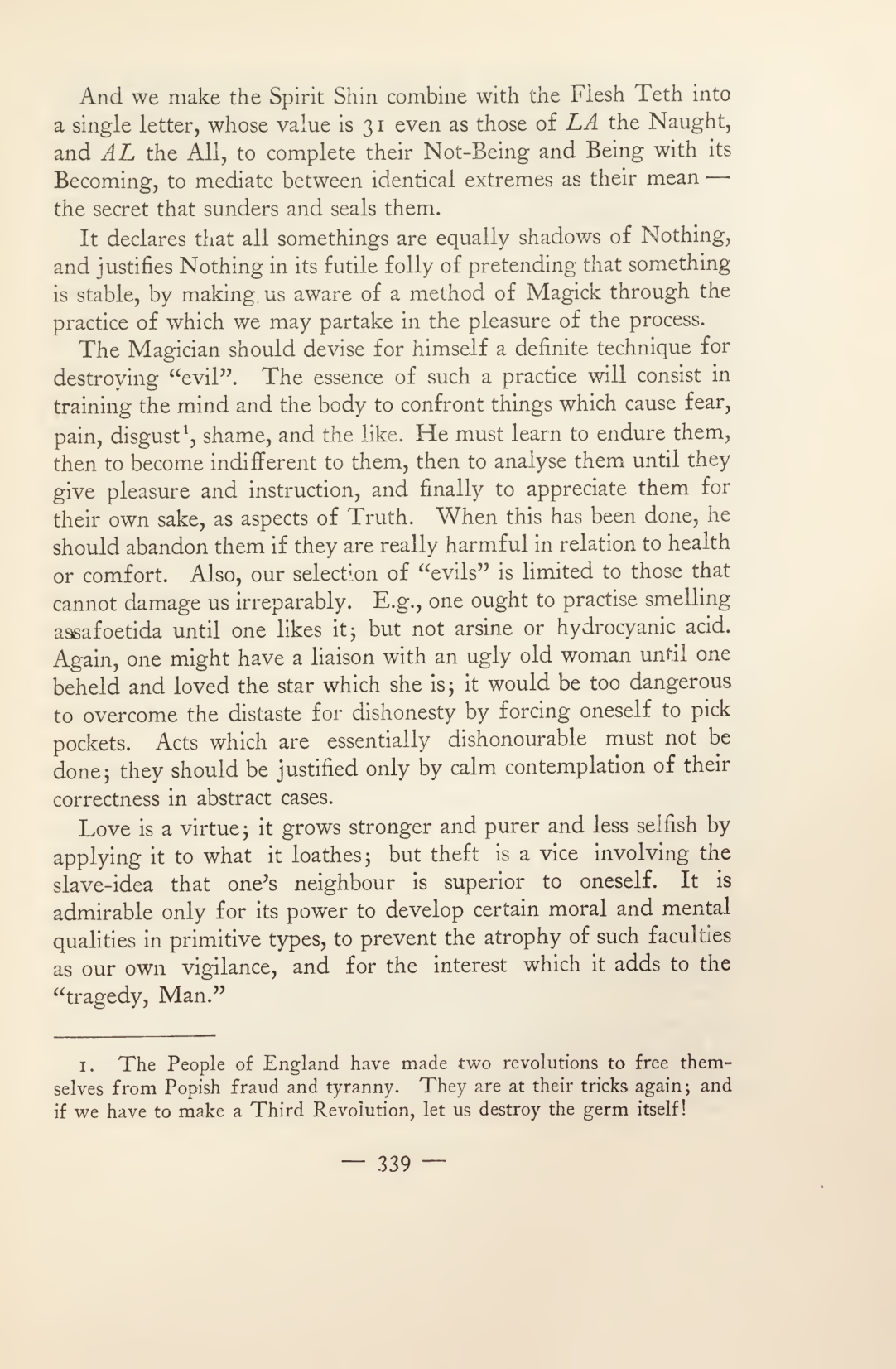
Highlights use the original PDF text layer. OCR-only matches may not be visible on the scan.
Transcription
Download text ↓raw extractionoriginal embedded textReview: unreviewed
And we make the Spirit Shin combine with the Flesh Teth into
a single letter, whose value is 31 even as those of LA the Naught,
and AL the Ail, to complété their Not-Being and Being with its
Becoming, to médiate between identical extremes as their mean —
the secret that sunders and seals them.
It déclarés that ail somethings are equally shadows of Mothing,
and justifies Nothing in its futile folly of pretending that something
is stable, by making us aware of a method of Magick through the
practice of which we may partake in the pleasure of the process.
The Magician should devise for himself a definite technique for
destroving “evil”. The essence of such a practice will consist in
training the mind and the body to confront things which cause fear,
pain, disgust1, shame, and the like. He must learn to endure them,
then to become indifferent to them, then to analyse them until they
give pleasure and instruction, and finally to appreciate them for
their own sake, as aspects of Truth. When this has been done, he
should abandon them if they are really harmful in relation to health
or comfort. Also, our sélection of “evils” is limited to those that
cannot damage us irreparably. E.g., 011e ought to practise smelling
assafoetida until one likes it ; but not arsine or hydrocyanic acid.
Again, one might hâve a liaison with an ugly old woman until one
beheld and loved the star which she is; it would be too dangerous
to overcome the distaste for dishonesty by forcing oneself to pick
pockets. Acts which are essentially dishonourable must not be
done; they should be justified only by calm contemplation of their
correctness in abstract cases.
Love is a virtue; it grows stronger and purer and less seifish by
applying it to what it loathes; but theft is a vice involving the
slave-idea that one’s neighbour is superior to oneself. It is
admirable only for its power to develop certain moral and mental
qualities in primitive types, to prevent the atrophy of such facultés
as our own vigilance, and for the interest which it adds to the
“tragedy, Man.”
1. The People of England hâve made two révolutions to free them-
selves from Popish fraud and tyranny. They are at their tricks again; and
if we hâve to make a Third Révolution, let us destroy the germ itself !
— 339
Page provenance & review flags
Stable page ID: 7753951376af2a884c0b63fa:p00039
Line breaks are preserved. Reading order and OCR accuracy may need review.
Printed page label has not been verified.
- No automated review flags. This does not establish transcription accuracy.