1902 · CLOSE READING
Tannhäuser
Tannhäuser (1902), PDF p. 14
Original page
Enlarge ↗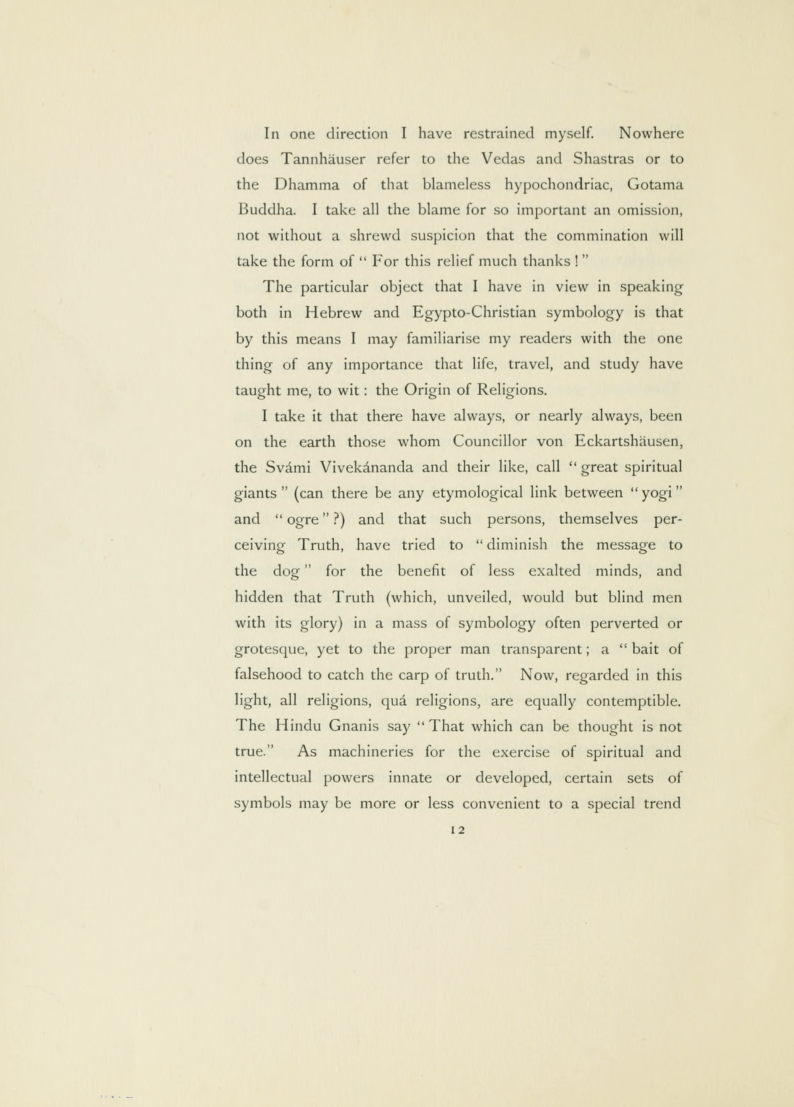
Highlights use the original PDF text layer. OCR-only matches may not be visible on the scan.
Transcription
Download text ↓raw extractionoriginal embedded textReview: unreviewed
In
one
direction
I
have
restrained
myself.
Nowhere
does
Tannhauser
refer
to
the
Vedas
and
Shastras
or
to
the
Dhamma
of
that
blameless
hypochondriac,
Gotama
Buddha.
I take
all
the
blame
for so important
an omission,
not
without
a
shrewd
suspicion
that
the
commination
will
take the form of " For this relief much thanks ! "
The particular
object
that
I
have
in
view
in
speaking
both
in
Hebrew
and
Egypto-Christian
symbology
is
that
by
this
means
I
may
familiarise
my
readers
with
the
one
thing
of
any
importance
that
life,
travel,
and study
have
taught me, to wit : the Origin of Religions.
I take it that
there
have
always,
or nearly
always,
been
on
the
earth
those
whom
Councillor
von
Eckartshausen,
the
Svdmi
Vivekdnanda
and
their like, call " great spiritual
giants" (can
there
be any etymological
link
between
"yogi"
and
" ogre
"
?)
and
that
such
persons,
themselves
per-
ceiving
Truth,
have
tried
to
" diminish
the
message
to
the
dog
"
for
the
benefit
of
less
exalted
minds,
and
hidden
that
Truth
(which,
unveiled,
would
but
blind
men
with
its glory)
in
a
mass
of symbology
often
perverted or
grotesque,
yet
to
the
proper
man
transparent ;
a
" bait of
falsehood to catch
the carp of truth."
Now,
regarded in this
light,
all
religions,
qud
religions,
are
equally
contemptible.
The
Hindu Gnanis
say "That which can
be thought
is not
true."
As
machineries
for
the
exercise
of
spiritual
and
intellectual
powers
innate
or
developed,
certain
sets
of
symbols may be
more
or less
convenient
to
a
special
trend
12
Page provenance & review flags
Stable page ID: 7646d0b2ad39d4a05a1a3694:p00014
Line breaks are preserved. Reading order and OCR accuracy may need review.
Printed page label has not been verified.
- No automated review flags. This does not establish transcription accuracy.