1930 · CLOSE READING
Magick in Theory and Practice (Section 2)
Magick in Theory and Practice (Section 2) (1930), PDF p. 81
Original page
Enlarge ↗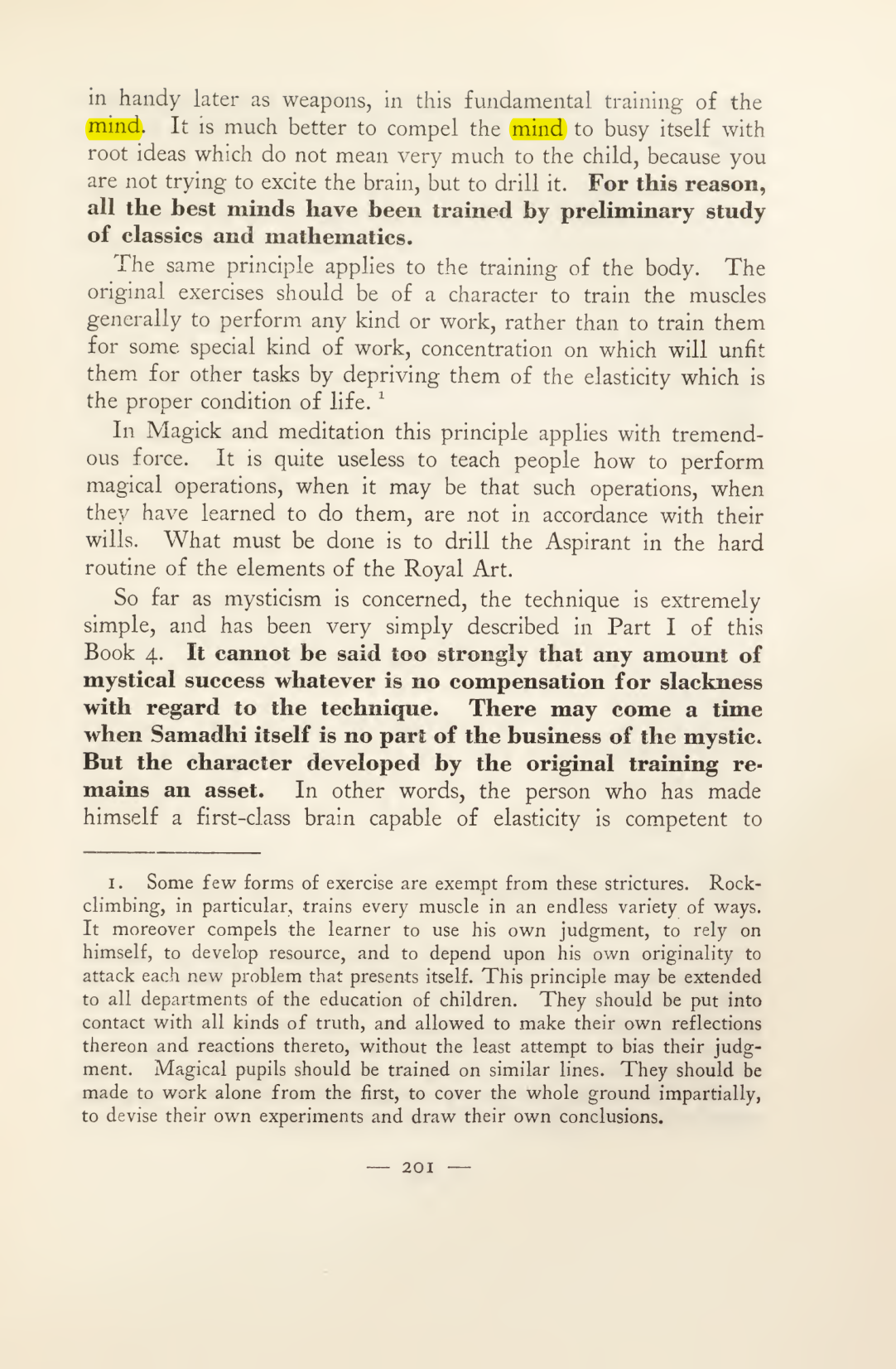
Highlights use the original PDF text layer. OCR-only matches may not be visible on the scan.
Transcription
Download text ↓raw extractionoriginal embedded textReview: unreviewed
in handy later as weapons, in this fundamental training of the
mind. It îs much better to compel the mind to busy itself with
root ideas which do not mean very much to the child, because you
are not trying to excite the brain, but to drill it. For this reason,
ail the hest mincis liave been trained by preliminary study
of classics and mathematics.
The same principle applies to the training of the body. The
original exercises should be of a character to train the muscles
generally to perform any kind or work, rather than to train them
for some spécial kind of work, concentration on which will unfit
them for other tasks by depriving them of the elasticity which is
the proper condition of life. 1
In Magick and méditation this principle applies with tremend-
ous force. It is quite useless to teach people how to perform
magical operations, when it may be that such operations, when
thev hâve learned to do them, are not in accordance with their
wills. What must be done is to drill the Aspirant in the hard
routine of the éléments of the Royal Art.
So far as mysticism is concerned, the technique is extremely
simple, and has been very simply described in Part I of this
Book 4. It cannot be said too strongly that any amouni of
mystical success whatever is 110 compensation for slackness
with regard to the technique. There may corne a time
when Samadhi itself is no part of the business of the mystic.
But the character developed by the original training re¬
mains an asset. In other words, the person who has made
himself a first-class brain capable of elasticity is competent to
1. Some few forms of exercise are exempt from these strictures. Rock-
climbing, in particular, trains every muscle in an endless variety of ways.
It moreover compels the learner to use his own judgment, to rely on
himself, to develop resource, and to dépend upon his own originality to
attack each new problem that présents itself. This principle may be extended
to ail departments of the éducation of children. They should be put into
contact with ail kinds of truth, and allowed to make their own reflections
thereon and reactions thereto, without the least attempt to bias their judg¬
ment. Magical pupils should be trained on similar lines. They should be
made to work alone from the first, to cover the whole ground impartially,
to devise their own experiments and draw their own conclusions.
201
Page provenance & review flags
Stable page ID: 7225bbab6d2ac2a8268d8bdd:p00081
Line breaks are preserved. Reading order and OCR accuracy may need review.
Printed page label has not been verified.
- No automated review flags. This does not establish transcription accuracy.