1930 · CLOSE READING
Magick in Theory and Practice (Section 2)
Magick in Theory and Practice (Section 2) (1930), PDF p. 75
Original page
Enlarge ↗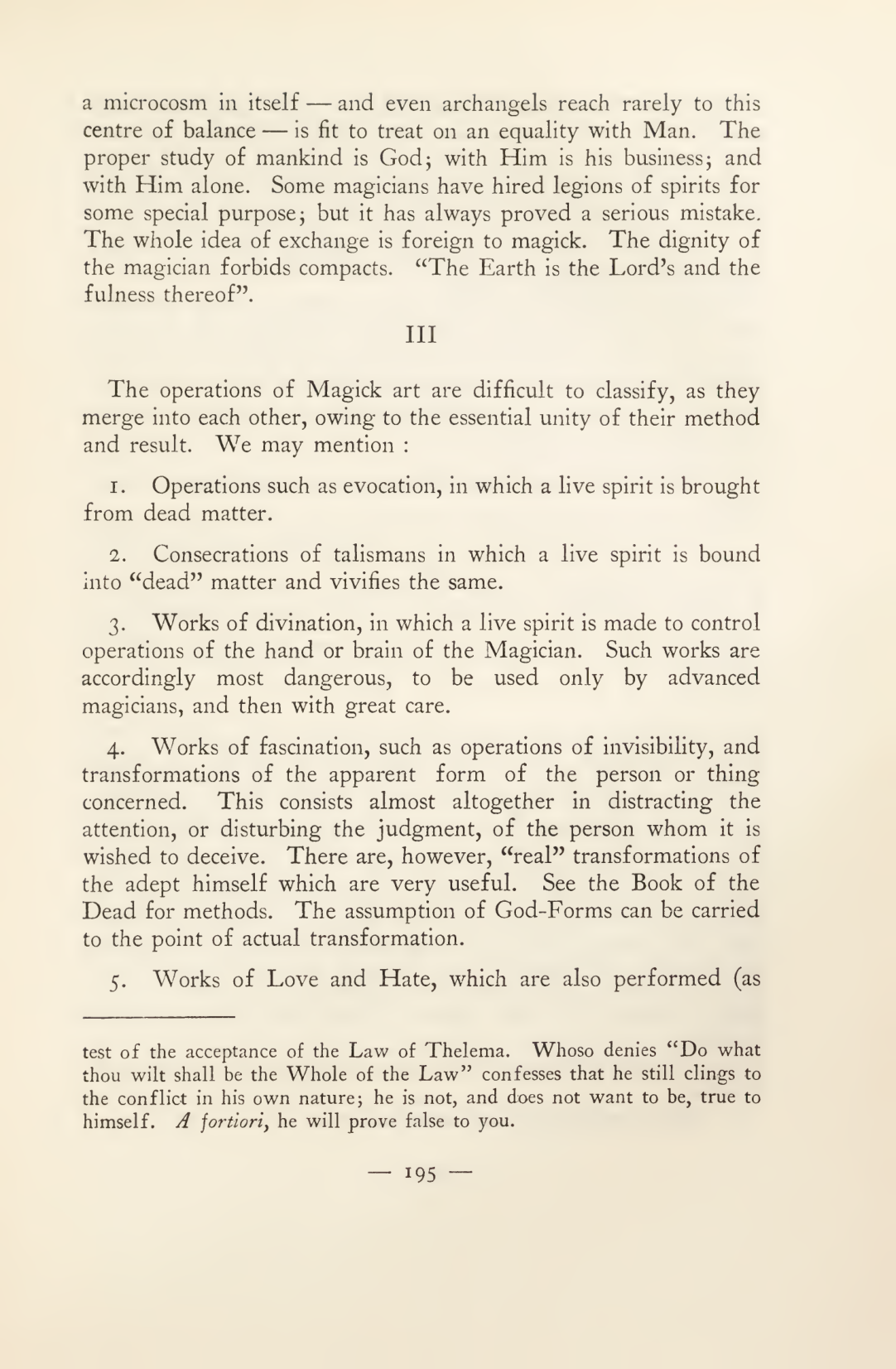
Highlights use the original PDF text layer. OCR-only matches may not be visible on the scan.
Transcription
Download text ↓raw extractionoriginal embedded textReview: unreviewed
a microcosm in itself — and even archangels reach rarely to this
centre of balance — is fit to treat on an equality with Man. The
proper study of mankind is God; with Him is his business; and
with Him alone. Some magicians hâve hired légions of spirits for
some spécial purpose; but it has always proved a serious mistake.
The whole idea of exchange is foreign to magick. The dignity of
the magician forbids compacts. “The Earth is the Lord’s and the
fulness thereof”.
III
The operations of Magick art are difficult to classify, as they
merge into each other, owing to the essential unity of their method
and resuit. We may mention :
1. Operations such as évocation, in which a live spirit is brought
from dead matter.
2. Consécrations of talismans in which a live spirit is bound
înto “dead” matter and vivifies the same.
3. Works of divination, in which a live spirit is made to control
operations of the hand or brain of the Magician. Such works are
accordingly most dangerous, to be used only by advanced
magicians, and then with great care.
4. Works of fascination, such as operations of invisibility, and
transformations of the apparent form of the person or thing
concerned. This consists almost altogether in distracting the
attention, or disturbing the judgment, of the person whom it is
wished to deceive. There are, however, “real” transformations of
the adept himself which are very useful. See the Book of the
Dead for methods. The assumption of God-Forms can be carried
to the point of actual transformation.
5. Works of Love and Hâte, which are also performed (as
test of the acceptance of the Law of Thelema. Whoso déniés “Do what
thou wilt shall be the Whole of the Law” confesses that he still clings to
the conflict in his own nature; he is not, and does not want to be, true to
himself. A fortiori, he will prove false to you.
— 195 —
Page provenance & review flags
Stable page ID: 7225bbab6d2ac2a8268d8bdd:p00075
Line breaks are preserved. Reading order and OCR accuracy may need review.
Printed page label has not been verified.
- No automated review flags. This does not establish transcription accuracy.