1930 · CLOSE READING
Magick in Theory and Practice (Section 2)
Magick in Theory and Practice (Section 2) (1930), PDF p. 64
Original page
Enlarge ↗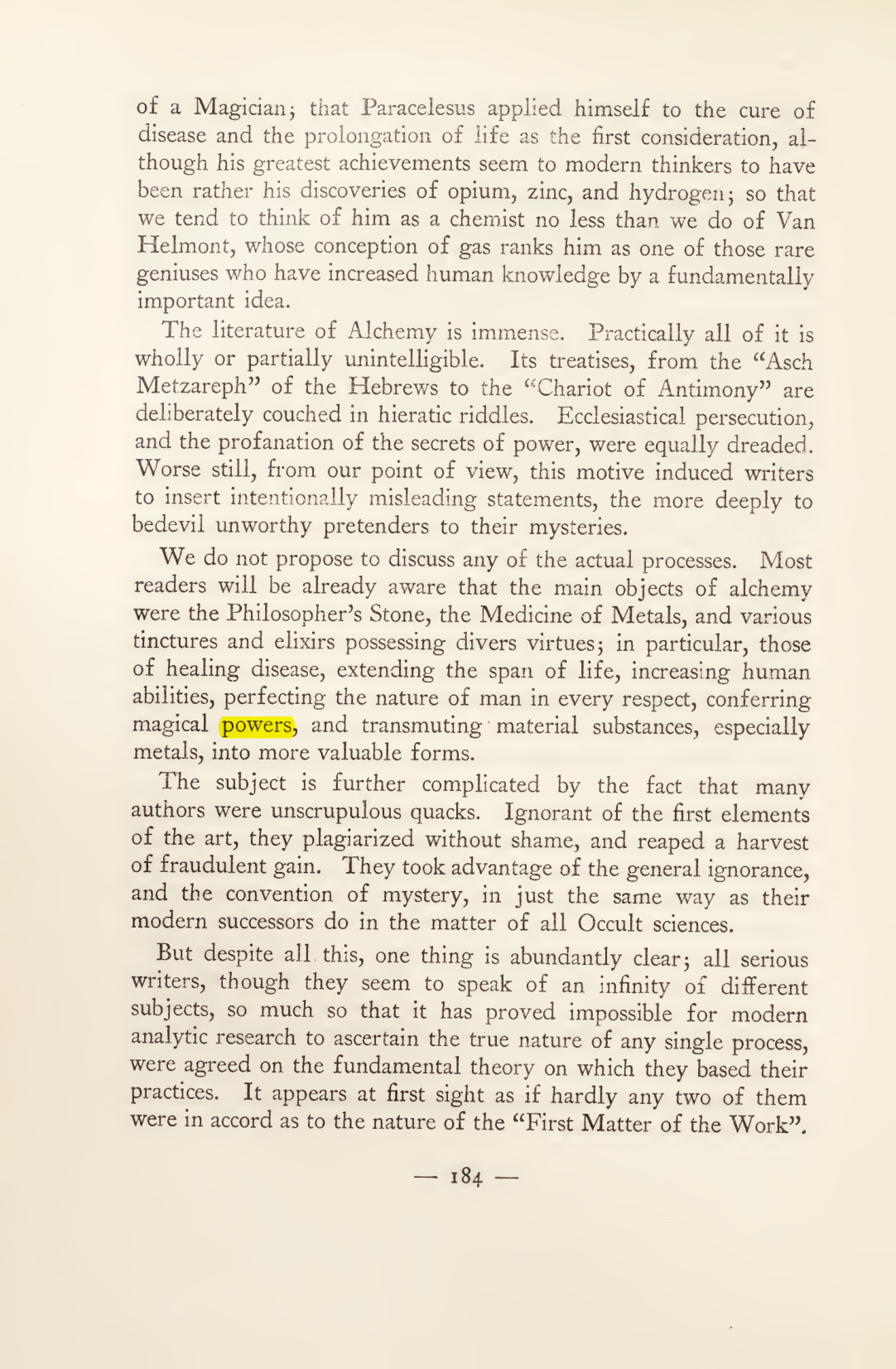
Highlights use the original PDF text layer. OCR-only matches may not be visible on the scan.
Transcription
Download text ↓raw extractionoriginal embedded textReview: unreviewed
of a Magician; that Paracelesus applied himself to the cure of
disease and the prolongation of life as the first considération, ai-
though his greatest achievements seem to modem thinkers to hâve
been ratifier his discoveries of opium, zinc, and hydrogen; so that
we tend to think of him as a chemist no less than we do of Van
Helmont, whose conception of gas ranks him as one of those rare
geniuses who hâve increased human knowledge by a fundamentally
important idea.
The literature of Alchemy is immense. Practicaliy ail of it is
wholly or partially unintelligible. Its treatises, from the aAsch
Metzareph” of the Hebrews to the “Chariot of Antimony” are
deliberately couched in hieratic riddles. Ecclesiastical persécution,
and the profanation of the secrets of power, were equally dreaded.
Worse still, from our point of view, this motive induced writers
to insert intentionally misleading statements, the more deeply to
bedevil unworthy pretenders to their mysteries.
We do not propose to discuss any of the actual processes. Most
readers will be already aware that the main objects of alchemy
were the Philosopheras Stone, the Medicine of Metals, and varions
tinctures and élixirs possessing divers virtues; in particular, those
of healing disease, extending the span of life, increasing human
abilities, perfecting the nature of man in every respect, conferring
magical powers, and transmuting material substances, especially
metals, into more valuable forms.
The subject is further complicated by the fact that many
authors were unscrupulous quacks. Ignorant of the first éléments
of the art, they plagiarized without shame, and reaped a harvest
of fraudulent gain. They took advantage of the general ignorance,
and the convention of mystery, in just the same way as their
modem successors do in the matter of ail Occult sciences.
But despite all.this, one thing is abundantly clear; ail serious
writers, though they seem to speak of an infinity of different
subjects, so much so that it has proved impossible for modem
analytic research to ascertain the true nature of any single process,
were agreed on the fundamental theory on which they based their
practices. It appears at first sight as if hardly any two of them
were in accord as to the nature of the “First Matter of the Work”.
— 184
Page provenance & review flags
Stable page ID: 7225bbab6d2ac2a8268d8bdd:p00064
Line breaks are preserved. Reading order and OCR accuracy may need review.
Printed page label has not been verified.
- No automated review flags. This does not establish transcription accuracy.