1930 · CLOSE READING
Magick in Theory and Practice (Section 2)
Magick in Theory and Practice (Section 2) (1930), PDF p. 5
Original page
Enlarge ↗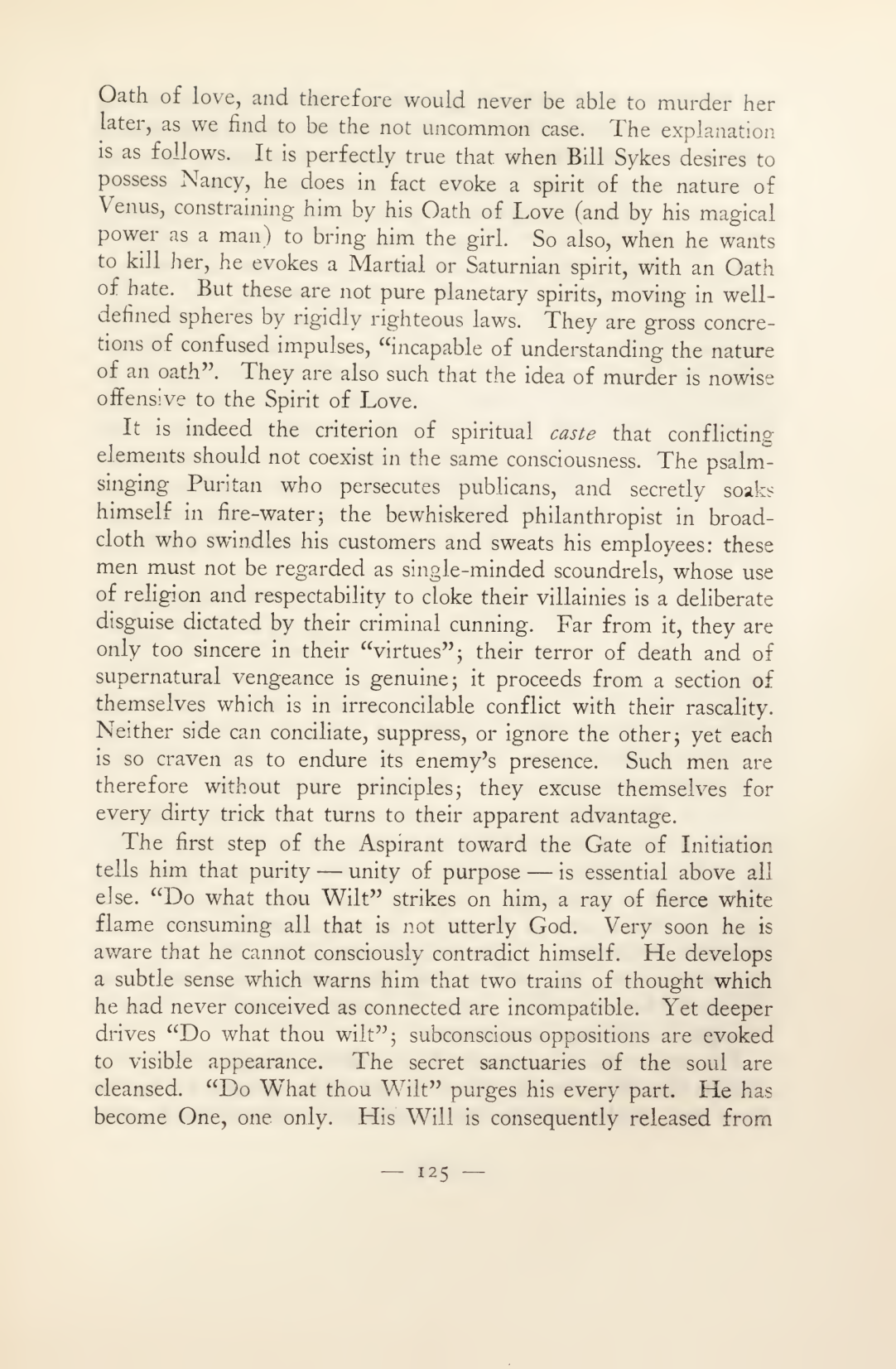
Highlights use the original PDF text layer. OCR-only matches may not be visible on the scan.
Transcription
Download text ↓raw extractionoriginal embedded textReview: unreviewed
Oath of love, and therefore would never be able to murder her
later, as we find to be the not uncommon case. The explanation
is as follows. It is perfectly true that when Bill Sykes desires to
possess Nancy, he does in fact evoke a spirit of the nature of
Venus, constraining him by his Oath of Love (and by his magical
power as a man) to bring him the girl. So also, when he wants
to kiJl her, he evokes a Martial or Saturnian spirit, with an Oath
of hâte. But these are not pure planetary spints, moving in well-
dehned spneres by rigidlv righteous laws. They are gross concré¬
tions of confused impulses, “incapable of understanding the nature
of an oath”. They are also such that the idea of murder is nowise
offensive to the Spirit of Love.
It is indeed the cntenon of spiritual caste that conflicting
éléments should not coexist in the same consciousness. The psalm-
singing Puritan who persécutes publicans, and secretly soaks
himself in hre-water; the bewhiskered philanthropist in broad-
cloth who swindles his customers and sweats his employées: these
men must not be regarded as single-minded scoundrels, whose use
of religion and respectability to cioke their villainies is a deliberate
disguise dictated by their criminal cunning. Far from it, they are
only too sincere in their “virtues”; their terror of death and of
supernatural vengeance is genuine; it proceeds from a section of
themselves which is in irreconcilable conflict with their rascality.
Neither si de can conciliate, suppress, or ignore the other; yet each
is so craven as to endure its enemy’s presence. Such men are
therefore without pure principles; they excuse themselves for
every dirty trick that turns to their apparent advantage.
The first step of the Aspirant toward the Gâte of Initiation
tells him that purity — unity of purpose — is essential above ail
else. “Do what thou Wilt” strikes on him, a ray of berce white
flame consuming ail that is not utterly God. Very soon he is
aware that he cannot consciously contradict himself. He develops
a subtle sense which warns him that two trains of thought which
he had never conceived as connected are incompatible. Yet deeper
drives “Do what thou wiit”$ subconscious oppositions are evoked
to visible appearance. The secret sanctuaries of the soûl are
cleansed. “Do What thou Wilt” purges his every part. He has
become One, one only. His Will is consequently released from
125 —
Page provenance & review flags
Stable page ID: 7225bbab6d2ac2a8268d8bdd:p00005
Line breaks are preserved. Reading order and OCR accuracy may need review.
Printed page label has not been verified.
- No automated review flags. This does not establish transcription accuracy.