1930 · CLOSE READING
Magick in Theory and Practice (Section 2)
Magick in Theory and Practice (Section 2) (1930), PDF p. 53
Original page
Enlarge ↗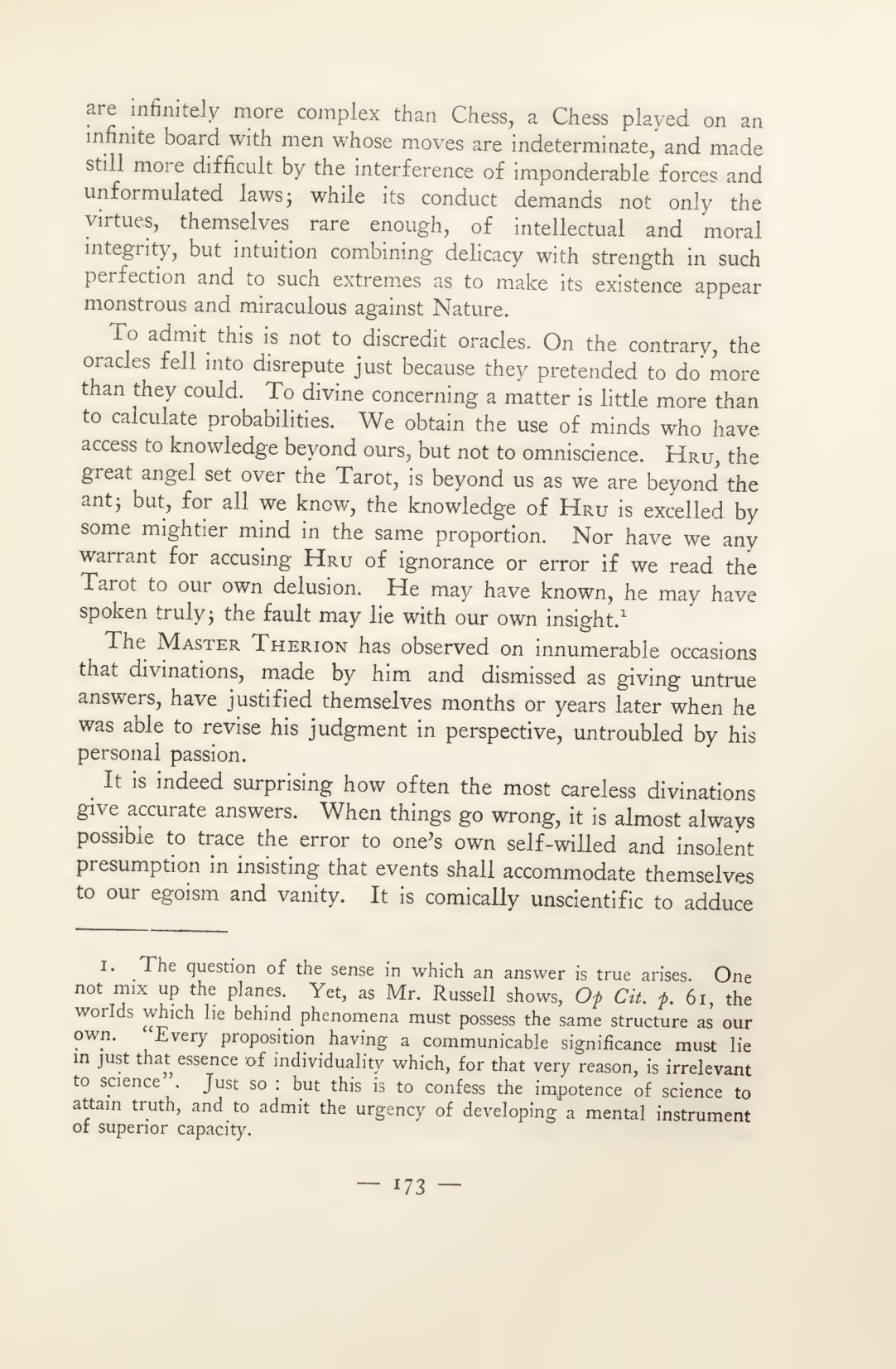
Highlights use the original PDF text layer. OCR-only matches may not be visible on the scan.
Transcription
Download text ↓raw extractionoriginal embedded textReview: unreviewed
are infinitely more complex than Chess, a Chess played on an
infinité boarci with men whose moves are indeterminate, and made
still more difficult by the interférence of impondérable forces and
unformulated laws; while its conduct demands not only the
virtues, themselves rare enough, of intellectual and moral
integrity, but intuition combining delicacy with strength in such
perfection and to such extremes as to make its existence appear
monstrous and miraculous against Nature.
To admit this is not to discrédit oracles. On the contrary, the
oracles fell mto disrepute just because they pretended to do more
than they could. To divine concerning a matter is little more than
to calculate probabilities. We obtain the use of minds who hâve
access ro knowledge beyond ours, but not to omniscience. Hru; the
gréai angel set over the Tarot, is beyond us as we are beyond the
antj but, for ail we know, the knowledge of Hru is excelled by
some mightier mind in the same proportion. Nor hâve we any
warrant for accusing Hru of ignorance or error if we read the
Taroi to our own delusion. He may hâve known, he may hâve
spoken trulyj the fault may lie with our own insight.1
The Master Therion has observed on innumerable occasions
that divinations, made by him and dismissed as giving untrue
answers, hâve justified themselves months or years later when he
was able to revise his judgment in perspective, untroubled by his
Personal passion.
It is mdeed surprising how often the most careless divinations
give accurate answers. When things go wrong, it is almost always
possible to trace thæ error to one’s own self-willed and insolent
presumption in insisting that events shall accommodate themselves
to our egoism and vanity. It is comically unscientific to adduce
i. The question of the sense in which an answer is true arises. One
not mix up the planes. Yet, as Mr. Russell shows, Of Cit. f. 61, the
worlds which lie behind phenomena must possess the same structure as our
own. Every proposition having a communicable significance must lie
in just that essence of individuality which, for that very reason, is irrelevant
to science , Just so : but this is to confess the impotence of science to
attam truth, and to admit the urgency of developing a mental instrument
of supenor capacity.
— x73
Page provenance & review flags
Stable page ID: 7225bbab6d2ac2a8268d8bdd:p00053
Line breaks are preserved. Reading order and OCR accuracy may need review.
Printed page label has not been verified.
- No automated review flags. This does not establish transcription accuracy.