1930 · CLOSE READING
Magick in Theory and Practice (Section 2)
Magick in Theory and Practice (Section 2) (1930), PDF p. 4
Original page
Enlarge ↗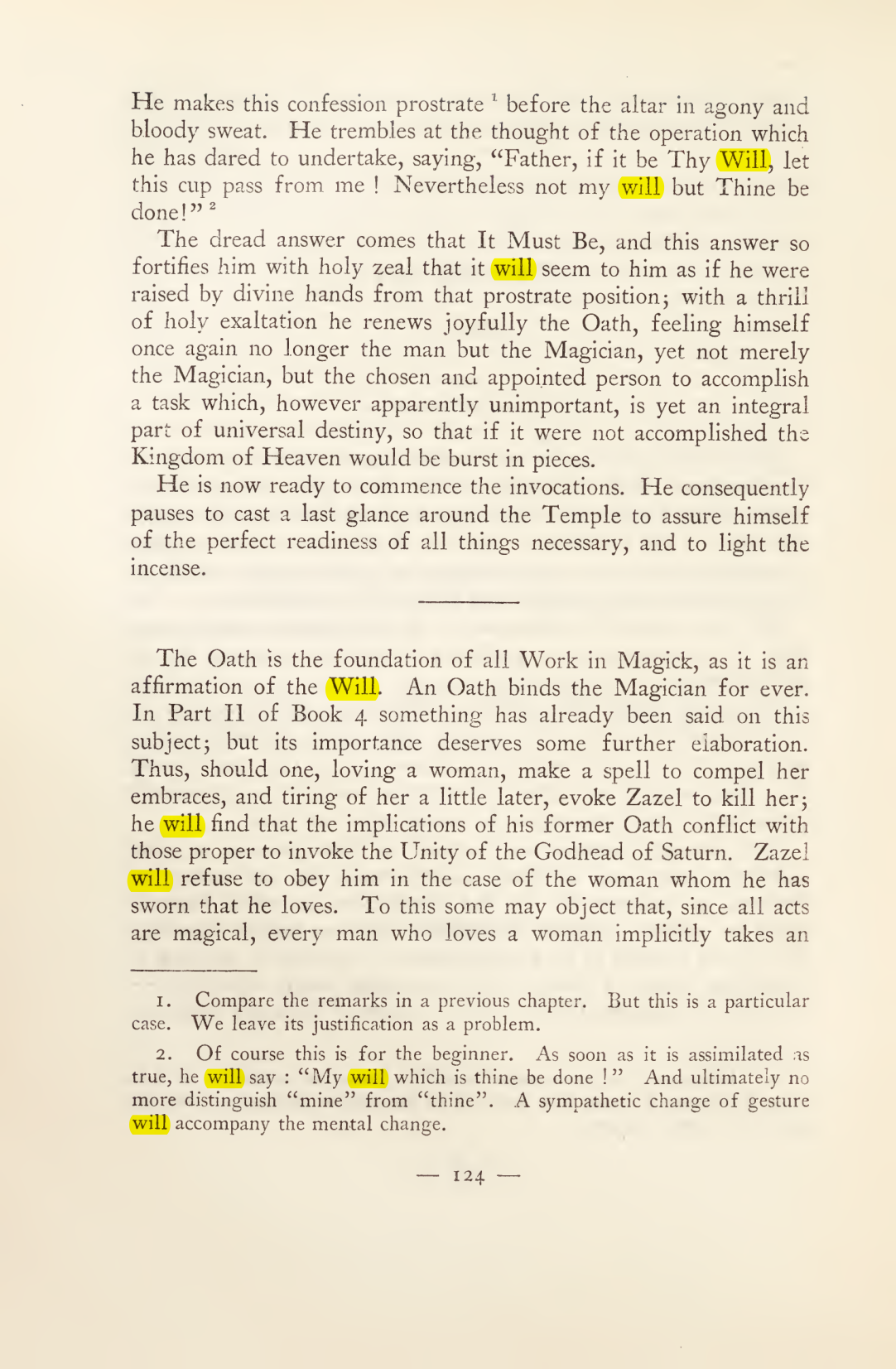
Highlights use the original PDF text layer. OCR-only matches may not be visible on the scan.
Transcription
Download text ↓raw extractionoriginal embedded textReview: unreviewed
He makes this confession prostrate J before the altar in agony and
bloody sweat. He trembles at the thought of the operation which
he has dared to undertake, saying, “Father, if it be Thy Will, let
this cup pass from me ! Nevertheless not my will but Thine be
done!”1 2
The dread answer cornes that It Must Be, and this answer so
fortifies him with holy zeal that it will seem to him as if he were
raised by divine hands from that prostrate position; with a thrill
of holy exaltation he renews joyfully the Oath, feeling himself
once again no longer the man but the Magician, yet not merely
the Magician, but the chosen and appointed person to accomplish
a task which, however apparently unimportant, is yet an intégral
part of universal destiny, so that if it were not accomplished the
Kingdom of Heaven would be burst in pièces.
He is now ready to commence the invocations. He consequently
pauses to cast a last glance around the Temple to assure himself
of the perfect readiness of ail things necessary, and to light the
incense.
The Oath is the foundation of ail Work in Magick, as it is an
affirmation of the Will. An Oath binds the Magician for ever.
In Part II of Book 4 something has already been said on this
subject; but its importance deserves some further élaboration.
Thus, should one, loving a woman, make a spell to compel her
embraces, and tiring of her a little later, evoke Zazel to kill her;
he will find that the implications of his former Oath conflict with
those proper to invoke the Unity of the Godhead of Saturn. Zazel
will refuse to obey him in the case of the woman whom he has
sworn that he loves. To this some may object that, since ail acts
are magical, every man who loves a woman implicitly takes an
1. Compare the remarks in a previous chapter. But this is a particular
case. We leave its justification as a problem.
2. Of course this is for the beginner. As soon as it is assimilated as
true, he will say : “My will which is thine be done ! ” And ultimately no
more distinguish “mine” from “thine”. A sympathetic change of gesture
will accompany the mental change.
124
Page provenance & review flags
Stable page ID: 7225bbab6d2ac2a8268d8bdd:p00004
Line breaks are preserved. Reading order and OCR accuracy may need review.
Printed page label has not been verified.
- No automated review flags. This does not establish transcription accuracy.