1930 · CLOSE READING
Magick in Theory and Practice (Section 2)
Magick in Theory and Practice (Section 2) (1930), PDF p. 49
Original page
Enlarge ↗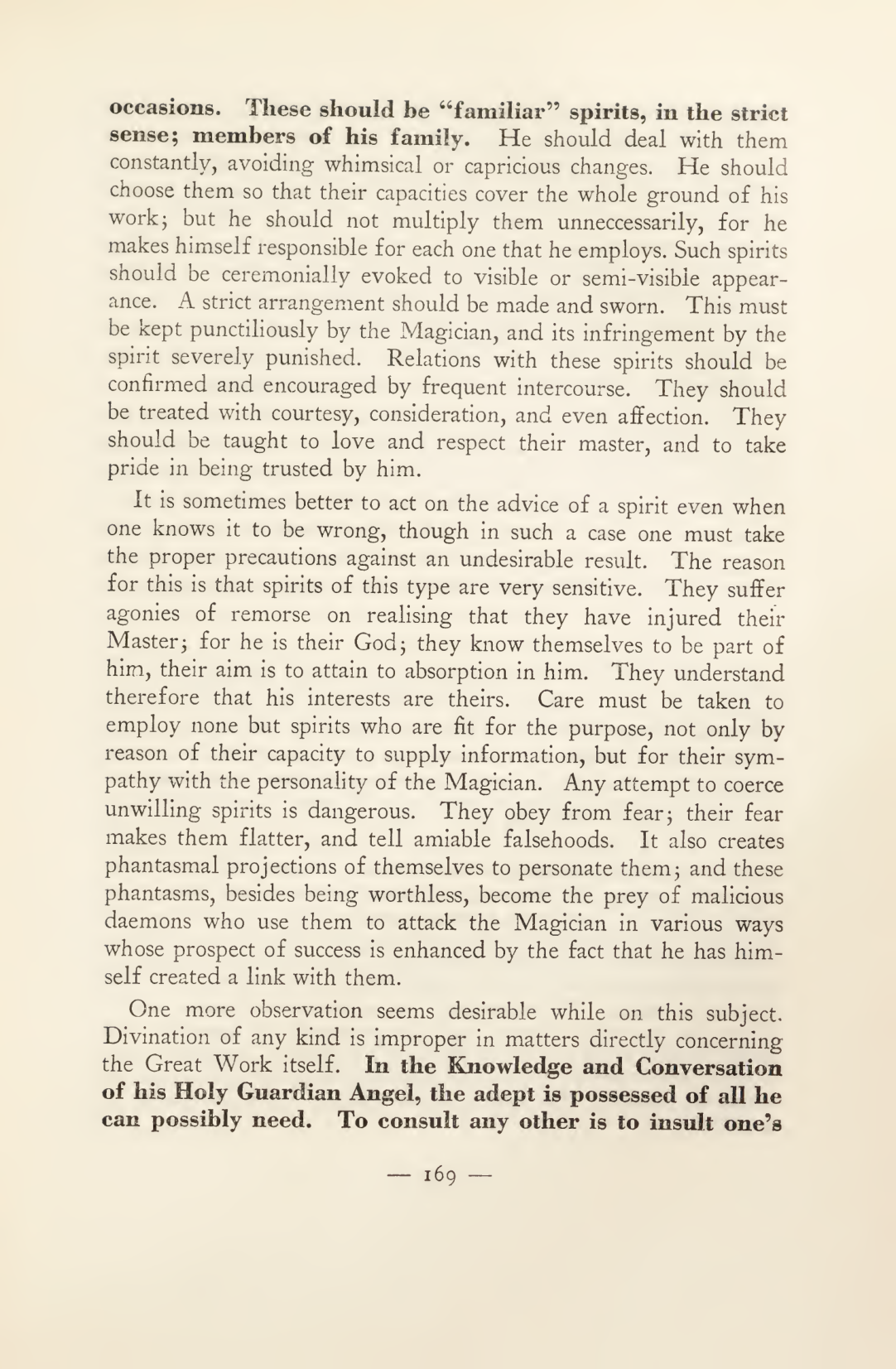
Highlights use the original PDF text layer. OCR-only matches may not be visible on the scan.
Transcription
Download text ↓raw extractionoriginal embedded textReview: unreviewed
occasions. These shouid be “familiar” spirits, in the strict
sense; members of bis family. He shouid deal with them
constantly, avoiding whimsical or capricious changes. He shouid
choose them so that their capacities cover the whole ground of his
workj but he shouid not multiply them unneccessarily, for he
makes himself responsible for each one that he employs. Such spirits
snould be ceremonially evoked to visible or semi-visible appear-
ance. A strict arrangement shouid be made and sworn. This must
be kept punctiliously by the Magician, and its infringement by the
spirit severely punished. Relations with these spirits shouid be
confirmed and encouraged by frequent intercourse. They shouid
be treated with courtesy, considération, and even affection. They
shouid be taught to love and respect their master, and to take
pride in being trusted by him.
It îs sometimes better to act on the advice of a spirit even when
one knows it to be wrong, though in such a case one must take
the proper précautions against an undesirable resuit. The reason
for this is that spirits of this type are very sensitive. They suffer
agonies of remorse on realising that they hâve injured their
Master5 for he is their God; they know themselves to be part of
him, their aim is to attain to absorption in him. They understand
therefore that his interests are theirs. Care must be taken to
employ none but spirits who are fit for the purpose, not only by
reason of their capacity to supply information, but for their sym-
pathy with the personality of the Magician. Any attempt to coerce
unwilling spirits is dangerous. They obey from fear; their fear
makes them flatter, and tell amiable falsehoods. It also créâtes
phantasmal projections of themselves to personate them; and these
phantasms, besides being worthless, become the prey of malicious
daemons who use them to attack the Magician in various ways
whose prospect of success is enhanced by the fact that he has him¬
self created a link with them.
One more observation seems désirable while on this subject.
Divination of any kind is improper in matters directly concerning
the Great Work itself. In the Knowledge and Conversation
of his Holy Guardian Angel, the adept is possessed of ail he
can possibly need. To consult any other is to insnlt one’s
Page provenance & review flags
Stable page ID: 7225bbab6d2ac2a8268d8bdd:p00049
Line breaks are preserved. Reading order and OCR accuracy may need review.
Printed page label has not been verified.
- No automated review flags. This does not establish transcription accuracy.