1930 · CLOSE READING
Magick in Theory and Practice (Section 2)
Magick in Theory and Practice (Section 2) (1930), PDF p. 42
Original page
Enlarge ↗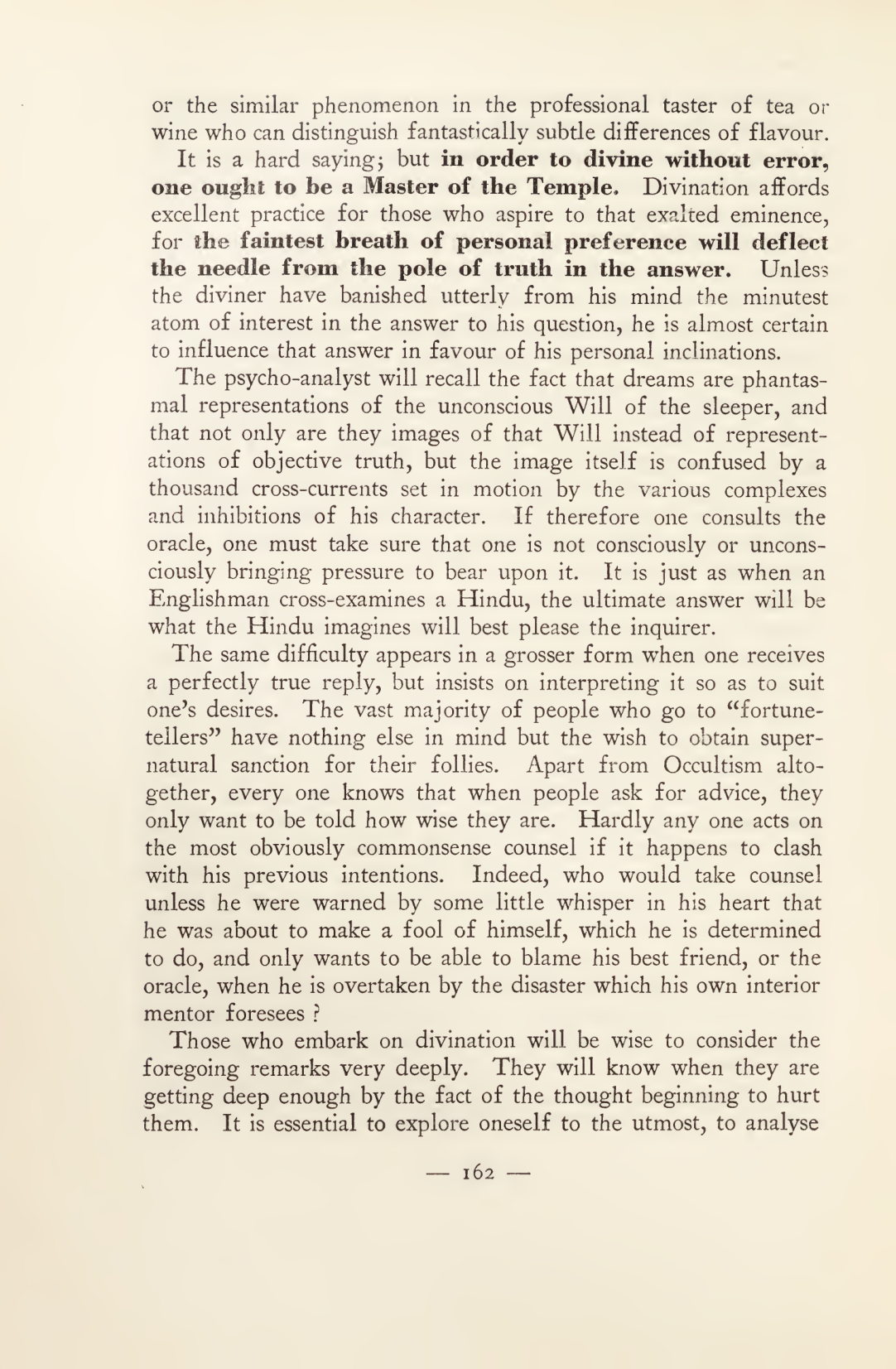
Highlights use the original PDF text layer. OCR-only matches may not be visible on the scan.
Transcription
Download text ↓raw extractionoriginal embedded textReview: unreviewed
or the similar phenomenon in the professional taster of tea or
wine who can distinguish fantastîcallv subtle différences of flavour.
It is a hard saying; but in order to divine without error,
one ought to be a Master of the Temple, Divination affords
excellent practice for those who aspire to that exalted eminence,
for the faintest breath of personal preference will deflect
the needle from the pôle of trnth in the answer. Unies?
the diviner hâve banished utterly from his mind the minutest
atom of interest in the answer to his question, he is almost certain
to influence that answer in favour of his personal inclinations.
The psycho-analyst will recall the fact that dreams are phantas-
mal représentations of the unconscious Will of the sleeper, and
that not only are they images of that Will instead of représent¬
ations of objective truth, but the image itself is confused by a
thousand cross-currents set in motion by the various complexes
and inhibitions of his character. If therefore one consults the
oracle, one must take sure that one is not consciously or uncons-
ciously bringing pressure to bear upon it. It is just as when an
Englishman cross-examines a Hindu, the ultimate answer will be
what the Hindu imagines will best please the inquirer.
The same difficulty appears in a grosser form when one receives
a perfectly true reply, but insists on interpreting it so as to suit
one’s desires. The vast majority of people who go to “fortune-
tellers” hâve nothing else in mind but the wish to obtain super-
natural sanction for their follies. Apart from Occultism alto-
gether, every one knows that when people ask for advice, they
only want to be told how wise they are. Hardly any one acts on
the most obviously commonsense counsel if it happens to clash
with his previous intentions. Indeed, who would take counsel
unless he were warned by some little whisper in his heart that
he was about to make a fool of himself, which he is determined
to do, and only wants to be able to blâme his best friend, or the
oracle, when he is overtaken by the disaster which his own interior
mentor foresees ?
Those who embark on divination will be wise to consider the
foregoing remarks very deeply. They will know when they are
getting deep enough by the fact of the thought beginning to hurt
them. It is essential to explore oneself to the utmost, to analyse
— 162
Page provenance & review flags
Stable page ID: 7225bbab6d2ac2a8268d8bdd:p00042
Line breaks are preserved. Reading order and OCR accuracy may need review.
Printed page label has not been verified.
- No automated review flags. This does not establish transcription accuracy.