1930 · CLOSE READING
Magick in Theory and Practice (Section 2)
Magick in Theory and Practice (Section 2) (1930), PDF p. 36
Original page
Enlarge ↗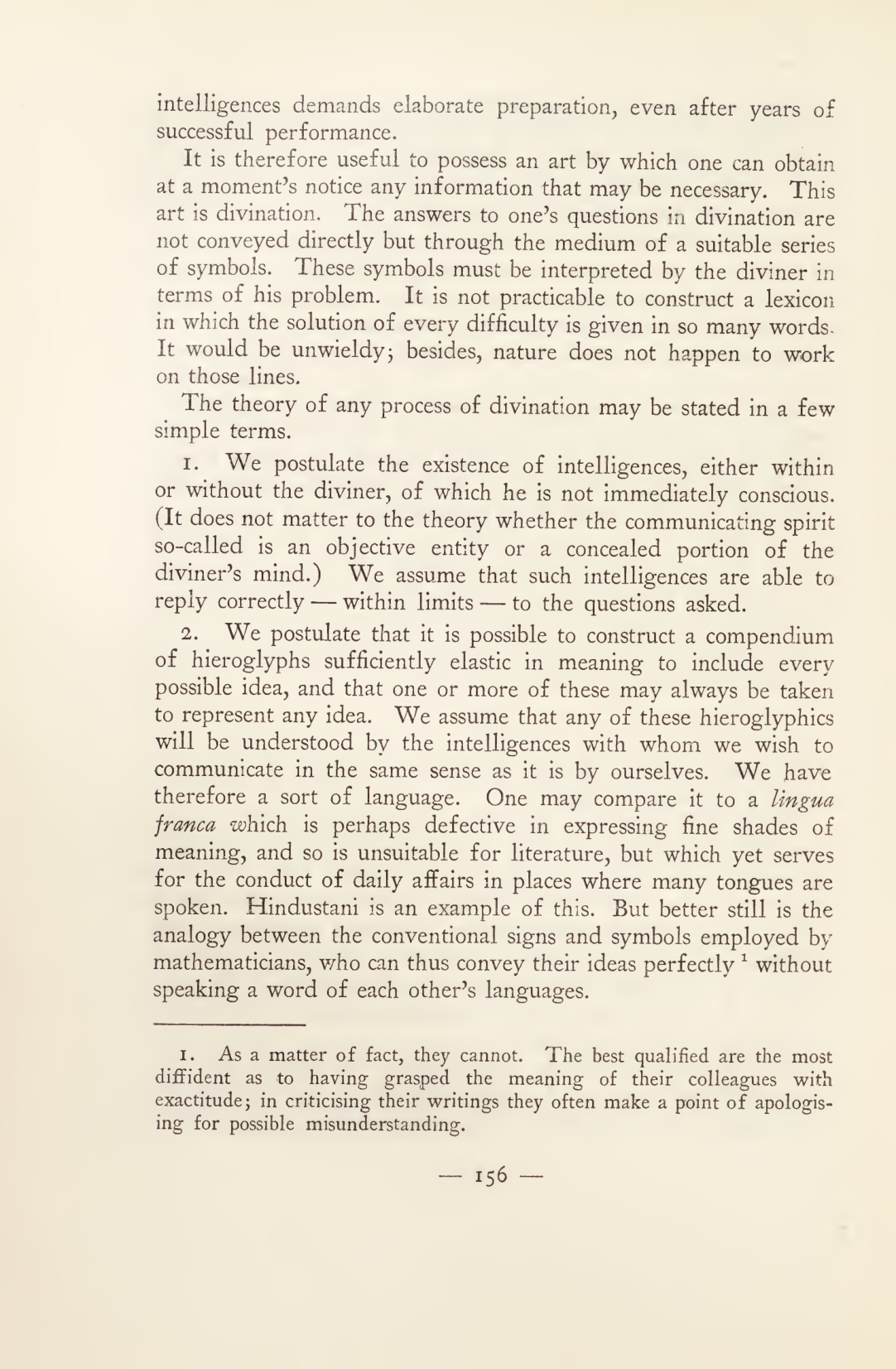
Highlights use the original PDF text layer. OCR-only matches may not be visible on the scan.
Transcription
Download text ↓raw extractionoriginal embedded textReview: unreviewed
intelligences demands elaborate préparation, even after years of
successful performance.
It is therefore useful to possess an art by which one can obtain
at a moments notice any information that may be necessary. This
art is divination. The answers to one’s questions in divination are
not conveyed directly but through the medium of a suitable sériés
of symbols. These symbols must be interpreted by the diviner in
terms of his problem. It is not practicable to construct a lexicon
in which the solution of every difficulty is given in so many words.
It would be unwieldy 3 besides, nature does not happen to work
on those lines.
The theory of any process of divination may be stated in a few
simple terms.
1. We postulate the existence of intelligences, either within
or without the diviner, of which he is not immediately conscious.
(It does not matter to the theory whether the communicating spirit
so-called is an objective entity or a concealed portion of the
diviner’s mind.) We assume that such intelligences are able to
reply correctly — within limits — to the questions asked.
2. We postulate that it is possible to construct a compendium
of hieroglyphs sufficiently elastic in meaning to include every
possible idea, and that one or more of these may always be taken
to represent any idea. We assume that any of these hieroglyphics
will be understood by the intelligences with whom we wish to
communicate in the same sense as it is by ourselves. We hâve
therefore a sort of language. One may compare it to a lingua
jranca which is perhaps defective in expressing fine shades of
meaning, and so is unsuitable for literature, but which yet serves
for the conduct of daily affairs in places where many tongues are
spoken. Hindustani is an example of this. But better still is the
analogy between the conventional signs and symbols employed by
mathematicians, who can thus convey their ideas perfectly 1 without
speaking a Word of each other’s languages.
1. As a matter of fact, they cannot. The best qualified are the most
diffident as to having grasped the meaning of their colleagues with
exactitude; in criticising their writings they often make a point of apologis-
ing for possible misunderstanding.
— 156
Page provenance & review flags
Stable page ID: 7225bbab6d2ac2a8268d8bdd:p00036
Line breaks are preserved. Reading order and OCR accuracy may need review.
Printed page label has not been verified.
- No automated review flags. This does not establish transcription accuracy.