1930 · CLOSE READING
Magick in Theory and Practice (Section 2)
Magick in Theory and Practice (Section 2) (1930), PDF p. 14
Original page
Enlarge ↗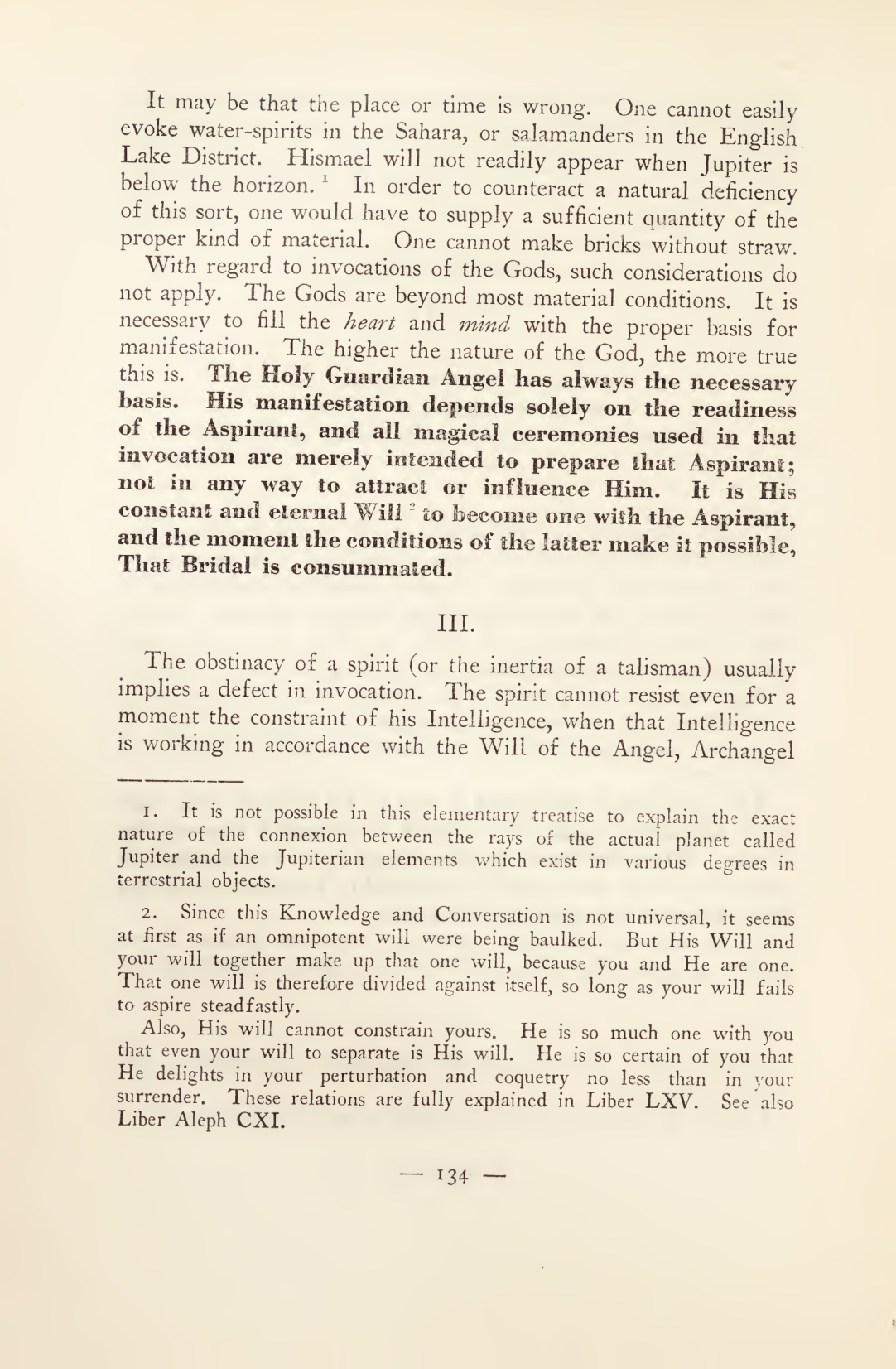
Highlights use the original PDF text layer. OCR-only matches may not be visible on the scan.
Transcription
Download text ↓raw extractionoriginal embedded textReview: unreviewed
It may be that tiie place or time is wrong. One cannot easily
evoke water-spirits in the Sahara, or salamanders in the English
Lake District. Hismael will not readily appear when Jupiter is
below the horizon. 1 2 In order to counteract a natural deficiency
of this sort, one would hâve to supply a sufficient quantity of the
proper kind of material. One cannot make bricks without straw.
With regard to invocations of the Gods, such considérations do
not apply. The Gods are beyond most material conditions. It is
necessarv to hll the heart and mïnd with the proper basis for
manuestauon. The higher the nature of the God, the more true
tins is. The Holy Guardian Angel has always the necessary
hasis. His manifestation dépends solely on the readiness
oî tue Aspirant, and ail magical ceremonies used in that
invocation are merely intended to préparé that Aspirant;
not in any way to attract or influence Him. It is His
constant and et ornai "W ill to hecome one with the Aspirant,
and the moment the coiiditions of the lutter muke it possible,
That Bridai is consummaled.
III.
The obstinacy of a spirit (or the inertia of a talisman) usually
implies a defect in invocation. The spirit cannot resist even for a
moment the constraint of his Intelligence, when that Intelligence
is working in accordance with the Will of the Angel, Archangel
1. It is not possible in this elementary treatise to explain the exact
nature of the connexion between the rays of the actual planet called
Jupiter and the Jupiterian éléments which exist in varions degrees in
terrestrial objects.
2. Since this Knowledge and Conversation is not universal, it seems
at first as if an omnipotent will were being baulked. But His Will and
your will together make up that one will, because you and He are one.
That one will is therefore divided against itself, so long as your will fails
to aspire steadfastly.
Also, His will cannot constrain yours. He is so much one with you
that even your will to separate is His will. He is so certain of you that
He delights in your perturbation and coquetry no less than in your
surrender. These relations are fully explained in Liber LXV. See also
Liber Aleph CXI.
~ 134 —
Page provenance & review flags
Stable page ID: 7225bbab6d2ac2a8268d8bdd:p00014
Line breaks are preserved. Reading order and OCR accuracy may need review.
Printed page label has not been verified.
- No automated review flags. This does not establish transcription accuracy.