1930 · CLOSE READING
Magick in Theory and Practice (Section 2)
Magick in Theory and Practice (Section 2) (1930), PDF p. 11
Original page
Enlarge ↗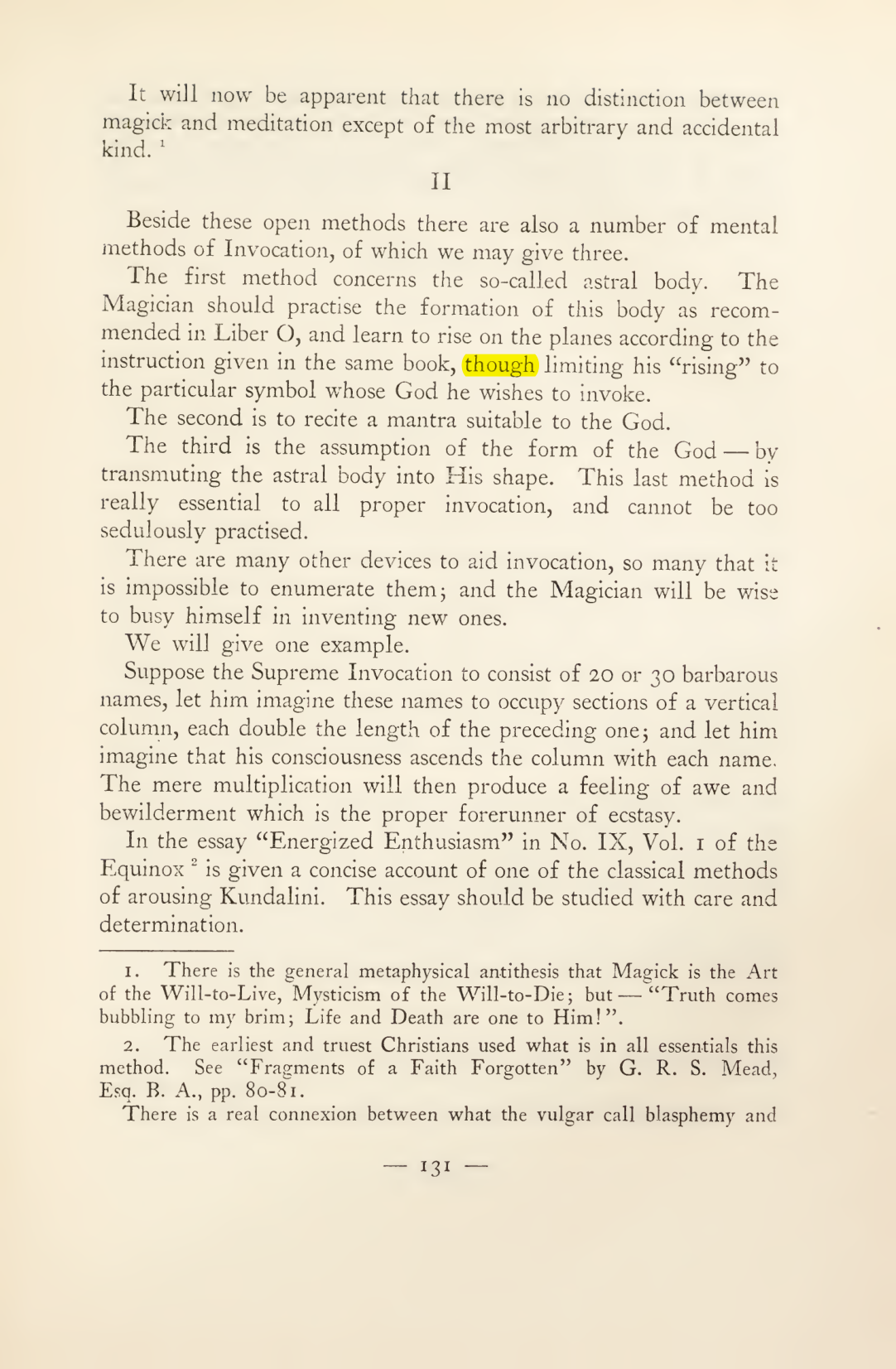
Highlights use the original PDF text layer. OCR-only matches may not be visible on the scan.
Transcription
Download text ↓raw extractionoriginal embedded textReview: unreviewed
It wiJl now be apparent that there is no distinction between
magick and méditation except of the most arbitrary and accidentai
kind. 1
II
Beside these open methods there are also a number of mental
methods of Invocation, of which we may give three.
The first method concerns the so-called astral body. The
Magician should practise the formation of this body as recom-
mended in Liber O, and learn to rise on the planes according to the
instruction given in the same book, though limiting his arising” to
the particular Symbol whose God he wishes to invoke.
The second is to recite a mantra suitable to the God.
The third is the assumption of the form of the God — by
transmuting the astral body into LIis shape. This last method îs
really essential to ail proper invocation, and cannot be too
sedulously practised.
There are many other devices to aid invocation, so many that it
is impossible to enumerate them; and the Magician will be wise
to busy himself in inventing new ones.
We will give one example.
Suppose the Suprême Invocation to consist of 20 or 30 barbarous
liâmes, let hirn imagine these liâmes to occupy sections of a vertical
column, each double the length of the preceding one 5 and let him
imagine that his consciousness ascends the column with each name,
The mere multiplication will then produce a feeling of awe and
bewilderment which is the proper forerunner of ecstasy.
I11 the essay “Energized Enthusiasm” in No. IX, Vol. 1 of the
Equinox 2 is given a concise account of one of the classical methods
of arousing Kundalini. This essay should be studied with care and
détermination.
1. There is the general metaphysical antithesis that Magick is the Art
of the Will-to-Live, Mysticism of the Will-to-Die; but—“Truth cornes
bubbling to my brim; Life and Death are one to Him!”.
2. The earliest and truest Christians used what is in ail essentials this
method. See “Fragments of a Faith Forgotten” by G. R. S. Mead,
Esa. B. A., pp. 80-81.
There is a real connexion between what the vulgar call blasphemy and
131 —
Page provenance & review flags
Stable page ID: 7225bbab6d2ac2a8268d8bdd:p00011
Line breaks are preserved. Reading order and OCR accuracy may need review.
Printed page label has not been verified.
- No automated review flags. This does not establish transcription accuracy.