1930 · CLOSE READING
Magick in Theory and Practice (Section 2)
Magick in Theory and Practice (Section 2) (1930), PDF p. 10
Original page
Enlarge ↗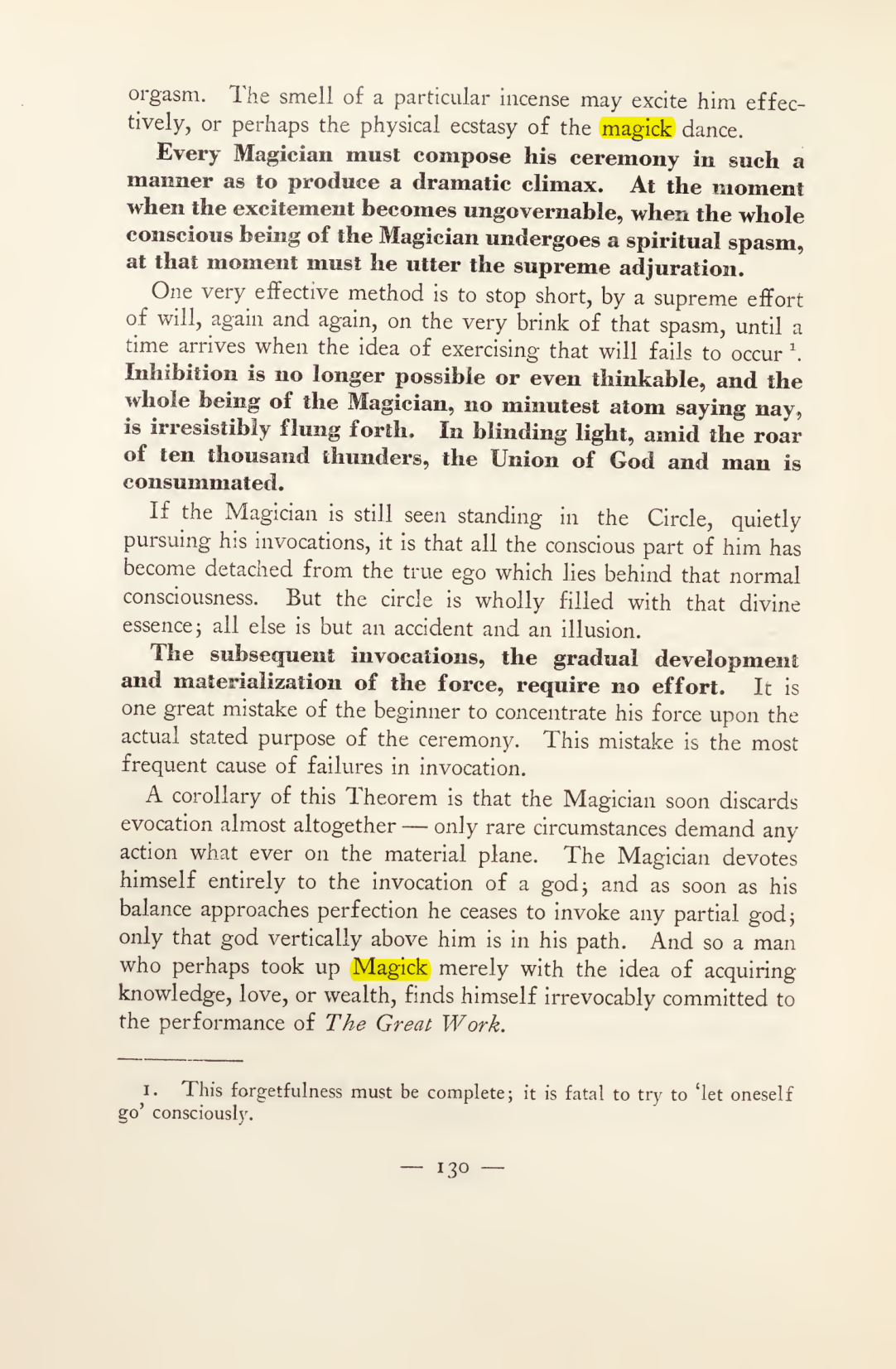
Highlights use the original PDF text layer. OCR-only matches may not be visible on the scan.
Transcription
Download text ↓raw extractionoriginal embedded textReview: unreviewed
orgasm. The smell o£ a particular incense may excite him effec-
tively, or perhaps the physical ecstasy of the magick dance.
Every Magician must compose liis ceremony in siieh a
manner as to produce a drasnatic climax. At the moment
when the excitement hecomes ungovernable, when the whole
conscious being of the Magician undergoes a spiritual spasm,
at thaï moment must lie utter the suprême adjuration.
One veiy effective method is to stop short, by a suprême effort
of will, again and again, on the very brink of that spasm, until a
time arrives when the idea of exercising that will fails to occur \
Inhibition is no longer possible or even thinkable, and the
whole heing of the Magician, no minutes! atom saying nay,
is irresistibly fJung forth. In blinding light, amid the roar
of ten thousand thunders, the Union of God and man is
consummated.
If the Magician is stiJl seen standing in the Circle, quietly
pursuing his invocations, it is that ail the conscious part of him has
become detached from the true ego which lies behind that normal
consciousness. But the circle is wholly filled with that divine
essence 3 ail else is but an accident and an illusion.
The subséquent invocations, the graduai development
and materialization of the force, require no effort. It is
one great mistake of the beginner to concentrate his force upon the
actual stated purpose of the ceremony. This mistake is the most
frequent cause of failures in invocation.
A coroliary of this Theorem is that the Magician soon discards
évocation almost altogether — only rare circumstances demand any
action what ever on the material plane. The Magician devotes
himself entirely to the invocation of a god 3 and as soon as his
balance approaches perfection he ceases to invoke any partial god 3
only that god vertically above him is in his path. And so a man
who perhaps took up Magick merely with the idea of acquiring
knowledge, love, or wealth, finds himself irrevocably committed to
the performance of The Great Work.
I. This forgetfulness must be complété; it is fatal to try to Tet oneself
go’ consciously.
— 130 —
Page provenance & review flags
Stable page ID: 7225bbab6d2ac2a8268d8bdd:p00010
Line breaks are preserved. Reading order and OCR accuracy may need review.
Printed page label has not been verified.
- No automated review flags. This does not establish transcription accuracy.