1996 · CLOSE READING
The Law is for All
The Law is for All (1996), PDF p. 95
Original page
Enlarge ↗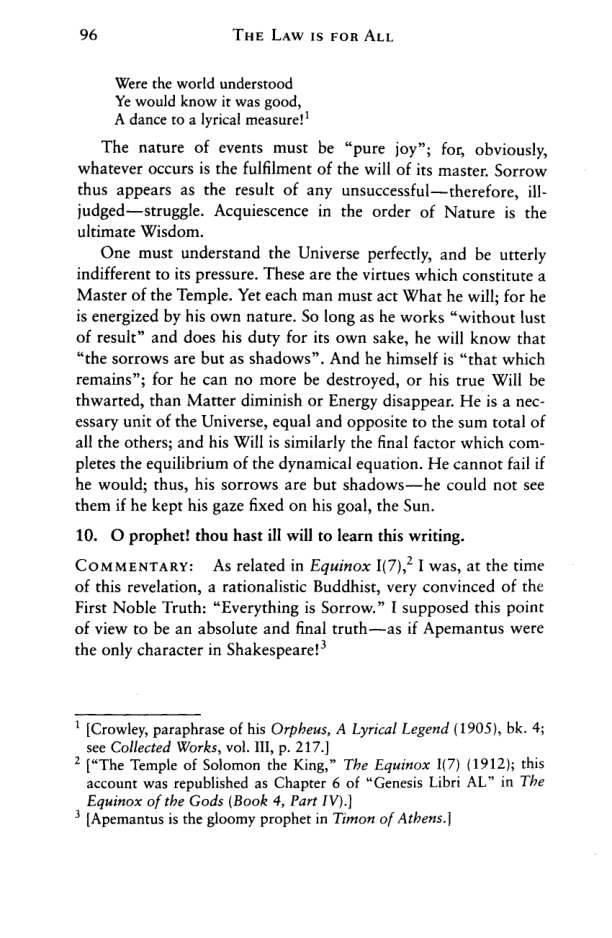
Highlights use the original PDF text layer. OCR-only matches may not be visible on the scan.
Transcription
Download text ↓raw extractionoriginal embedded textReview: unreviewed
96
The Law is for All
Were the world understood
Ye would know it was good,
A dance to a lyrical measure!1
1 [Crowley, paraphrase of his Orpheus, A Lyrical Legend (1905), bk. 4;
see Collected Works, vol. Ill, p. 217.]
2 [“The Temple of Solomon the King,” The Equinox 1(7) (1912); this
account was republished as Chapter 6 of “Genesis Libri AL” in The
Equinox of the Gods (Book 4, Part ZV).]
3 [Apemantus is the gloomy prophet in Timon of Athens.]
The nature of events must be “pure joy”; for, obviously,
whatever occurs is the fulfilment of the will of its master. Sorrow
thus appears as the result of any unsuccessful—therefore, ill-
judged—struggle. Acquiescence in the order of Nature is the
ultimate Wisdom.
One must understand the Universe perfectly, and be utterly
indifferent to its pressure. These are the virtues which constitute a
Master of the Temple. Yet each man must act What he will; for he
is energized by his own nature. So long as he works “without lust
of result” and does his duty for its own sake, he will know that
“the sorrows are but as shadows”. And he himself is “that which
remains”; for he can no more be destroyed, or his true Will be
thwarted, than Matter diminish or Energy disappear. He is a nec
essary unit of the Universe, equal and opposite to the sum total of
all the others; and his Will is similarly the final factor which com
pletes the equilibrium of the dynamical equation. He cannot fail if
he would; thus, his sorrows are but shadows—he could not see
them if he kept his gaze fixed on his goal, the Sun.
10. O prophet! thou hast ill will to learn this writing.
Commentary: As related in Equinox 1(7),1 2 I was, at the time
of this revelation, a rationalistic Buddhist, very convinced of the
First Noble Truth: “Everything is Sorrow.” I supposed this point
of view to be an absolute and final truth—as if Apemantus were
the only character in Shakespeare!3
Page provenance & review flags
Stable page ID: 6528ce4d28e01eb80a128d9c:p00095
Line breaks are preserved. Reading order and OCR accuracy may need review.
Printed page label has not been verified.
- No automated review flags. This does not establish transcription accuracy.