1996 · CLOSE READING
The Law is for All
The Law is for All (1996), PDF p. 8
Original page
Enlarge ↗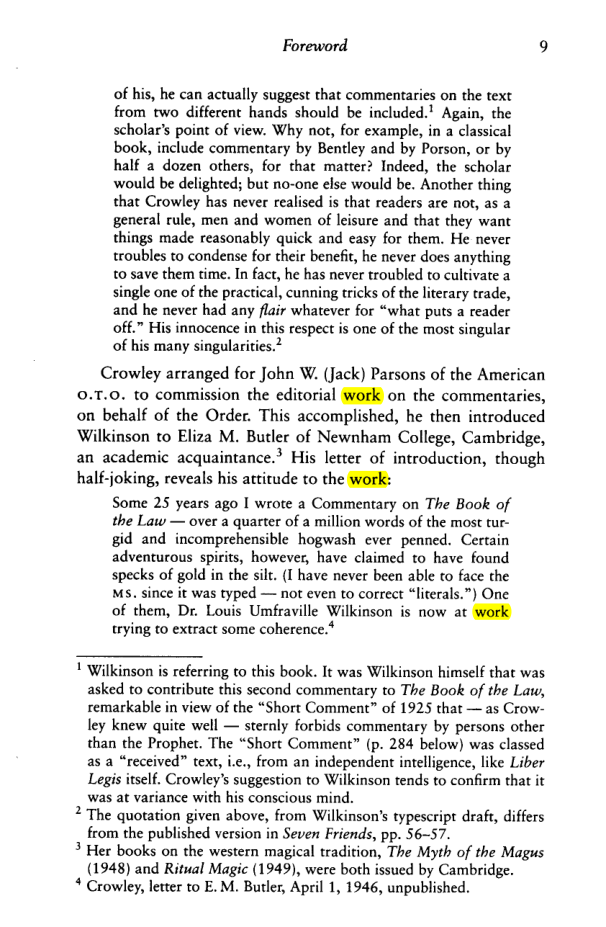
Highlights use the original PDF text layer. OCR-only matches may not be visible on the scan.
Transcription
Download text ↓raw extractionoriginal embedded textReview: unreviewed
Foreword
9
of his, he can actually suggest that commentaries on the text
from two different hands should be included.1 Again, the
scholar’s point of view. Why not, for example, in a classical
book, include commentary by Bentley and by Porson, or by
half a dozen others, for that matter? Indeed, the scholar
would be delighted; but no-one else would be. Another thing
that Crowley has never realised is that readers are not, as a
general rule, men and women of leisure and that they want
things made reasonably quick and easy for them. He never
troubles to condense for their benefit, he never does anything
to save them time. In fact, he has never troubled to cultivate a
single one of the practical, cunning tricks of the literary trade,
and he never had any flair whatever for “what puts a reader
off.” His innocence in this respect is one of the most singular
of his many singularities.1 2
1 Wilkinson is referring to this book. It was Wilkinson himself that was
asked to contribute this second commentary to The Book of the Law,
remarkable in view of the “Short Comment” of 1925 that — as Crow
ley knew quite well — sternly forbids commentary by persons other
than the Prophet. The “Short Comment” (p. 284 below) was classed
as a “received” text, i.e., from an independent intelligence, like Liber
Legis itself. Crowley’s suggestion to Wilkinson tends to confirm that it
was at variance with his conscious mind.
2 The quotation given above, from Wilkinson’s typescript draft, differs
from the published version in Seven Friends, pp. 56-57.
3 Her books on the western magical tradition, The Myth of the Magus
(1948) and Ritual Magic (1949), were both issued by Cambridge.
4 Crowley, letter to E. M. Butler, April 1, 1946, unpublished.
Crowley arranged for John W. (Jack) Parsons of the American
o.T.o. to commission the editorial work on the commentaries,
on behalf of the Order. This accomplished, he then introduced
Wilkinson to Eliza M. Butler of Newnham College, Cambridge,
an academic acquaintance.3 His letter of introduction, though
half-joking, reveals his attitude to the work:
Some 25 years ago I wrote a Commentary on The Book of
the Law — over a quarter of a million words of the most tur
gid and incomprehensible hogwash ever penned. Certain
adventurous spirits, however, have claimed to have found
specks of gold in the silt. (I have never been able to face the
ms. since it was typed — not even to correct “literals.”) One
of them, Dr. Louis Umfraville Wilkinson is now at work
trying to extract some coherence.4
Page provenance & review flags
Stable page ID: 6528ce4d28e01eb80a128d9c:p00008
Line breaks are preserved. Reading order and OCR accuracy may need review.
Printed page label has not been verified.
- No automated review flags. This does not establish transcription accuracy.