1996 · CLOSE READING
The Law is for All
The Law is for All (1996), PDF p. 7
Original page
Enlarge ↗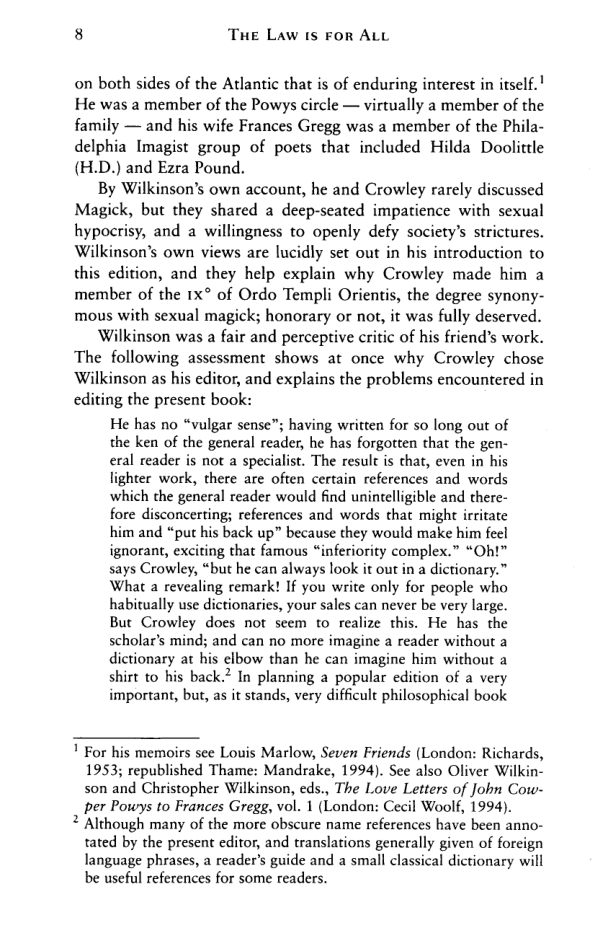
Highlights use the original PDF text layer. OCR-only matches may not be visible on the scan.
Transcription
Download text ↓raw extractionoriginal embedded textReview: unreviewed
8
The Law is for All
on both sides of the Atlantic that is of enduring interest in itself.1
He was a member of the Powys circle — virtually a member of the
family — and his wife Frances Gregg was a member of the Phila
delphia Imagist group of poets that included Hilda Doolittle
(H.D.) and Ezra Pound.
1 For his memoirs see Louis Marlow, Seven Friends (London: Richards,
1953; republished Thame: Mandrake, 1994). See also Oliver Wilkin
son and Christopher Wilkinson, eds., The Love Letters of John Cow
per Powys to Frances Gregg, vol. 1 (London: Cecil Woolf, 1994).
2 Although many of the more obscure name references have been anno
tated by the present editor, and translations generally given of foreign
language phrases, a reader’s guide and a small classical dictionary will
be useful references for some readers.
By Wilkinson’s own account, he and Crowley rarely discussed
Magick, but they shared a deep-seated impatience with sexual
hypocrisy, and a willingness to openly defy society’s strictures.
Wilkinson’s own views are lucidly set out in his introduction to
this edition, and they help explain why Crowley made him a
member of the ix° of Ordo Templi Orientis, the degree synony
mous with sexual magick; honorary or not, it was fully deserved.
Wilkinson was a fair and perceptive critic of his friend’s work.
The following assessment shows at once why Crowley chose
Wilkinson as his editor, and explains the problems encountered in
editing the present book:
He has no “vulgar sense”; having written for so long out of
the ken of the general reader, he has forgotten that the gen
eral reader is not a specialist. The result is that, even in his
lighter work, there are often certain references and words
which the general reader would find unintelligible and there
fore disconcerting; references and words that might irritate
him and “put his back up” because they would make him feel
ignorant, exciting that famous “inferiority complex.” “Oh!”
says Crowley, “but he can always look it out in a dictionary.”
What a revealing remark! If you write only for people who
habitually use dictionaries, your sales can never be very large.
But Crowley does not seem to realize this. He has the
scholar’s mind; and can no more imagine a reader without a
dictionary at his elbow than he can imagine him without a
shirt to his back.1 2 In planning a popular edition of a very
important, but, as it stands, very difficult philosophical book
Page provenance & review flags
Stable page ID: 6528ce4d28e01eb80a128d9c:p00007
Line breaks are preserved. Reading order and OCR accuracy may need review.
Printed page label has not been verified.
- No automated review flags. This does not establish transcription accuracy.