1996 · CLOSE READING
The Law is for All
The Law is for All (1996), PDF p. 63
Original page
Enlarge ↗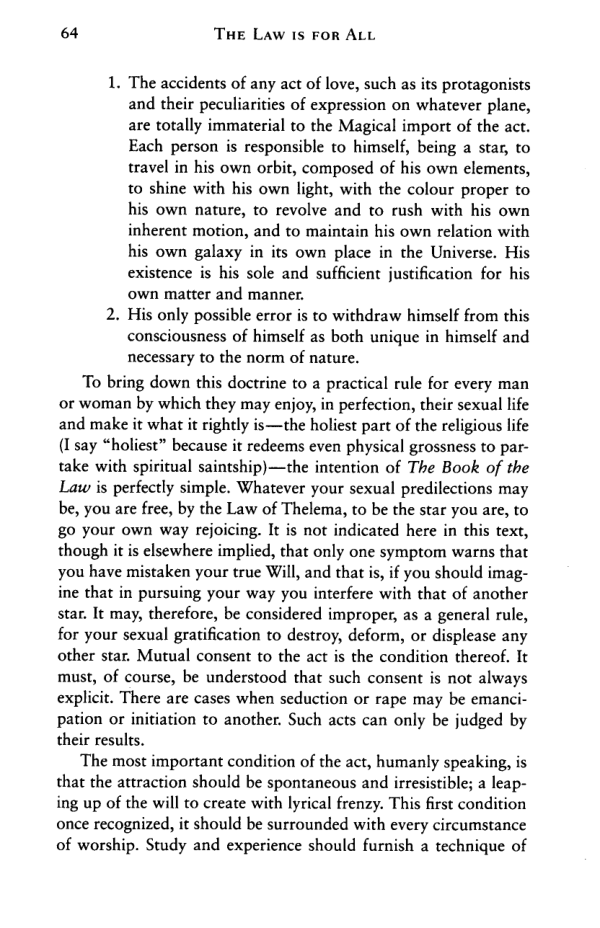
Highlights use the original PDF text layer. OCR-only matches may not be visible on the scan.
Transcription
Download text ↓raw extractionoriginal embedded textReview: unreviewed
64
The Law is for All
1. The accidents of any act of love, such as its protagonists
and their peculiarities of expression on whatever plane,
are totally immaterial to the Magical import of the act.
Each person is responsible to himself, being a star, to
travel in his own orbit, composed of his own elements,
to shine with his own light, with the colour proper to
his own nature, to revolve and to rush with his own
inherent motion, and to maintain his own relation with
his own galaxy in its own place in the Universe. His
existence is his sole and sufficient justification for his
own matter and manner.
2. His only possible error is to withdraw himself from this
consciousness of himself as both unique in himself and
necessary to the norm of nature.
To bring down this doctrine to a practical rule for every man
or woman by which they may enjoy, in perfection, their sexual life
and make it what it rightly is—the holiest part of the religious life
(I say “holiest” because it redeems even physical grossness to par
take with spiritual saintship)—the intention of The Book of the
Law is perfectly simple. Whatever your sexual predilections may
be, you are free, by the Law of Thelema, to be the star you are, to
go your own way rejoicing. It is not indicated here in this text,
though it is elsewhere implied, that only one symptom warns that
you have mistaken your true Will, and that is, if you should imag
ine that in pursuing your way you interfere with that of another
star. It may, therefore, be considered improper, as a general rule,
for your sexual gratification to destroy, deform, or displease any
other star. Mutual consent to the act is the condition thereof. It
must, of course, be understood that such consent is not always
explicit. There are cases when seduction or rape may be emanci
pation or initiation to another. Such acts can only be judged by
their results.
The most important condition of the act, humanly speaking, is
that the attraction should be spontaneous and irresistible; a leap
ing up of the will to create with lyrical frenzy. This first condition
once recognized, it should be surrounded with every circumstance
of worship. Study and experience should furnish a technique of
Page provenance & review flags
Stable page ID: 6528ce4d28e01eb80a128d9c:p00063
Line breaks are preserved. Reading order and OCR accuracy may need review.
Printed page label has not been verified.
- No automated review flags. This does not establish transcription accuracy.